Kimberly Koljat ’11 transformed personal loss into groundbreaking research on grief, embodiment, and connection in an increasingly digital world.
June 11, 2026
When Kimberly Koljat, Drama Therapy M.A. ’11, first encountered Developmental Transformations — a drama therapy approach commonly abbreviated as DvT — she was terrified. The practice, which emphasizes playful, embodied encounters that demand full authenticity and presence, felt like nothing she had experienced in traditional theater training. “It turned up the volume of ‘real’ and ‘not real’ acutely,” she recalls, “holding that duality in ways traditional theatre could not. Developmental Transformations demanded my full, authentic self.”
But that terror, it turned out, was precisely the invitation she needed. Taking the DvT class became her “first introduction of trying on intimacy in ways I never had before,” she says. It awakened something. “It left me hungry for more, and built a desire within me to build that inquiry for others.”
In reality, I wasn’t terrified of DvT. I was terrified of intimacy. Our traumas show up in relationship, and DvT put that front and center. Kimberly Koljat, Class of 2011 and Adjunct Faculty, Counseling Psychology, Drama Therapy
Koljat describes her education at CIIS as transformative not only for the techniques she learned but for the self-awareness the program demanded. The coursework required her to examine her own biases, privilege, and trauma. “As a result,” she says, “I am able to be present with others in their experiences with deeper capacity while engaging in the embodied, relational work I love.”
That capacity, Koljat has observed, distinguishes CIIS graduates in clinical settings. Since graduation, she has directed community mental health programs and supervised staff, associates, and trainees from various graduate schools. Those who attended the CIIS Drama Therapy program, she notes, consistently demonstrate a level of self-awareness that shows up in their clinical work in ways others do not. “It feels incredibly rewarding to do the work I do,” she reflects, “and my foundation and perspectives were birthed in this program.”
Image
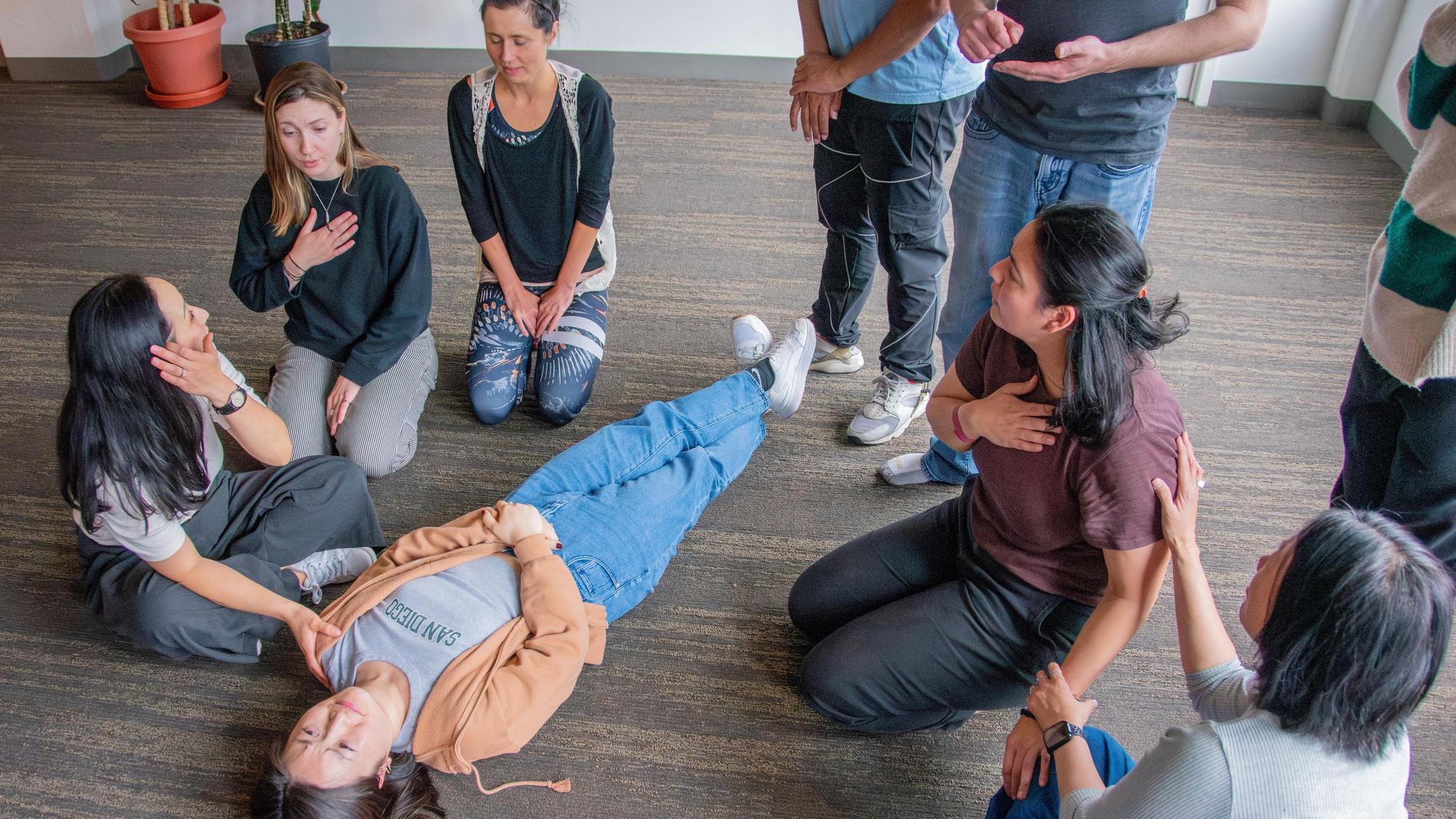
Drama Therapy students engage in Developmental Transformations (DvT) practice in the classroom.
After graduating from CIIS in 2011, Koljat continued her drama therapy studies at I-West, the Institute for Developmental Transformations. Writing her final graduation paper coincided, though, with losses in her personal life. These losses affected her profoundly, and through her grief, she created a project to combine therapeutic inquiry and performance art.
The project, titled “The Eyed Entity Project,” explored the intersectionality of grief, the loss of identities tied to those who had died, and re-engagement with the world through an unorthodox approach to DvT. It examined empowerment in the context of embodiment, an increasingly complex subject in the modern world. The work considers embodied encounters with others, but also the role of disembodied encounters in the online worlds of fandom culture, where social media increasingly serves as a site of connection and community.
Koljat published the entire project online, allowing herself to be witnessed on social media in a manner similar to self-revelatory performance. The work has since been presented at the DvT Conference in 2025 and will be presented at the North American Drama Therapy Association (NADTA) conference later in 2026.
Image
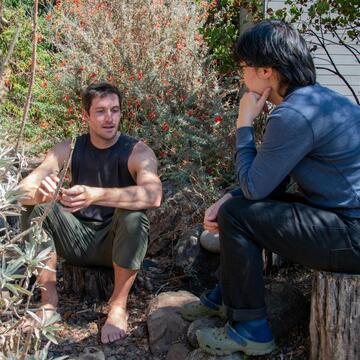
Portrait of Kimberly Koljat, Class of 2011 and Adjunct Faculty, Counseling Psychology, Drama Therapy.
How do we build the bridge to them to help them connect to themselves and each other again? Kimberly Koljat, Class of 2011 and Adjunct Faculty, Counseling Psychology, Drama Therapy
Koljat’s current inquiry continues to engage with the question of embodiment. It is a debate that has become increasingly urgent for drama therapists and other mental health and creative practitioners: what does it mean to invite clients into embodied spaces when they spend the majority of their lives disembodied, connected primarily through their laptops and phones?
Koljat wonders this too. “How far are we asking our clients to move if we invite them into embodied spaces in our relationship if they spend the majority of their lives disembodied?” she asks. “How do we build the bridge to them to help them connect to themselves and each other again?”
It is a question rooted in the same compassionate curiosity that CIIS inspired her to pursue so fearlessly. That thirst for exploration, she says, continues to expand her interests within the field, from her early work supporting communities in the San Francisco Children, Youth and Family System of Care to her current practice serving music industry professionals and people navigating profound loss.
Image
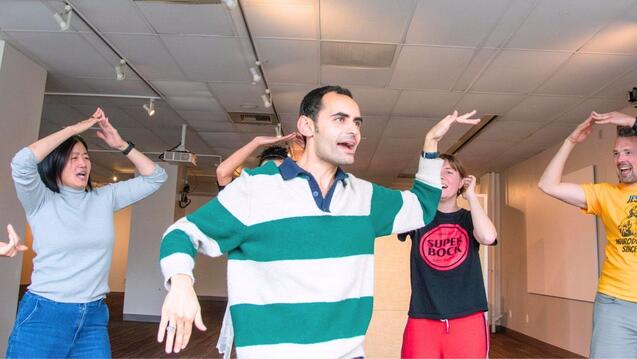
Drama Therapy students engage in Developmental Transformations (DvT) practice in the classroom.
It also drives her in her work at CIIS. Koljat now teaches as adjunct faculty, teaching in the same Drama Therapy program that challenged her to confront her fear of intimacy more than a decade ago. She describes feeling privileged to have studied with the educators who created the practices themselves — an opportunity that shaped not only her clinical skills but her capacity to be present in relationships. “The adaptability of this work is endless, and I feel forever grateful I made the choice to make CIIS a part of my journey.”
The training I received in the Drama Therapy program gives me a larger vocabulary of ways of expressing appreciation, not only through words, but through sound, movement, relationally, and playfully. Kimberly Koljat, Class of 2011 and Adjunct Faculty, Counseling Psychology, Drama Therapy
Associate Professor Doug Ronning graduated from CIIS' Drama Therapy program in 2006. Now he teaches in it — with monsters, role play games, and embodied play.