When the Work Isn’t Work: Student and Alum Collaborate on Artistic Outpouring
Addam Ledamyen ’26 and Dazié Grego-Sykes ’18 share how CIIS’ M.F.A. in Interdisciplinary Arts and Writing creates space for artistic risk, collaboration, and work that refuses to play it safe.
May 19, 2026
Addam Ledamyen is weeks away from graduating with an M.F.A. in Interdisciplinary Arts and Writing from California Institute of Integral Studies (CIIS). Their final project — a staged reading of a new play they wrote — is also a collaboration with Dazié Grego-Sykes ’18, an alum of the same program. What began as a formal mentorship arrangement — six hours of guidance, as the program requires — quickly became much more. “I don’t even know if there was a moment where I was asked to be the director,” Grego-Sykes recalls. “I just remember being really excited about the work.” Both artists graciously agreed to talk to us about the processes that drew them into collaboration, as well as what drew them to CIIS in the first place — and to a degree that refuses to limit what an artist can be or do, and that values process as much as product.
Enjoy the process and keep going, even when you don’t know what the next move is, just keep creating because it always finds a home. Dazié Grego-Sykes, Class of 2018, Interdisciplinary Arts and Writing
Finding Room to Grow
Ledamyen came to CIIS after spending time in Washington, D.C., where they found themselves caught between the demands of paying rent and the demands of their creative work. “I wasn’t able to both have a job that allowed me to pay rent and work on my creative projects with enough time to make me feel like I was really giving them what they deserved,” they say. “And that was killing me a little bit inside.” They moved back to the Bay Area, where they had grown up, and began looking at graduate programs. Philosophy interested them, and CIIS came up in their search as a school with “a particularly unique philosophy about philosophy.”
But it was the M.F.A. in Interdisciplinary Arts and Writing that really caught their attention. Ledamyen is a playwright, novelist, actor, and painter. Most graduate programs, they say, “kind of pigeonhole you into the one thing that they’re supposed to be teaching you.” The CIIS program offered room for all of it.
Image
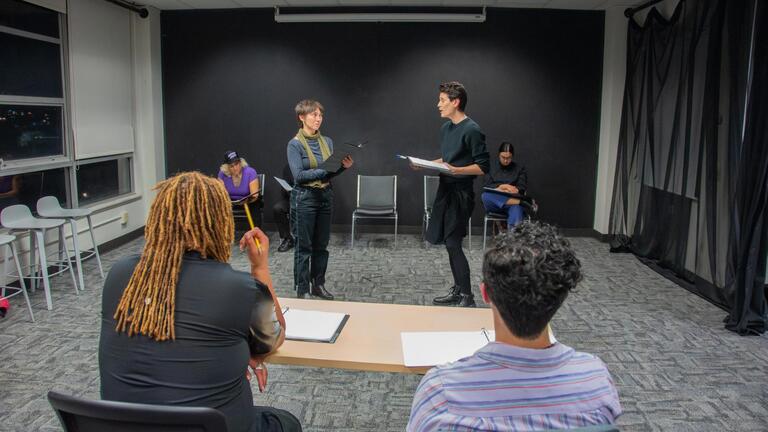
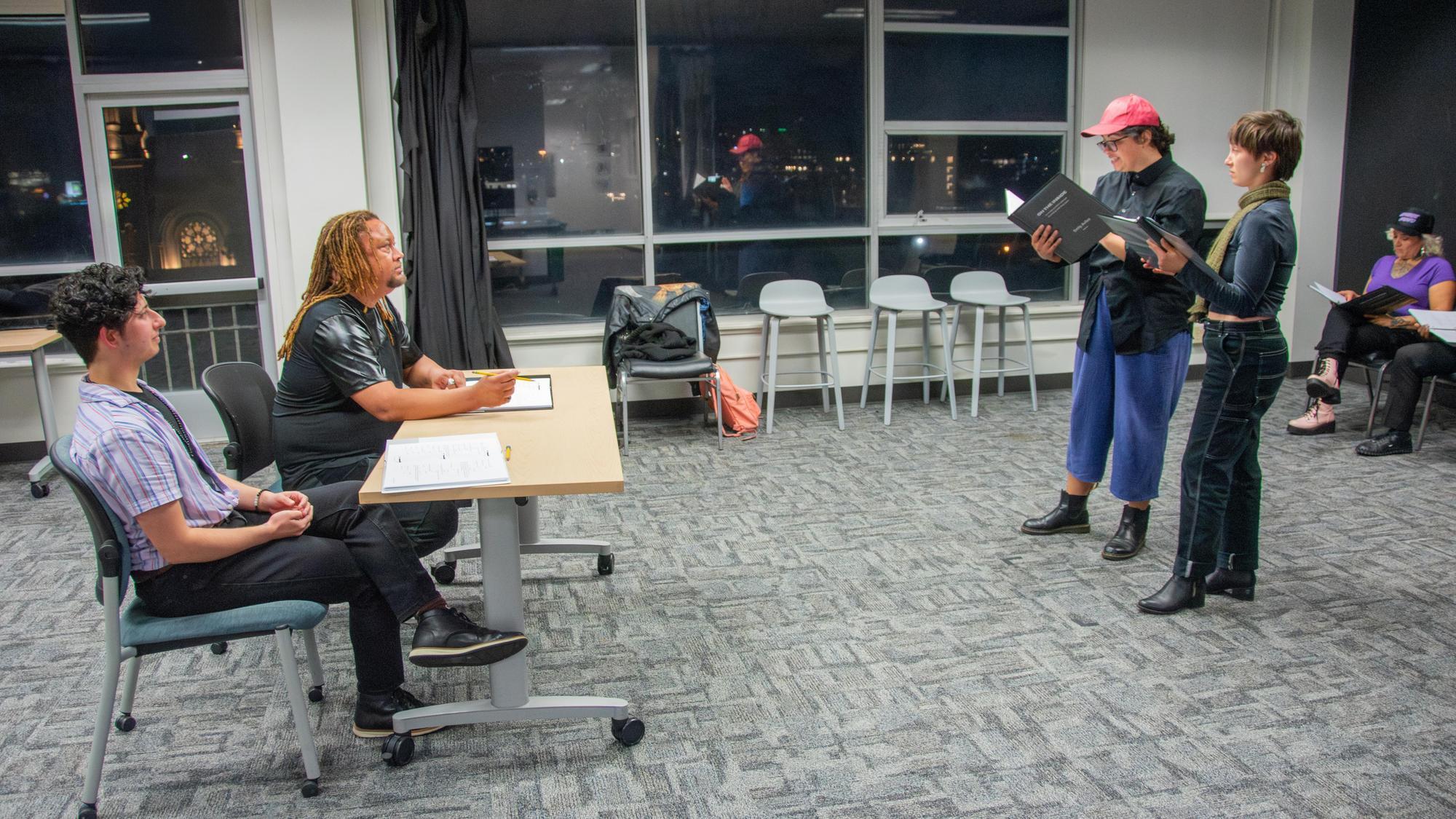
Photo from Interdisciplinary Arts and Writing student Addam Ledamyen's final project, directed by MFA alum Dazié Grego-Sykes.
Grego-Sykes arrived at CIIS in 2018 under different circumstances — following a professor who had started a theater and performance-making program at the University. That program ended, and he transferred into Interdisciplinary Arts and Writing. He came, as he puts it, wanting to “legitimize” his practice. “I felt like if I got an M.F.A., then the work that I was creating would be taken more seriously,” he says.
What he found was something he had not known he needed. “Before that, I would go into my room and I would write and I would rehearse and I would present work,” he recalls. “But I didn’t get much feedback and I didn’t learn about other artists and other practices.” The program gave him exposure to techniques he would not have encountered otherwise — and, more importantly, it gave him a community. “It was an opportunity to be changed,” he says.
Work With Teeth
Grego-Sykes describes his work as the kind that “pushes people’s buttons.” During his time at CIIS, his cohort pushed back. “People would challenge me a lot,” he says. “And I was defensive. I didn’t know what else to be.” Then came a pivotal moment with professor Stephanie Johnson, who stopped everything in the room and said, “We don’t do the beat down.” Johnson, Grego-Sykes recalls, said he “worked for the ancestors” and facilitated a conversation that was not personal but focused on the intention of the work, “why the work had teeth, what the purpose of those teeth were.”
I’m attracted to work that makes my stomach flip. I want to know why I feel nervous about talking publicly about things that we think about and discuss privately. Dazié Grego-Sykes, Class of 2018, Interdisciplinary Arts and Writing
Image
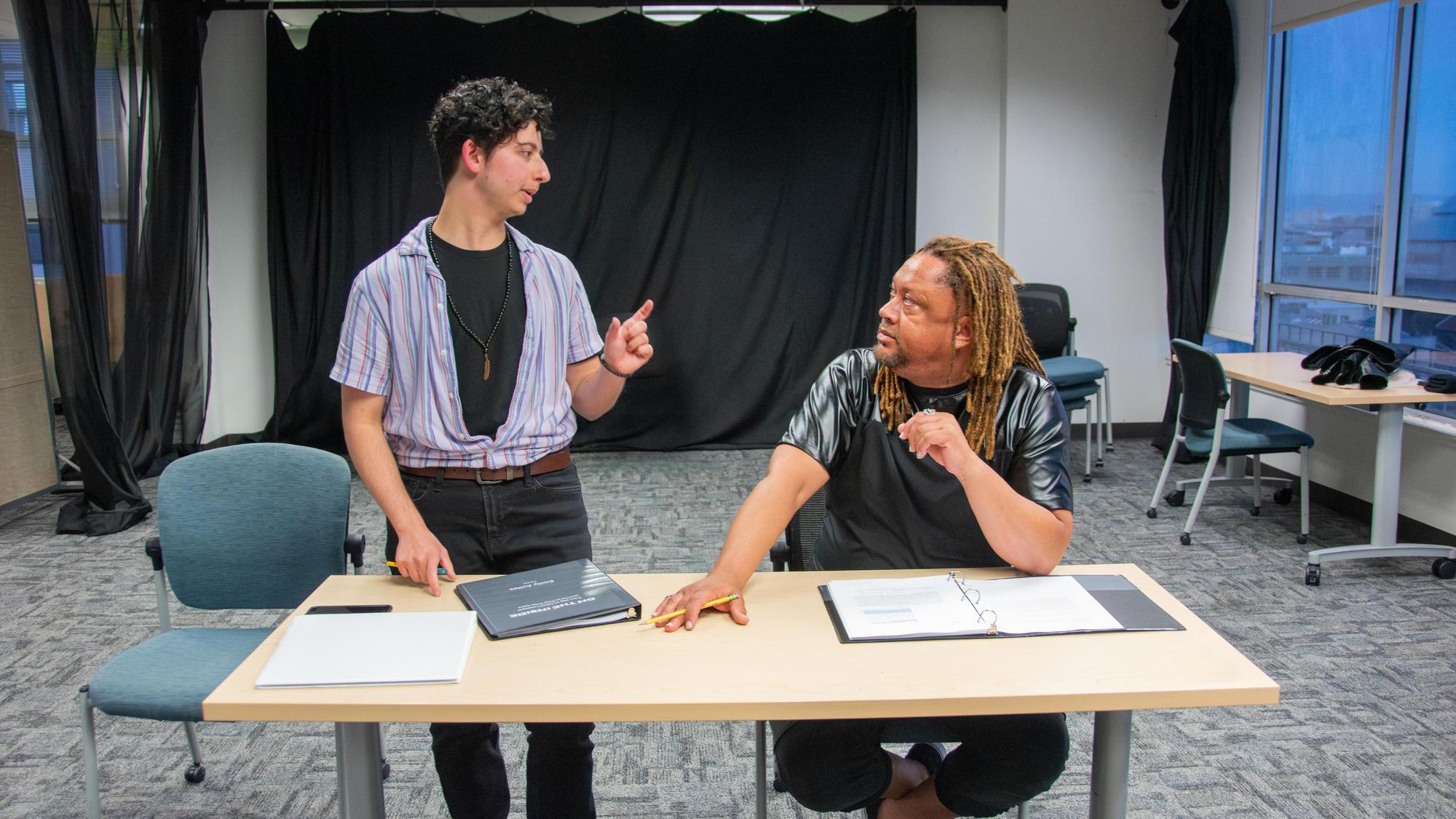
Photo from Master of Fine Arts student Addam Ledamyen's final project, directed by MFA alum Dazié Grego-Sykes.
The experience taught him something fundamental. “How we position our work really matters,” he says. “And also that it’s not personal.” His work — which he describes as “in your face, broad, unapologetic” — continues to provoke strong responses. “I’m attracted to work that makes my stomach flip,” he explains. “I want to know why I feel nervous about talking publicly about things that we think about and discuss privately.”
Ledamyen, by contrast, describes their experience at CIIS as one where there was “room for anything that someone is genuinely artistically drawn to.” They cite examples from their cohort — students writing about BDSM, erotica, subjects that might be controversial elsewhere — and note that there was “not only no judgment, but genuine support” for exploring those topics with scholarly rigor.
The Collaboration
Ledamyen spent much of their first year and a half at CIIS working on a series of novels. But playwriting, they say, was always their true passion. As soon as the creative work on the novels was finished, they returned to theater. “I needed to write a play,” they say.
Image
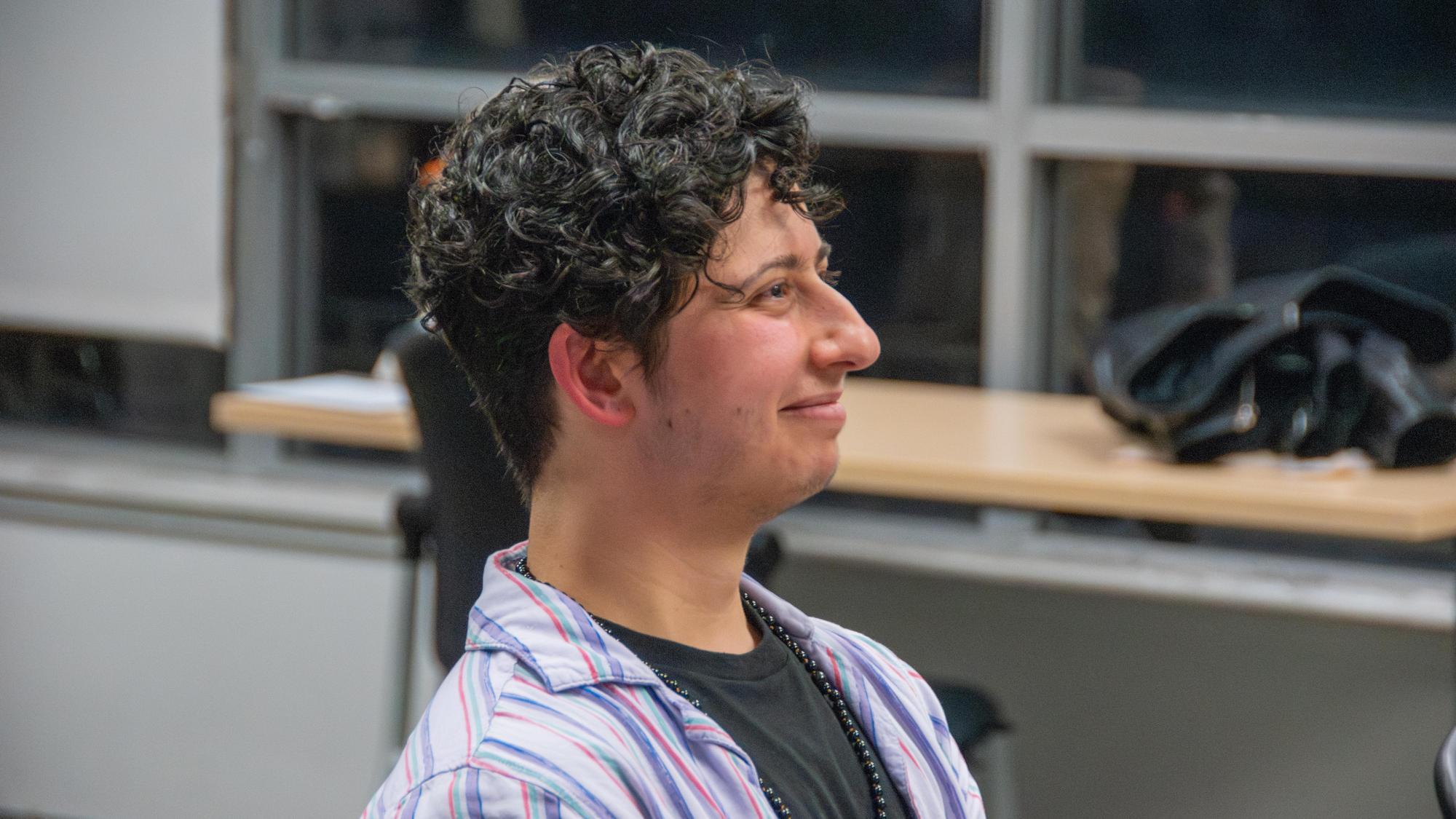
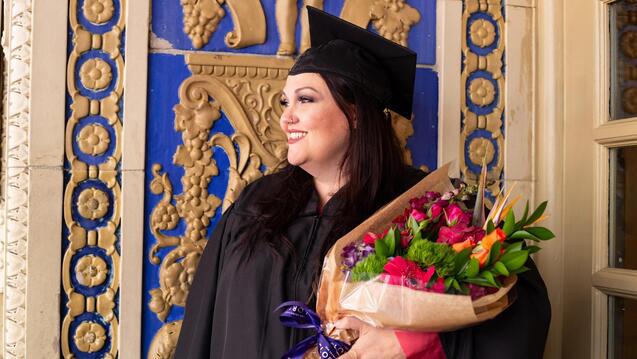
Portrait of Interdisciplinary Arts and Writing student Addam Ledamyen captured during their final project, directed by MFA alum Dazié Grego-Sykes.
When Ledamyen decided to stage a reading of their new play for their M.F.A. project, professor Carolyn Cooke recommended Grego-Sykes as a mentor. Grego-Sykes remembers receiving the call and thinking about how he had once been in Ledamyen’s position. He remembers feeling a thrill of excitement to be on the other side and to have more than a decade of experience to share.
The six-hour mentorship requirement went by in a blink. “You can’t put people that are artists that are passionate about the creation of work in the same space together and limit the amount of time and energy that’s going to be put into it,” Grego-Sykes says. The work — a play Ledamyen describes as a response to the attacks on the transgender community and other marginalized groups — pulled him in. “The dialogue and the piece is really strong,” he says. “Using these characters as vehicles to be opportunities for people to think and unpack their own issues, it is just done beautifully.”
The rehearsal process has been, in Ledamyen’s words, “a complete collaboration.” Grego-Sykes describes it as a conversation on all ends — not a rigid hierarchy of roles but a fluid exchange between director, playwright, and actors. “It hasn’t been ‘do this,’” he says. “It’s been like, ‘what can we find here?’” This process of community through discovery has been transformative for them both.
Love the Process
When asked what advice he would give to graduating students, Grego-Sykes returns to a principle he learned at CIIS and has carried with him since: the work is the process, not the applause. “We will spend two hours in a room with people,” he says, referring to the upcoming staged reading. “We’ve spent three months working on this project, and for two hours some strangers are going to come into a room, they’re going to observe, they’re going to clap and they’re going to leave.” Rather than frustration, he feels satisfaction at all the work that goes into those two hours. “Love the process and enjoy the process and keep going,” he exhorts fellow artists. “Even when you don’t know what the next move is, just keep creating because it always finds a home.”
Image
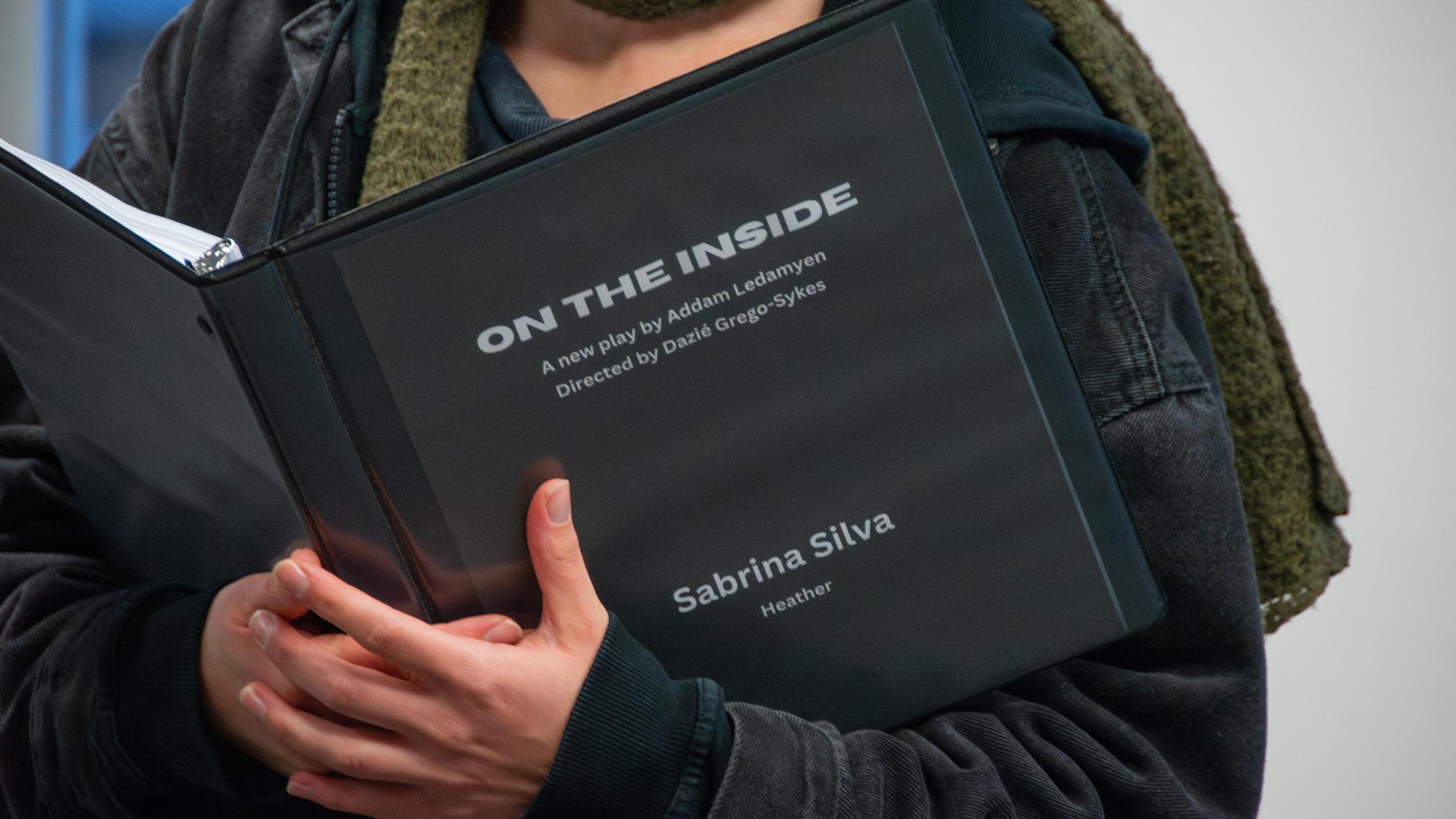
Photo from Interdisciplinary Arts and Writing student Addam Ledamyen's final project, directed by MFA alum Dazié Grego-Sykes.
For Grego-Sykes, returning to CIIS to work with Ledamyen has been its own kind of homecoming. “To be called back and to be remembered by your faculty,” he says, “it’s like coming home.” And for Ledamyen, the experience has confirmed what they came to CIIS to find — a place where they could become the artist they always knew they were meant to be.
Associate Professor Sara Salazar shares how CIIS’ B.A. in Interdisciplinary Studies creates space for students who have started and stopped their degrees to finally complete on their own terms.