
M.A.-C.P. in Somatic Psychology
Honoring the whole person lived experience.
Program Overview
Our Approach
CIIS is one of only three accredited U.S. graduate schools offering a fully immersive master’s curriculum in body-oriented psychotherapy, not just electives or concentrations, making it a distinctive choice for those seeking to center the body in therapeutic work.
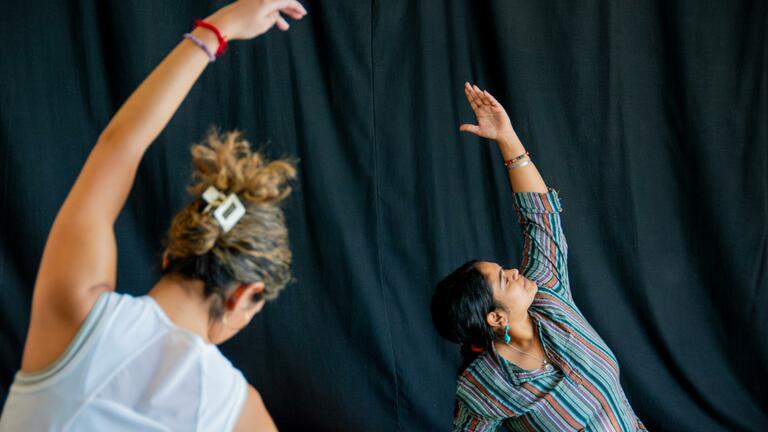
The Somatic Psychology program at CIIS is an immersive, three-year, fully on-campus/in-person program rooted in embodied learning and trauma-informed care. Through clinical training, personal inquiry, and socioculturally-responsive curriculum, you’ll prepare for licensure as a psychotherapist and develop a deeply relational, body-based therapeutic practice.
Our faculty combine scholarship and personal embodiment, drawing on neuroscience, traumatology, Jungian psychology, and sociocultural studies to foster a relational and integrative clinical practice.
Career Paths
Our graduates are making a difference in private practice, schools, nonprofits, addiction recovery, and more. With a 92% pass rate on the MFT licensure exam, CIIS alumni are leading the field in somatic and trauma-informed care. Graduates go on to work in roles such as:
- Private practice therapists
- Somatic trauma specialists
- Community mental health counselors
- Child and family advocates
- Addiction recovery therapists
- Prison and reentry program therapists
- School-based clinicians
- City and county program counselors
To explore career pathways and learn more about Somatic Psychology graduates, visit the Impact page.
Curriculum
The Somatic Psychology curriculum is designed to meet the California Board of Behavioral Sciences requirements for the California Marriage and Family Therapist (MFT) license including: 60 total semester units, 6 units of practicum, 12 units in courses explicitly related to family therapy, and classes in psychopathology, substance dependency, professional ethics and the law, and cross-cultural counseling. While states differ in their licensure requirements, California requirements often meet or exceed those of other states.
Students are required to participate in the first-year retreat, and to complete 50 hours of personal psychotherapy with a licensed somatic mental health professional during their course of study.
All students are required to participate in a year-long practicum in their final year of study. The practicum affords students the opportunity to apply learned clinical skills under the supervision of a licensed therapist and to integrate feedback into clinical practice. For those on the MFT track, 225 practicum hours are required for graduation. For those on the LPCC track, the requirement for graduation is 280 practicum hours.
During year two of the program, students will work with our Field Placement Office to research, apply to, and secure a placement that matches their therapeutic interests. The Center for Somatic Psychotherapy, one of CIIS’ six award-winning community mental health clinics, is one option for practicum. Others include schools, hospitals, hospice, community mental health, and child/family settings.
Personal Therapy Requirement
Students are required to complete 50 hours of personal psychotherapy with a licensed mental health professional.
Featured Courses
- Neuroscience for Somatic Psychology Practice
This course explores clinical neuroscience fundamentals, with a focus on polyvagal theory, attachment neurobiology, psychoneuroimmunology, neuroplasticity, as well as the impact of trauma, oppression, and other social shadows on the nervous system. Neurobiologically-informed interventions and treatment are emphasized. - The Body: Experienced, Conceptualized, and Verbalized
Invites students to explore the dialectic of bodily experiences and the power of language, i.e., ideas and words about bodily experience; reinforcing the salience of living narratives of identity and sense of self iteratively rooted in embodiment. This course utilizes breath, movement, and sensory practices to ground a student’s unique cultivation of clinical skills in somatic psychotherapy. - Somatics and Society
This course examines the body in context - how social institutions and power dynamics shape bodily experience, fostering critical awareness of somatic therapy’s role in addressing personal and political trauma.
-
Three-Year Sequence (60 units total)
Semester 1 | Fall
- MCPS 5201 Human Development and the Family (3 units)
- SOM 5202 The Body: Experienced, Conceptualized, and Verbalized (2 units)
- SOM 5607 Movement Approaches in Somatic Psychotherapy (2 units)
- MCPS 5609 Therapeutic Communication (3 units)
Semester 2 | Spring
- MCPS 5501 Psychodynamics (3 units)
- MCPS 5622 Group Facilitation and Group Therapy (2 units)
- MCPS 5605 Family Dynamics and Therapy (3 units)
- MCPS 6104 Multicultural Counseling and the Family (2 units)
Semester 3 | Fall
- SOM 6646 Theories and Techniques of Somatic Psychotherapy I (3 units)
- MCPS 6601 Couple Counseling (3 units)
- MCP 6102 Assessment and Treatment of Addiction Disorders (1 unit)
- MCPS 6102 Human Sexuality (2 units)
- SOM 6476 Neuroscience for Somatic Psychology Practice (2 units)
Semester 4 | Spring
- MCP 5108 Psychopathology & Psychological Assessment (3 units)
- SOM 6647 Theories and Techniques of Somatic Psychotherapy II (2 units)
- SOM 6202 Somatics and Society (2 units)
- MCP 5101 Professional Ethics and Family Law (2 units)
- SOM 6659 Somatic Approaches to Trauma & PTSD (2 units)
Semester 5 | Summer
- MCPS 7602 Practicum: Group Supervision (2 units)
Semester 6 | Fall
- MCP 6233 Intro to Community Mental Health and the Recovery Model (2 units)
- MCPS 6401 Research Methods (3 units)
- MCPS 7601 Practicum: Individual Supervision (2 units)
- MCPS 6605 Child Therapy (2 units)
Semester 7 | Spring
- MCPS 5602 Clinical Relationship (2 units)
- MCPS 7601 Practicum: Individual Supervision (2 units)
- SOM 7701 Integrative Seminar (3 units)
Connect With Your Counselor
Alejandro (Alex) Perez
Entry Requirements
If you would like to learn more about this program, we’re here to help. Explore our program further with in-depth materials, discuss your personal and career goals at one of our open houses, or get in touch with our admissions counselors, who are ready to assist you in navigating the application process.
Required Application Materials
Your application is your opportunity to share who you are. To be considered essays and written responses must be your own authentic work.
The admissions committee seeks candidates who demonstrate self-awareness, embodied curiosity, critical thinking, flexibility, and the maturity and readiness for depth work that graduate-level study in psychology requires.
Online Admissions Application: Begin the application process by submitting an online application and paying the nonrefundable $68 application fee.
Degree Requirement: An undergraduate degree (B.A., B.S., or BFA) from an accredited college or university.
Minimum GPA: A GPA of 3.0 or higher in previous coursework is required. A GPA below 3.0 does not automatically disqualify an applicant. CIIS will consider a prospective student whose GPA is between 2.0 and 3.0. These individuals are required to submit a GPA Statement and are encouraged to contact our Admissions Team to discuss their options.
Transcripts: Official transcripts from all accredited academic institutions attended where 7 or more credits have been earned. Transcripts may be sent digitally to materials@ciis.edu or mailed to CIIS in their official, sealed envelope. Transcripts from institutions outside the U.S. or Canada require a foreign credit evaluation through World Education Services (WES). CIIS will also accept foreign credential evaluations that are in a comprehensive course-by-course format from the current members of the National Association of Credential Evaluation Services (NACES).
Autobiographical Statement: In four-to-six pages (typed, double-spaced), discuss childhood and early family experiences, and significant educational, sociocultural, or personally meaningful experiences in your later development. Describe how your life experiences shaped your relationship to the body and led to your decision to apply to the graduate program in somatic psychology. Please include a brief description of your current somatic practices (formal or informal). If there are any gaps related to expected background in psychology (i.e., some foundational coursework) or somatics (i.e., formal training) please substantiate your sense of your own readiness to engage in the rigor of a graduate program in somatic psychology.
Statement of Purpose: Include a one-page (typed, double-spaced) statement of what draws you to CIIS and the somatic program's particular approach and how you imagine your professional life might look like in 10 years, including how your practice might be structured, especially how the somatics component might be present, and any other items such as research and other aspects of personal and professional development.
Resume
Two Letters of Recommendation: Letters of recommendation will be accepted from academic advisors, professors, professional supervisors, or someone able to attest to your ability to undertake the work required for your program. Recommenders should address the applicant's self-reflection, interpersonal presence, ability to sit with emotional complexity, and capacity for the academic rigor necessary to becoming a successful member of the somatic psychology graduate program. Recommenders should use standard business format and include full contact information: name, email, phone number, and mailing address.
Candidate Selection
The somatic psychology graduate program seeks highly motivated, creative, and mature students who have demonstrated a strong interest in work with somatic understandings.
While this includes work in literature, humanities, and the social sciences, it is useful for prospective students to have had training in various somatic approaches, such as massage therapy, Feldenkrais, the Alexander technique, bioenergetics, Rosen work, massage, shiatsu, acupuncture, martial arts, dance, yoga, yoga therapy, or meditation.
Given the experiential dimension of the program, it is necessary that applicants be emotionally stable. Students must be able to cope with both the strong feelings that often emerge from somatic experiential work and the rigors of intellectual work.
Events and Info Sessions

Attend the Fall Open House to get to know your admissions counselors and learn more about CIIS' bachelor's, master's, and Ph.D. programs.


A Workshop with Ananta Ripa Ajmera and Cheryl Montanez


FAQ
-
Somatic Psychology combines traditional approaches to counseling, including dream work, talk, interpretation, and reflection, with experiential explorations. The underlying insight in somatic psychotherapies is that human beings enact self-feeling, identity, and connection with others through bodily means.
Somatic psychotherapists are trained to help clients explore the bodily means by which they conduct their daily lives. Through the use of breath work, movement exercises, touch, and explorations of feeling, sensation, posture, gesture, and expression, clients learn to understand how they shape particular identities and interact with others.
Somatic psychotherapy has been found to be particularly effective when working with attachment challenges and disruptions, trauma, post-traumatic stress disorder (PTSD), dissociation, identity issues, and emotional regulation. They are effective in both group and individual settings, and are especially useful as aids for self-reflection and the development of new ranges of emotional and behavioral expression.
-
The Somatic Psychology program at CIIS is one of three accredited graduate programs in the United States that prepares students to use both conventional and body-oriented approaches to psychotherapy.
-
Yes, our three-year program meets and exceeds national norms for training in counseling and fulfills the educational requirements of California's Marriage and Family Therapy (MFT) license and the national Licensed Professional Clinical Counselor (LPCC). CIIS graduates boast a 92% pass rate on the MFT licensure exam and have held the #1 position in California for pass rates over the last six exam cycles.
-
While CIIS is based in CA, and we must meet CA standards, often our state standards exceed those of other states and no further training is required for you to move to the state of your choice. That said, in some cases certain states will require an additional class or two or a shift in how you approach your post graduation internship hours. Luckily, you will have the full support of an advisor in the Field Placement Office who will help you understand the specific licensure requirements.

Take the Next Step
For over 50 years, CIIS has been at the forefront of education that integrates rigorous science, innovative scholarship, and social justice. You will learn from faculty at the forefront of their fields, local artists and activists, and a community of peers as passionate and dedicated as you. There’s never been a better time to be here – let’s build a healthier and more equitable world.