When Method Becomes Relation: Transformative Studies
In Transformative Studies, methodology isn't something applied to the world — it's something brought into relationship with it.
Fernando OnaNovember 23, 2026
In Transformative Studies, particularly within Transformative Studies at CIIS, methodology is not something you apply to the world. It is something that brings you into relationship with it, something shaped, tested, and at times undone by the realities you are working within.
This becomes especially clear when methodology is carried into spaces that do not conform to academic expectations. In the Tenderloin and SoMa, working alongside street-facing veteran communities and survivors of torture, methodology cannot remain abstract. It is immediately confronted by conditions of trauma, fragmentation, hypervigilance, and at times, psychosis. The question is no longer "what method am I using?" but "what way of being makes this encounter possible at all?"
One such methodology is Critical Time Intervention, an evidence-based practice for vulnerable individuals that incorporates community integration during transitional periods. But in environments shaped by violence and displacement, consciousness itself is often unstable. Awareness may be constricted, dissociated, flooded, or fractured. If methodology does not account for this – that consciousness is both what we study and the medium through which study occurs – it risks misrecognizing what is happening.
The question is no longer "what method am I using?" but "what way of being makes this encounter possible at all?" Fernando Ona, Chair and Core Faculty in the Department of Transformative Inquiry
I have come to understand methodology as something that must be ritualized, not in a ceremonial sense alone, but in the sense of creating repeatable, meaning-bearing structures that can hold attention, regulate the nervous system, and invite presence without overwhelming it. Sitting with someone outside a single-room occupancy hotel, sharing breath, orienting to sound, marking a moment of stillness — these are the conditions that make knowing possible.
Critical Time Intervention, when approached through this lens, becomes more than a model of support. It becomes a temporal methodology, a way of structuring engagement so that individuals moving through acute vulnerability are not only stabilized but are gradually reintroduced to perception and relationship.
What Counts as Data
What we might call data in these settings does not arrive neatly. It emerges in fragments, in gestures, in pauses, in the way someone tracks your presence or withdraws from it. To engage this requires a form of attention that is both disciplined and adaptive. Coding, in the conventional sense, begins to feel insufficient. What is needed is a capacity to register shifts in tone, rhythm, sensation, and relational movement. This is where methodology begins to take on a somatic dimension. The researcher is analyzing what is said and simultaneously sensing what is occurring.
In our Transformative Studies program, I often see students reaching a point where their chosen methods begins to strain under the weight of their inquiry. Grounded theory, phenomenology, narrative approaches — they provide entry points, but something more is being asked of them. The work is not to abandon these methods, but to deepen them, to allow them to be informed by the conditions in which the research is actually taking place.
In my own work, ritual becomes a bridge between methodological rigor and relational presence. Lighting a candle before a conversation, pausing to mark entry and exit, returning to the body as a shared reference point — these practices are not symbolic add-ons. They create continuity in environments where continuity has been disrupted. They allow participants, and the researcher, to orient within an encounter that might otherwise feel ungrounded.
The Ethics of Slow Attention
Consciousness shapes how questions are asked, how responses are received, how meaning is made. It requires the researcher to cultivate attunement, patience, and the ability to remain with what does not immediately resolve. This is not a softening of rigor. It is a different form of it.
There is also an ethical dimension. When working with communities who have experienced systemic violence and displacement, methodology must account for the asymmetries of power, the histories carried in the body, and the ways in which research itself can replicate harm if not carefully held. Ritual, again, becomes a way of marking this awareness — of slowing down the impulse to extract, to interpret too quickly, to move past what is difficult to sit with.
The most rigorous thing we can do is to create the conditions under which presence becomes possible. Fernando Ona, Chair and Core Faculty in the Department of Transformative Inquiry
Image
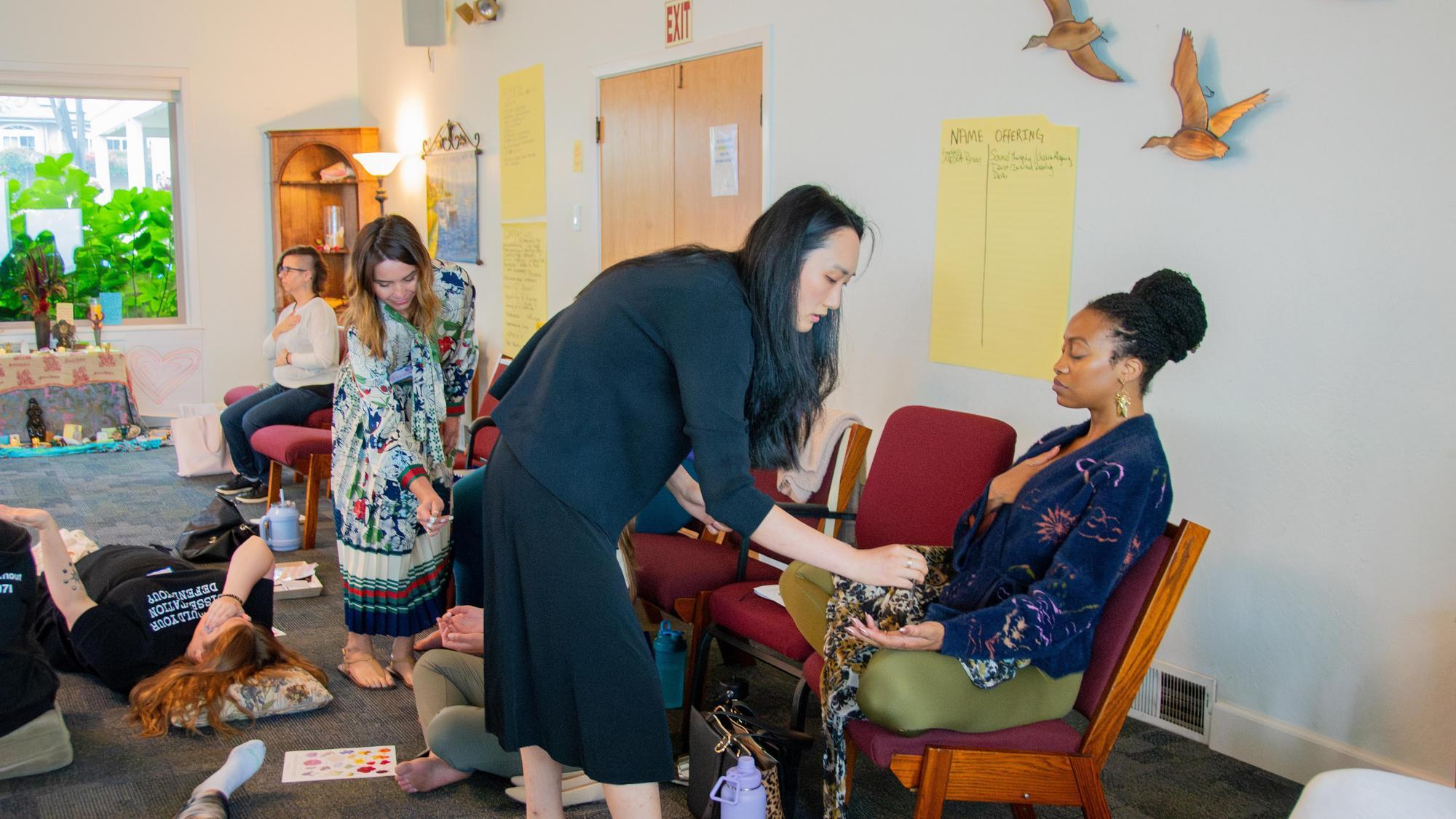
Students participating in a ritual during a CIIS program retreat.
Within Transformative Studies, methodology becomes inseparable from praxis. It is both about generating knowledge and about how that knowledge is produced, who it serves, and what it does in the world. The researcher is not outside of this process. They are implicated in it, shaped by it, responsible to it.
What begins to emerge is a different understanding of method — not as a fixed pathway, but as a responsive practice. One that can hold complexity without collapsing it, that can engage consciousness as a living dimension of inquiry. And perhaps most importantly, one that recognizes that in certain contexts, the most rigorous thing we can do is to create the conditions under which presence becomes possible.
This is where the work deepens. Not in abstraction, but in relation.
Newly released second edition highlights the scholarship of CIIS faculty and students and the University’s continuing leadership in transpersonal psychology
Associate Professor Doug Ronning graduated from CIIS' Drama Therapy program in 2006. Now he teaches in it — with monsters, role play games, and embodied play.