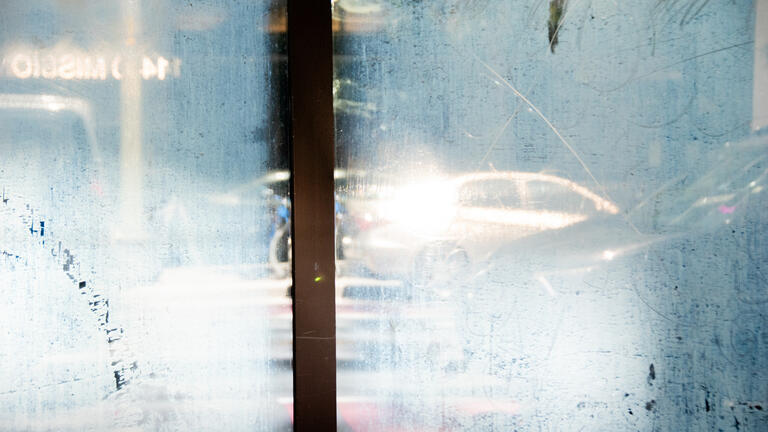
City life, seen through foggy glass. Photo by Nelson Melgar.
City life, seen through foggy glass. Photo by Nelson Melgar.
Faculty News
Revealing Luminosity in the Tenderloin
What somatic practice and Tibetan Bön teachings reveal about the heart's capacity for luminosity — even in conditions of extreme suffering.
Fernando OnaAugust 25, 2026
Luminosity is not elsewhere. It is present in the alleyway, in the clinic, in the moment when someone who has not felt their body in years suddenly notices the rhythm of their own breath. Fernando Ona, Chair and Core Faculty in the Department of Transformative Inquiry
There is something about the heart that is rarely discussed in the language of intervention. Yet for those of us who walk alongside street-facing communities, the heart is never abstract, never metaphor, never sentiment. For me, the heart is an energetic field that has often been ruptured, defended, numbed, or rendered inaccessible through cycles of violence, displacement, and psychic overwhelm. To speak of heart space in these contexts is to speak of a terrain that is both fragile and fiercely intelligent.
From a somatic perspective, the heart is not only an organ or a symbolic center of love — it is where the body organizes toward or away from connection. In individuals who have experienced repeated trauma, or who are navigating psychosis, the heart space often becomes a site of contraction, fragmentation, or overexposure. The nervous system learns that openness is dangerous, that feeling too much may lead to disintegration. And yet, even here, something remains.
But the heart does not disappear. As I have witnessed, it goes offline, it armors, it dissociates — but it retains a kind of latent luminosity. This is where the teachings of Geshe Tenzin Wangyal Rinpoche begin to resonate in a deeply practical way. At a recent CIIS Public Programs event, "An Evening with Geshe Tenzin Wangyal Rinpoche: On Understanding Luminosity of Consciousness in the Tibetan Bön Tradition," Rinpoche shared that in the Bön tradition, luminosity is not something achieved but something recognized. The light of awareness, as he teaches, is never extinguished — even in the midst of suffering. This becomes profoundly relevant when working with individuals whose lived reality is saturated with fragmentation.
Bridging Street Practice and Contemplative Wisdom
In the Tenderloin and SoMa neighborhoods close to CIIS, in spaces where survival organizes perception, we do not begin with transcendence. We begin with micro-conditions of safety. A pause. A shared breath. The placement of a hand over the sternum — not as instruction, but as invitation to a moment when time slows enough for the body to register that it is here, that it is alive.
What I have come to understand is that heart space is not accessed through insistence. It is accessed through the slow reintroduction of relational presence. For someone in psychosis, this may not look like emotional expression at all. It may look like orienting to the sound of a voice, tracking a sensation of warmth, or simply tolerating proximity without collapse. These are not small things. These are the conditions under which the heart begins to re-emerge as a field of experience.
Rinpoche's articulation that "you are that luminosity" is not a poetic abstraction in this context. It becomes an orienting principle for practice — the work is not to fix or repair the person, but to create conditions where the obscurations can soften enough for that luminosity to be glimpsed, even momentarily. In somatic terms, this might be experienced as a shift from contraction to expansion, from numbness to subtle sensation, from fragmentation to a fleeting sense of coherence.
Ritual as Return
This is where ritual becomes essential. Not ritual as performance, but ritual as repetition of meaning-bearing gestures. Lighting a candle. Writing intentions on bay leaves at a shelter or a street corner. Naming the breath. Returning, again and again, to the body as a site of knowing. These practices create continuity where there has been rupture. They allow the heart space to be approached indirectly, without overwhelming the system.
Image
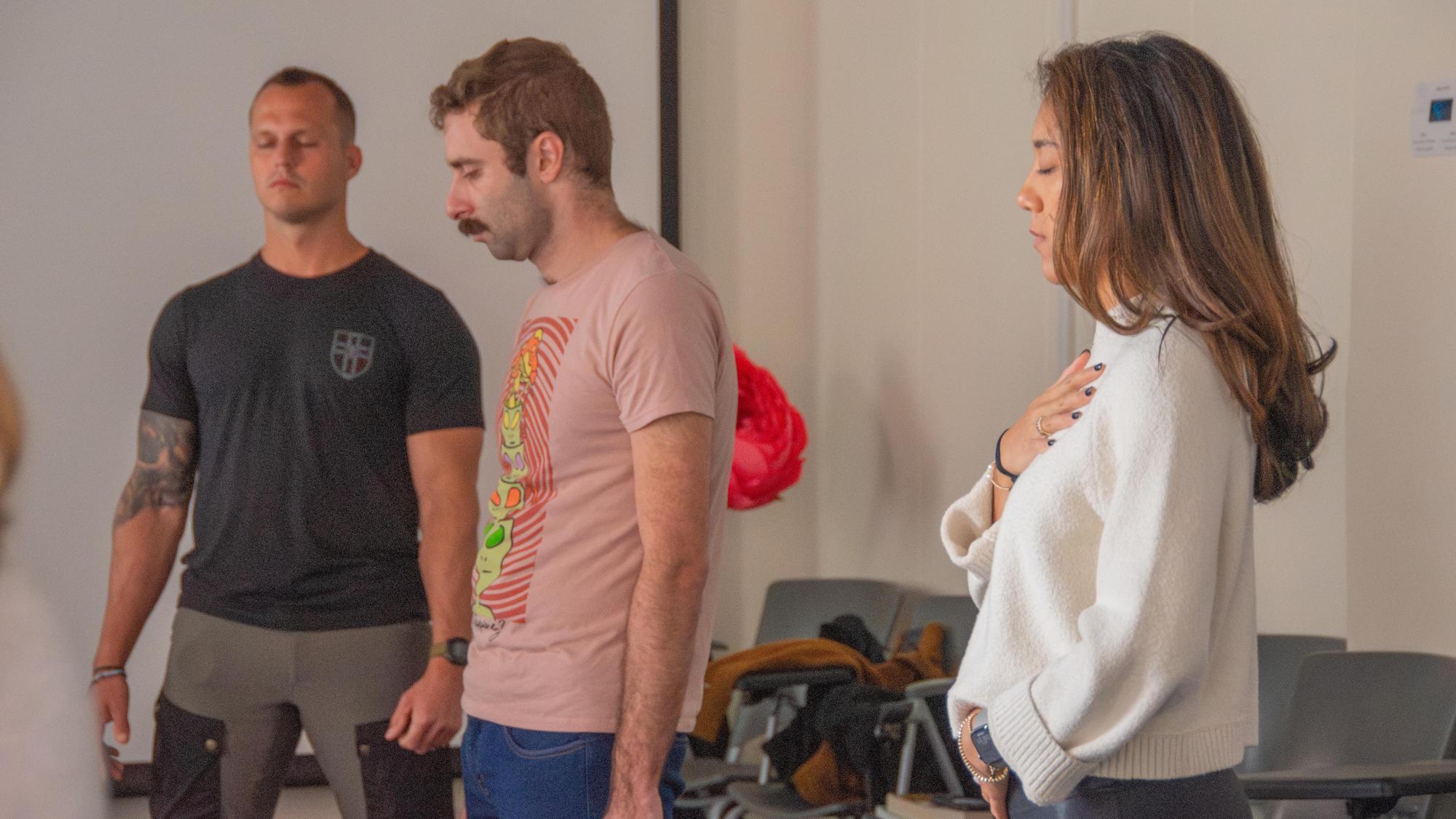
CIIS students in a moment of reflection.
Within the frame of Transformative Studies at CIIS, this work sits at the intersection of embodiment, consciousness, and social transformation. It asks us to consider transformation in the body, in relationship with other bodies. The reconstitution of heart space in individuals most impacted by violence is an inquiry into what it means to be human in conditions of extremity.
Luminosity, then, is not elsewhere. It is not reserved for retreat centers or contemplative spaces. It is present in the alleyway, in the clinic, in the moment when someone who has not felt their body in years suddenly notices the rhythm of their own breath. It is present in the capacity to remain with another without turning away. In the smallest movements toward connection.
To work with heart space in this way is to engage in a quiet, radical practice — one that does not seek to impose coherence, but to listen for it. To attune. To trust that even in the most fragmented states, there is an underlying field of awareness that can be contacted. And when it is, even briefly, something shifts. Not everything, not all at once, but enough to suggest that another way of being might be possible.