Systems Thinking for Changemakers: Scholarship for Navigating the 21st Century
Systems thinking equips changemakers and doctoral researchers to find meaningful intervention points within complex social and ecological challenges.
Jennifer WellsJuly 14, 2026
We are living in a time of existential polycrisis. To go forward, we need deep-rooted care, thinking and change. Systems thinking generally, and the most synthesized school of it called complex thinking (Morin), is emerging and evolving as a very important lens for navigating the 21st century. Complex thinking incorporates while also evolving beyond previous generations of systems thinking. We eschew the common everyday systems buzzwords. Instead we focus on teaching the best of today's scholarship on systems and complex thinking.
In fact, we might see complex thinking as the dominant scientific worldview coming full circle, an epochal ouroboros. We might see it as the bridge between ancient wisdom traditions and flourishing possible futures. Today's cutting edge of systems thinking is not just another tool, or even another toolkit. It is a vast, collective project emerging from the whole array of leading science and scholarship. In fact, I see it as the dawn of the most consequential shift in the predominant worldview of knowledge since the 16th century Scientific Revolution, one that resonates with our ancient worldviews, reanimating wildness, interbeing, care, and reverence.
This new synthesis of knowledge is more akin to our global Indigenous legacies, and so, it opens possibilities of more meaningful and generative dialogues with the world's Indigenous scholars and leaders. At the same time, this new synthesis is born of and builds on the whole weave of our major contemporary scientific discoveries — quantum mechanics, Barad's intra-action, Heisenberg's Uncertainty Principle, Goedel's Theorem, chaos, new materialisms — the whole lineage of breakthroughs that, little by little, are changing the very edifice of knowledge. In other words, the 16th century modern worldview is deconstructing itself from within, even as its errors are still threaded through the ideas and institutions driving the polycrisis.
It is a vast, collective project emerging from the whole array of leading science and scholarship. Jennifer Wells, Professor, Transformative Inquiry
In this larger sense, systems thinking is a vital resource to change our minds, change our worldview, and change our world system. And of course, the timing is striking. Since, according to some of our best scientists, it is 'one minute to midnight,' which is to say, times are perilous and the work is urgent. Changemakers are luminaries for these times.
As we know, social and environmental issues can't be tackled individually. They don't stay in their lanes. Rather, they are enmeshed, co-evolving, and always manifesting as wicked problems creating collateral consequences. Systems thinking offers ways to work with the complexity rather than against it. Instead of trying to isolate a single cause and prescribe a silver bullet or single fix, this approach asks researchers and practitioners to look at how parts and systems interact, where feedback loops worsen or enhance change, and which small levers might lead to helpful greater changes.
For doctoral researchers in transformative studies, systems thinking is a lens, a way, a method, a practice. It reshapes how questions get asked, how interventions get designed, and how scholars understand their own place within the systems they study.
Connecting the Dots
As a professor in CIIS' Transformative Inquiry Department, I have spent years mapping these connections. In my 2012 (2014) book, Complexity and Sustainability, I traced how social and environmental issues are interlocking patterns rather than separate crises. I developed a theory for understanding, thinking through and advancing human and ecological well-being and sustainability by shifting from vicious cycles to virtuous cycles of change. Since then, I've been building on this theory of virtuous cycles, exploring various examples. For instance, in understanding how both extreme poverty and extreme wealth drive the polycrisis, how both subsistence fossil fuel emissions and luxury emissions play an outsized role in driving the worst of social and ecological harms, and how both can be shifted towards synergies for social and ecological healing (Wells 2021, The Thomas Project). Also, I've created typologies to understand better how whole categories of modernity's worst ills are born of such vicious cycles, and how small shifts towards more virtuous cycles have the potential to help spark deeper rooted and rapid changes.
Ultimately, these patterns of vicious cycles are embedded throughout social sectors — health, education, urban design, economics, politics and more. This is one of the reasons why the Transformative Studies Department curriculum is so effective. It's part of our 'magic sauce.' While our Ph.D. students come from a wide array of sectors and careers, we co-create a scholarly community that draws on a set of ideas and visions at the cutting edge of different ways of knowing, studying and creating today. My work has shown how complex thinking lets us see the errors and distortions in the modern worldview and modern world system itself that have been causing systemic patterns of harms and ruptures. But most importantly, conversely, how even small shifts to that dominant worldview can also help to create positive changes in today's dominant world system. This empowers the great work of our era: to collectively create changes towards powerful worldviews and world systems that are also more reverent, flourishing, and regenerative.
Image
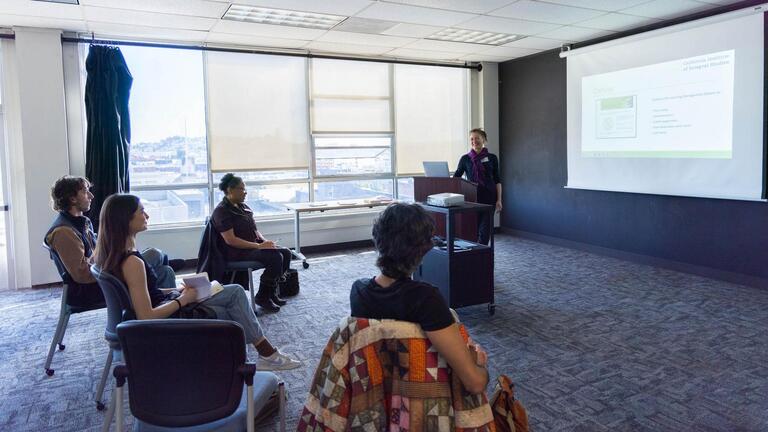
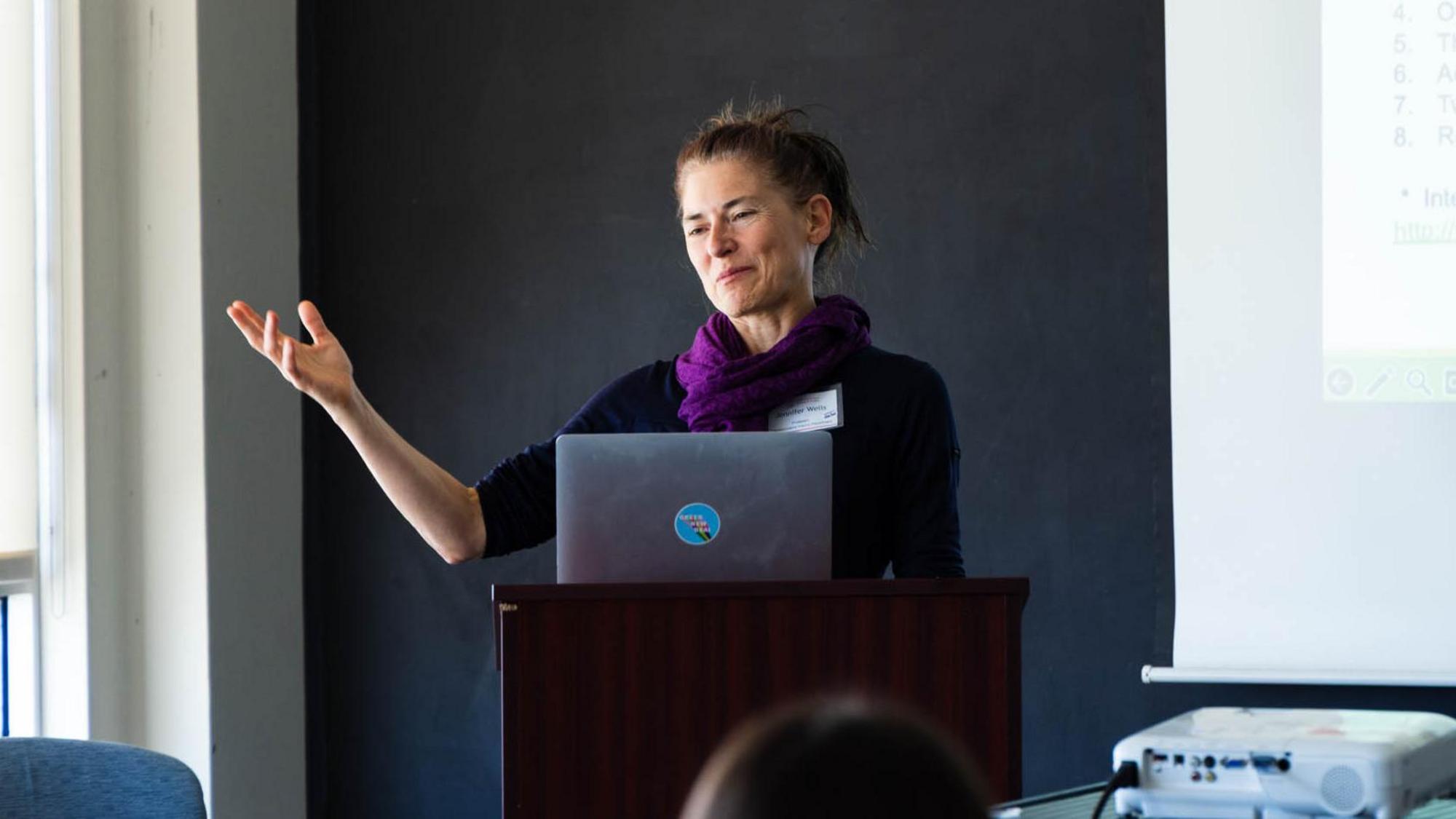
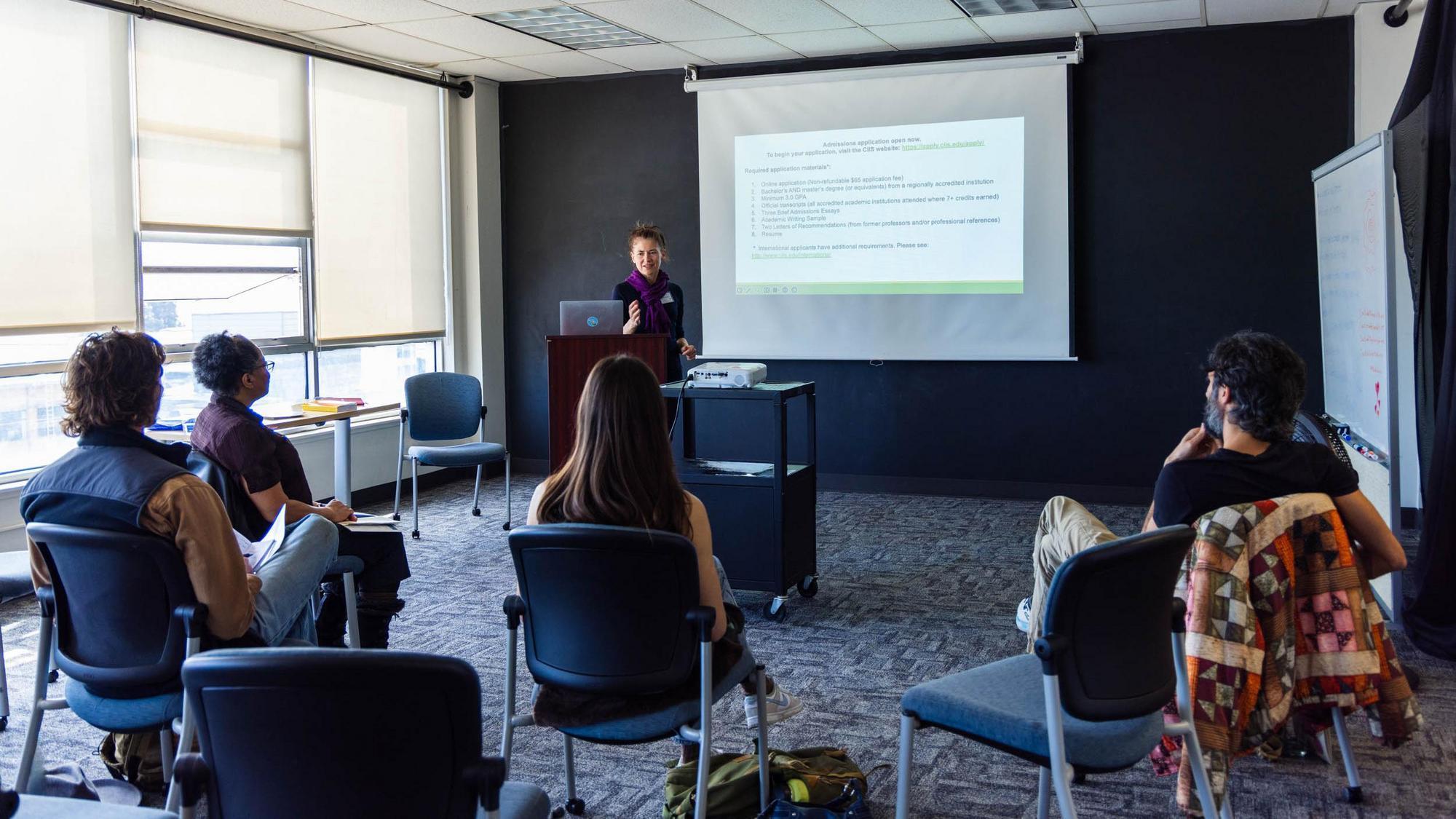
Jennifer Wells engaging with prospective students at the CIIS Spring Open House, 2025.
This vision draws on thousands of our greatest thinkers, over a long time, and culminating in insights of recent visionaries. Edgar Morin is a French polymath who founded complex thinking, a profound synthesis of diverse knowledge breakthroughs, one that evolves beyond systems thinking by better incorporating dynamics like the diverse sciences of emergence, self-organization, and symbiosis — as they operate across all scales from subatomic particles, to whirlpools, cells, bodies, whole ecosystems, and stars.
Today, systems thinking demands a reorientation: the capacity to really focus on issues in terms of webs of relationships, in turn helping us see each issue itself more fully and accurately. That shift changes our research: the kinds of questions we ask, the approaches we use, the richness of our results, and strength of our analysis. The work moves from "What is known?" to "What change can happen?"
The Feedback Effect
As many current fields of social scholarship and natural sciences are increasingly showing, our world is wildly lively, entangled, and interactive. One of the most persistent habits in social change work is the assumption that interventions will produce certain and predictable results. Launch a program, solve a problem. Invest more funding, get more impact. Systems thinking challenges such assumptions and offers more flexible approaches, approaches based not on fixed assumptions, but on principles of feedback, curiosity, learning, and adaptation.
We are not designing for certainty, but designing for imagination, experimentation, mindfulness, and adaptation. Jennifer Wells, Professor, Transformative Inquiry
Complex social and ecological systems are non-linear. It turned out that the linearity that's been intrinsic to much modern thinking is actually the odd exception. As for our research goals, it's important to keep in mind how such distortions in the dominant worldview are root causes of the polycrisis we are living through. As the mathematician Stanislaw Ulam said, using a term like nonlinear science is like referring to zoology as the study of non-elephant animals. In fact, our scholarly lens needs to be as vibrant as the real world. Our thinking needs to be as open to dynamics as the subject we are studying. A small action (a conversation, a policy tweak, a shift in roles) will cascade in unexpected ways. A well-funded initiative may falter, failing to produce measurable change, or even and in fact often, bring about more harms. My work has studied how working from and not against such dynamics or 'non-linearity' changes the researcher's posture: we are not designing for certainty, but designing for imagination, experimentation, mindfulness, and adaptation.
This is where many systems principles provide powerful insights for framing and analyzing research. For instance, it's helpful to grasp the principle of feedback loops. Positive feedback loops accelerate a trend. Early adopters of a technology create pathways and pressures for others to use it, which creates more incentives, more adopters, and so on. Negative feedback loops act as stabilizers, pushing a system back toward equilibrium. Changemakers can identify these loops in their field of study to be better attuned to how their actions will play out over time, and where a well-placed effort might gain momentum on its own.
Finding the Leverage Points
Not all interventions are created equal. Systems thinker Donella Meadows argued that there are specific places within a system, leverage points, where a small shift can produce a large change. We build on these pivotal ideas, asking how we can identify these critical intervention points, rather than defaulting to common flaws such as focusing on singular causes. This challenges how we tend to default to the most visible or politically convenient targets, freeing us to be curious about other feasible and preferable pathways.
Image
A conversation with Jennifer Wells at the CIIS Spring Open House, 2025.
Scholars working with leverage points often mobilize win-win-win solutions. While this phrase has been trite, that's partly because it's not always well executed. But it still is a key to positive social impacts today. These are skills that develop with practice. A student studying food insecurity, for instance, might initially focus on distribution: getting food to people who need it. A systems perspective could reveal that the more powerful leverage point sits upstream, in how land-use policy, agricultural subsidies, and supply-chain logistics interact to determine what food is available, where, and at what cost. This was the insight of Buckminster Fuller Prize finalist Cheryl Dahle, who focuses on researching, developing and launching ways to solve large-scale, systemic problems. For instance, Cheryl founded the Future of Fish, a non-profit innovation hub that supports the collective impact of entrepreneurs working to end overfishing.
Generally speaking, the interventions shift from treating symptoms to focusing on addressing and restructuring the very conditions that create them. For all these reasons, the shift towards worldviews that are ecological, entangled, and reverent tends to highlight the inherently ethical dimensions of research. When researchers identify leverage points and design systemic interventions in social systems, their actions always already affect people and communities. A systems perspective encourages critical reflection on the consequences: who benefits, who bears risk, and whose voices shape the process. Ethical awareness emerges from grappling with complexity, not in addition to it. Together we work to cultivate and shape this as a source of better vision and collective futures.
Building Adaptive Capacity
Systems thinking adds powerful capacity to designing a successful project. Faced with the dizzying polycrisis, the goal is to build the capacity of communities and organizations to learn, understand, envision and adapt as conditions change. As it resonates more fully with our real world and real experiences, systems thinking gives us insights into how to remember and inhabit our innate powers of caring, healing and transformation. In social settings, we call it resilience: the ability to reorganize in response to disruption while maintaining core functions and values, rather than the ability to bounce back to a previous state.
In inner work, some call it post-traumatic growth in contrast with often inescapable post-traumatic stress disorder. As we learn these ways of thinking and they start to become second nature, we might find that they echo in shifts and weight of post-traumatic stress towards post-traumatic growth. After challenges and traumas, with care and connection, we can build greater inner strength, relationships and life energies.
The result is scholarship that can speak to the lived experience of communities facing uncertainty, which, in an era of growing challenges, is every community. Jennifer Wells, Professor, Transformative Inquiry
Doctoral candidates in transformative studies learn to design research that overcomes many of the weaknesses and flaws of past methods. One way to do this is in working with complexity. Rather than testing a single hypothesis under controlled conditions, we develop methodologies that incorporate issues like how to track systemic change over time, how actors within the system learn and adjust, and how the researcher's own presence can shape what unfolds. This research takes the messiness of real-world social change seriously and works with it effectively.
The result is scholarship that can speak to the lived experience of communities facing uncertainty, which, in an era of growing challenges, is every community.
Seeing Differently
It's tempting to treat systems thinking as another simple analytical framework, a source of new buzzwords, a way of drawing better diagrams. For changemakers, the value lies in the way this growing knowledge allows for a deep reorientation. Systems thinking trains you to notice patterns you would otherwise miss, to hold multiple perspectives together, and to resist quick fixes, when the situation calls for big picture and long-range vision.
This is a practice of seeing, being and feeling differently. At CIIS, that practice is embedded within a broader commitment to connecting inner transformation with service to the larger world. We aim for a university 'in which many worlds fit.' The Transformative Studies Ph.D. program prepares scholars from a very wide range of career backgrounds and goals, but with a common set of today's most vibrant scholarly lenses. We train Ph.D. students with some of the most exciting, visionary areas of social science and humanities scholarship. As we work on our many different topics, we are working towards one collective, flourishing future.