Done With Disruption, Hearts Ready for Real Change
Addressing wicked problems takes more than analytical skills. Heart-knowing brings the relational depth that systems-thinking needs to heal.
Daniel Deslauriers, Ph.D.August 11, 2026
We are living through a moment that demands more than intelligence. Climate disruption, fracturing democracies, widening inequity — these are not puzzles that yield to analysis alone. They are what theorists call "wicked problems": entangled, adaptive, and stubbornly resistant to any single frame of understanding. Solving them requires the full range of human capacity. And somewhere near the center of that range sits the heart.
At CIIS, this conviction is built into how we teach. Students in the Transformative Studies doctoral program immerse themselves in complexity theory and systems-thinking as living tools for addressing real-world challenges. What distinguishes that training — and what Daniel Deslauriers, a core faculty member in the program since 2011, has spent decades exploring — is the integration of heart-knowing alongside analytical rigor.
Disruption Has Failed Us
For much of the past two decades, systemic change has been conflated with disruption — the faster and more destabilizing, the more celebrated. The costs of that approach are now visible. Disruption produces velocity, but it also produces casualties: workers whose livelihoods evaporate overnight and communities whose social fabric tears.
The Transformative Studies program asks a different question: What conditions, practices, and skills actually make flourishing possible? What does mutual thriving look like? Rather than imagine an abstract future, Transformative Studies starts in the present, asking what practices can build the future, step by step and heart by heart.
This is where heart-knowing becomes indispensable for systems-mending. Leaders capable of holding uncertainty, creating psychological safety, and inviting others' imagination into service of the whole must develop their skills in the same deliberate, thoughtful way they can then demonstrate to others. This requires sustained practice and intentional study. They learn, through both theory and action, to step outside their comfort zones with others, creating shared experience that leads to richer insight and knowledge.
Image
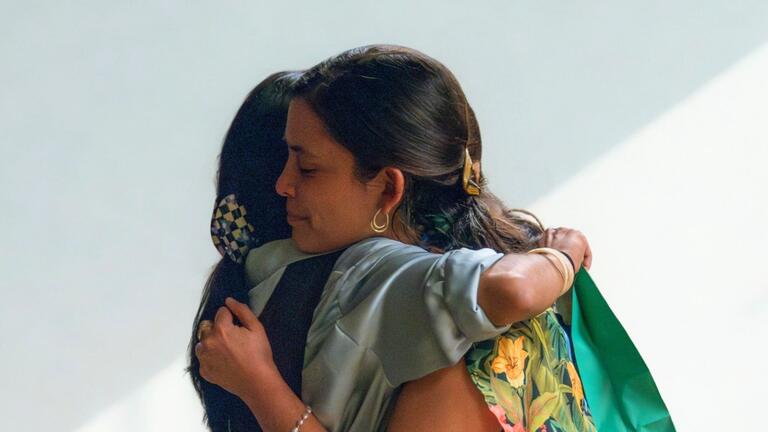
A CIIS student, hand to heart, in a moment of reflection.
What Is Heart-Knowing?
Heart-knowing is not sentiment dressed up as method. It is felt intelligence — a form of perception grounded in relationship, empathy, and ethical attunement. Where analytical thinking maps systems from the outside, heart-knowing enters them from within. It senses what matters to the people living inside a system, what has been lost, and what wants to emerge.
Deslauriers frames this through the concept of reciprocal embeddedness, the idea that our consciousness does not end at the edges of the self. We are woven into families, communities, institutions, and the living world. Heart-knowing is what allows us to feel that embeddedness. It is the capacity that lets a researcher notice how they impact systems, and how systems impact them. It is what allows a systems-change leader to hold space for others' uncertainty instead of rushing toward solutions.
In integral education, this means critical thinking walks beside compassionate imagination, ethical care, and the courage to remain present in the face of complexity. Together, they become something more capable than either alone.
Bringing the Whole Self to the Research Table
Graduate education has long privileged the cognitive — the well-structured argument, the clean methodology, the defensible claim. The Transformative Studies program does not abandon those standards. It extends them.
Students are invited to bring mind, heart, and body to their inquiry. Rigorous philosophical analysis often begins with personal experience — an encounter with systemic harm, a moment of unexpected grace. That experience is more than an anecdote. Examined carefully, it becomes a source of insight that abstract frameworks cannot reach on their own.
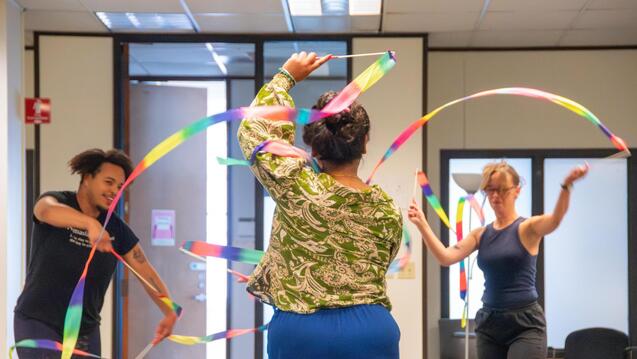
Deslauriers' own practice illustrates the principle. A researcher in consciousness and ecological phenomenology, he is also a practitioner of Contact Improvisation and trained in the Balinese mask dance form of Topeng. For him, embodied knowing is scholarship of a different register. The body perceives relationships, thresholds, and tensions that the analytical mind can take weeks to articulate.
Research That Reaches Into the Real World
The challenges ahead require scholars who can hold complexity without collapsing it, who bring analytical precision and relational intelligence to the same table. CIIS' Ph.D. in Transformative Studies prepares exactly those scholars.
The program draws students who are already embedded in their fields — practitioners, educators, artists, activists, leaders — and deepens their capacity to understand and shape the systems they inhabit. Students engage with complexity theory, integral approaches, and the full spectrum of ways of knowing, including the felt and the relational alongside the empirical and the theoretical.
Heart-knowing is felt and is at the core of what makes us humans. Daniel Deslauriers, Professor, Transformative Inquiry
The dissertations and research projects that emerge from Transformative Studies reflect this breadth. Students carry their inquiry into the fields where they already work: corporate governance, K–12 education, ecological design, the arts, community health, social activism. Most address change practices that make a concrete difference in the current moment, changes that also serve as foundations for greater future flourishing.
What unifies this range is a common orientation: research conducted in service to the living systems it studies. That orientation asks scholars to be present to what they are studying. And it holds both the rigor of careful methodology and the warmth of genuine investment in the people and places the work is meant to serve.
That kind of scholarship is a practice of service. And it begins, as Deslauriers would say, with the willingness to show up whole.
Associate Professor Sara Salazar shares how CIIS’ B.A. in Interdisciplinary Studies creates space for students who have started and stopped their degrees to finally complete on their own terms.