
Campus News
An endowed Drama Therapy scholarship honors a life of creativity, compassion, and service
What are you looking for?
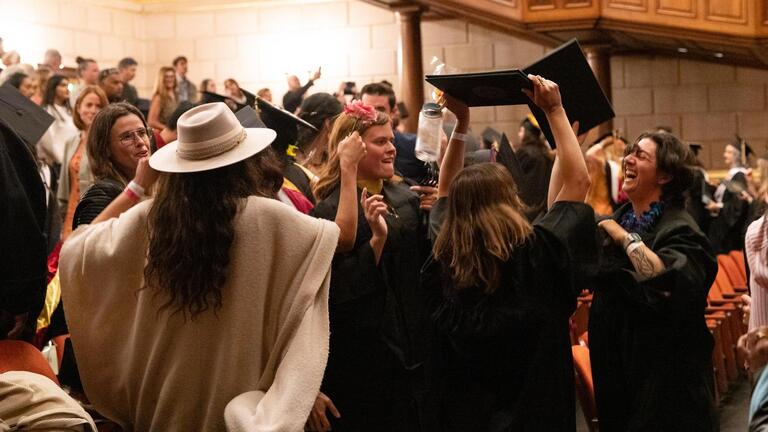
At CIIS’ 58th Commencement, the student speaker and the keynote speaker came from different worlds — and arrived at a very similar truth.
From the geography of their early lives to the journeys their careers and education brought them on, Hadyatou Diallo and Meihong Xu have lived very different lives. One navigated Guinea, West Africa, American military service, motherhood, and a doctoral program at the same time. The other grew up in rural China, led tech ventures in Silicon Valley, and returned to school in her fifties, drawn toward the inner life.
But at the same podium, on the same May afternoon at Herbst Theatre in San Francisco, they kept circling the same idea: that showing up whole and integrated, fully present and fully oneself, is both one of the hardest things a person can do and the most necessary.
Hadyatou Diallo stood in the spotlight, but she started by sharing her moment with the Class of 2026, and then with the whole crowd. She honored her fellow scholars, the professors, and the loved ones near and far who made the education journey possible. “None of us got here alone,” she underlined for the graduates. Everyone present had a whole story to tell from their programs: some had completed their degrees while raising children, while working full time, while enduring or healing from unseen wounds. Including Diallo herself.
Diallo described herself as “someone who has had to become herself more than once.” She briefly detailed a lifetime of education, from kindergarten through doctoral study, in which she encountered exactly one Black instructor at the front of a classroom. She couldn’t just take the path less traveled by, she had to make it.
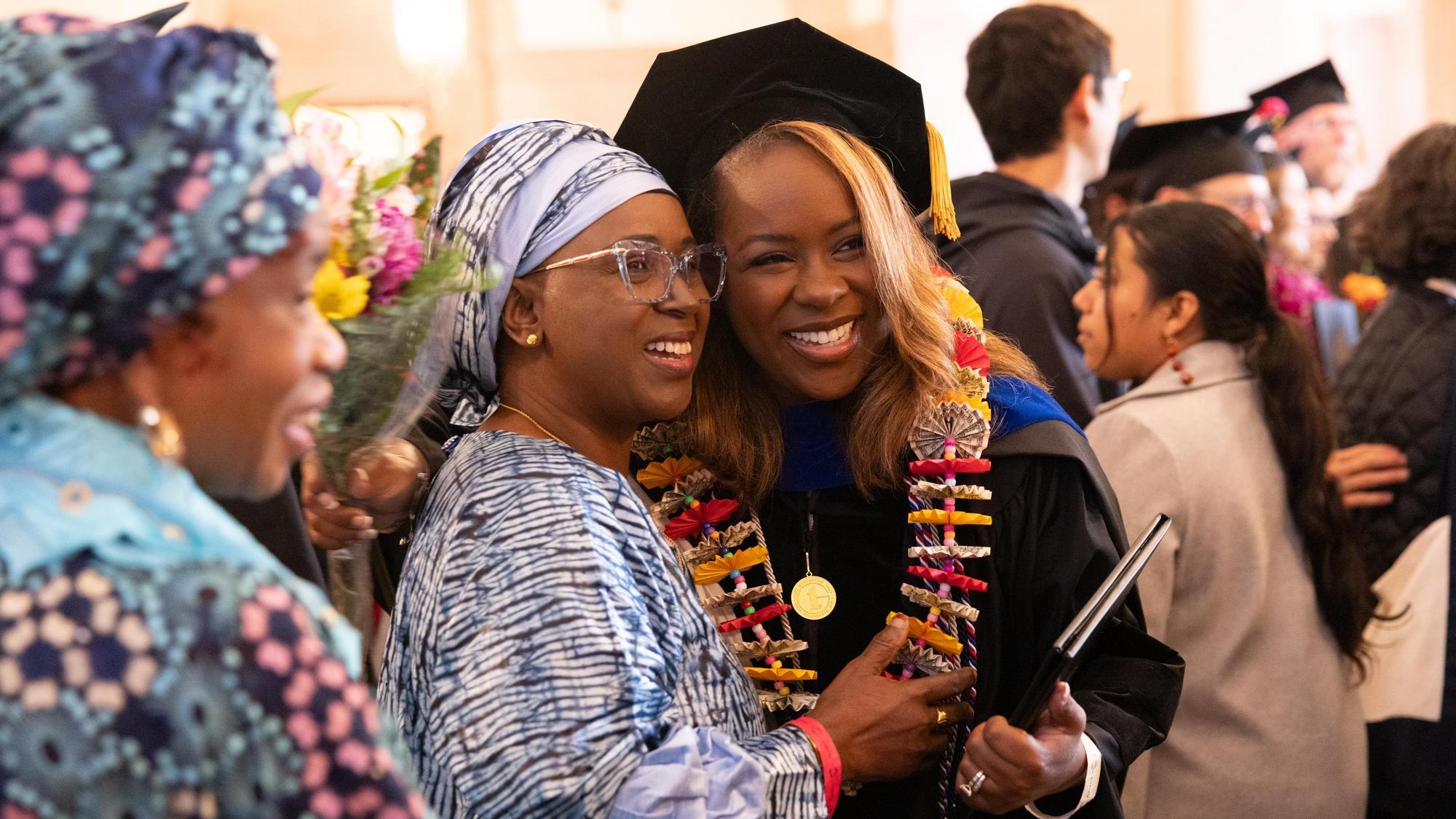
CIIS gave her opportunities to chart that path, to resist disconnection, to notice what and who was neglected in a world obsessed with speed. “There were moments in this journey — quiet ones — where I did not recognize my own life,” she told her classmates. “Moments where I had to ask myself very honestly: Who am I when I am not performing? And who am I allowed to become if I stop shrinking?”
Institutions like academia and the Army, she noted, were never designed with someone like her at the center. But, she said, “they evolve because people who were not imagined within them refuse to disappear.” She told the room she intended to one day be the representation at the front of the classroom that she had never had.
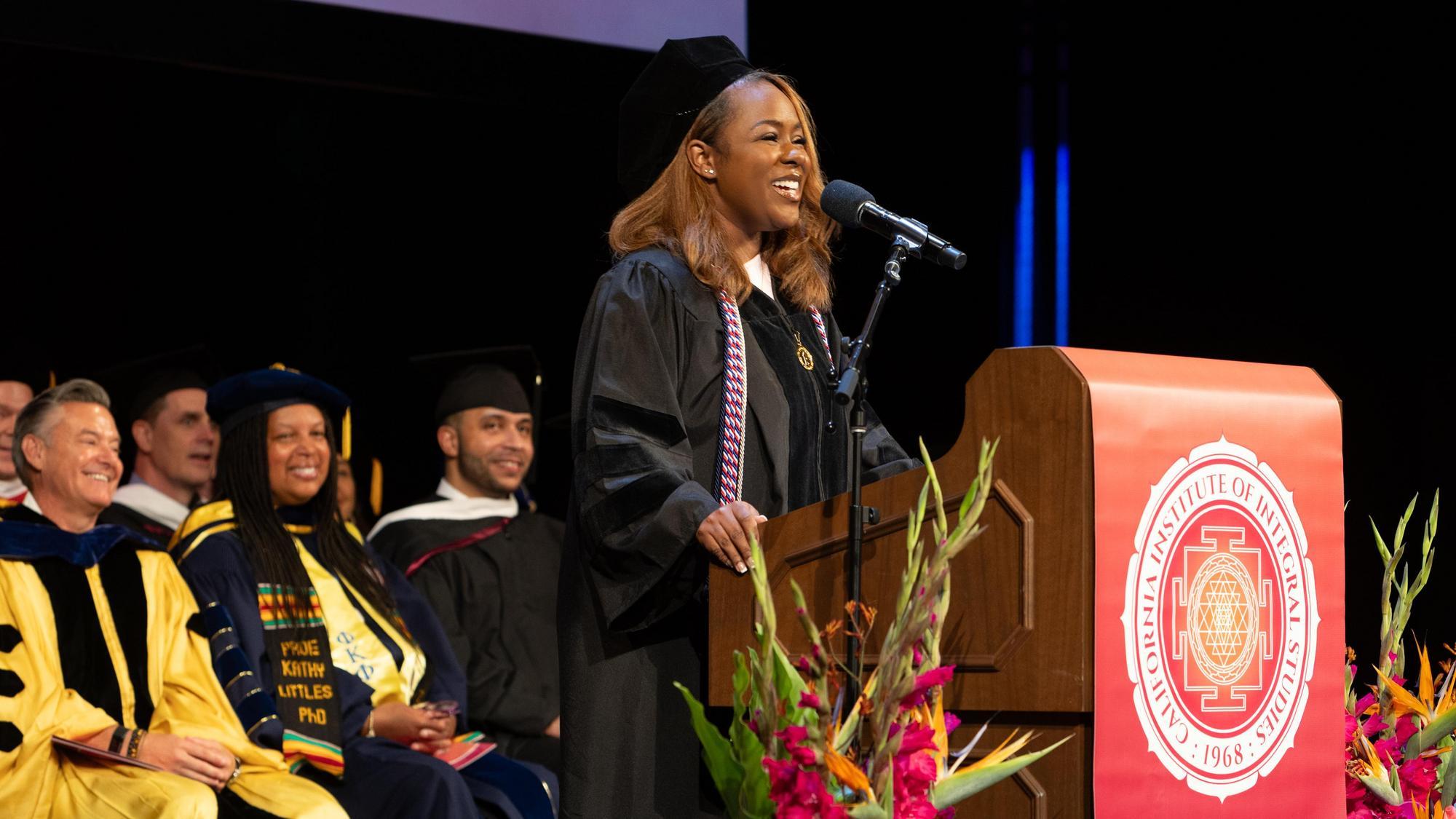
Ask yourself what kind of presence you are creating. What kind of humanity people experience when they encounter you.
Hadyatou Diallo, Class of 2026, Ph.D. in Human Sexuality
Her invitation to her classmates was to expand, to take up space and take up their places in leadership and in community. “Do not shrink yourself to fit spaces that were never designed to hold your fullness,” she told the crowd. She further urged them to not be content to ask what they can produce; instead, she implored them to ask what kind of presence they are creating, how they make people feel. And then she asked them to keep one piece of wisdom if they kept nothing else: “You do not have to become someone else to do meaningful work in this world.”
As she left the podium, the room was full to the brim with cheering.
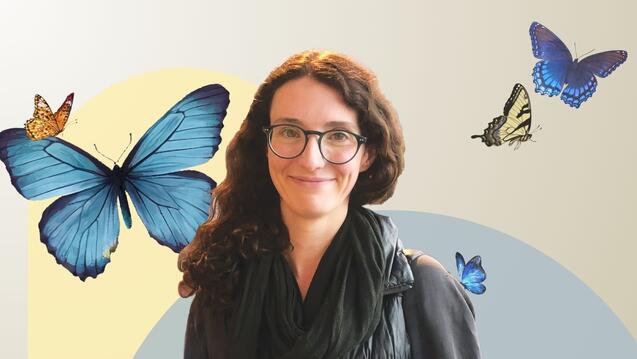
Meihong Xu’s keynote drew its strength from the long view. She stood, she said, as three things at once: a trustee, a fellow practitioner, and a proud alum who had graduated from CIIS’ Integral Counseling Psychology program in 2021 and once sat exactly where the graduates were sitting. She wanted, first, to honor the “call” that had brought them: the courageous decision to pursue a radically different kind of education, one that asks a person to look directly into the messy, beautiful complexity of being human.
Then she took them back to where she began. Her own childhood, she said, “wasn’t measured in data points, but in the slow pace of the water buffalo I led through rice paddies.” As the first girl in her family to receive any education, she had arrived at college with a rigid “us versus them” view of the world, until a chance encounter with a visiting American professor dissolved it. The “other,” she realized, “wasn’t a threat, but a person with a different frame of reference.”
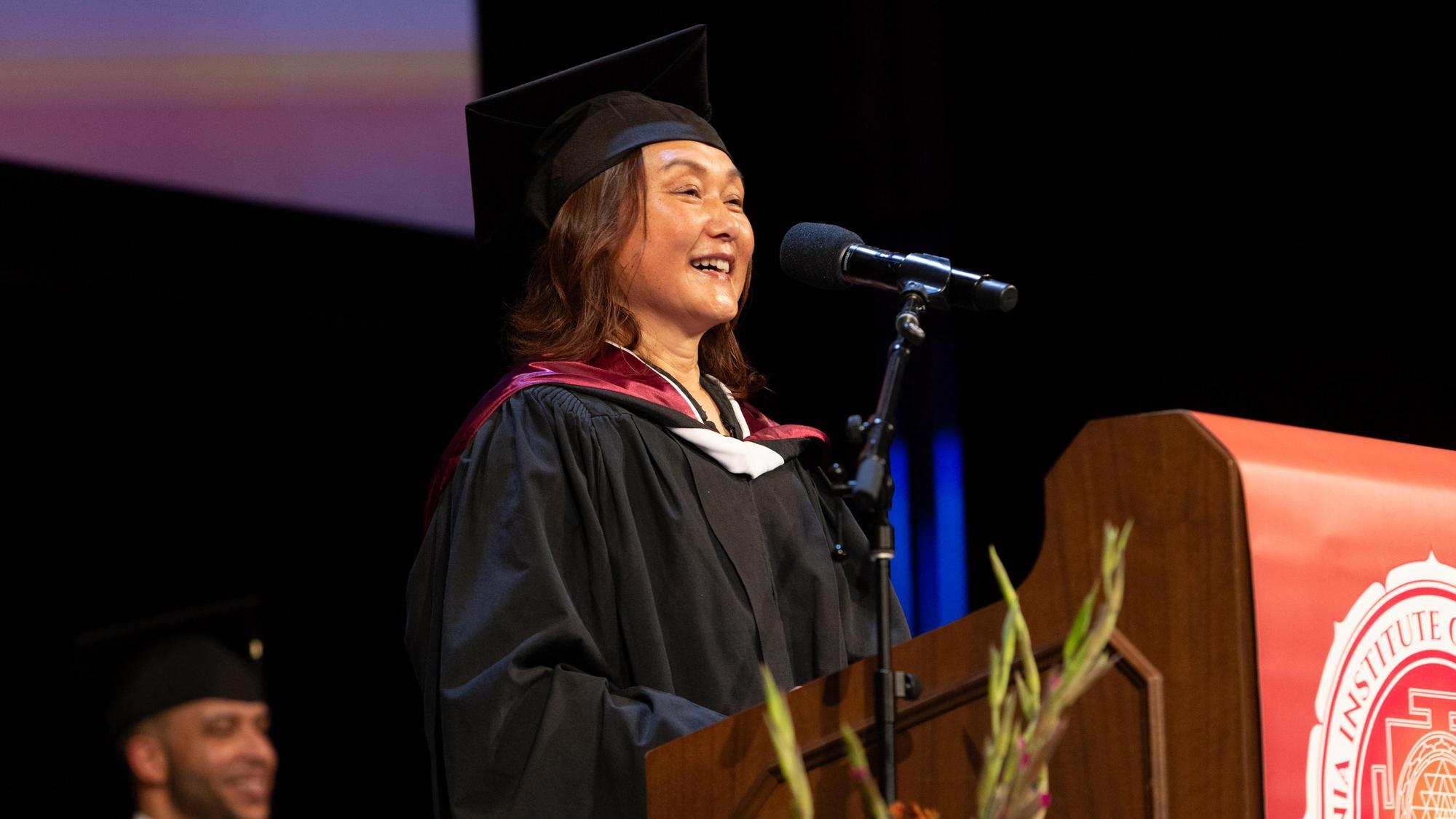
For years, the chapters of her life — village girl, student, tech executive, author, trustee — had felt like separate, disconnected lives, each replacing the last. CIIS, she said, taught her otherwise. “Growth is a spiral. We often return to the same questions, but each time, we have a bigger heart to hold the answers.” We don’t leave the past behind, she told them; we bring all of it, the village girl and the professional, into a single, integrated whole.
The center of her address was a classical Chinese parable, 塞翁失马, The Old Man Who Lost His Horse. When the man’s horse ran away, his neighbors offered sympathy; he asked only, is that so? When it returned with a wild stallion in tow, they cheered his fortune; and still he asked, is that so? When his son broke a leg taming the stallion, they called it tragedy; but still the refrain, is that so? Until the broken leg spared the young man from being drafted into a war.
“Fortune and misfortune are intertwined,” Xu said. “Life is an interplay of light and shadow.” What matters is not the event but the capacity to meet change with radical acceptance, an inner stillness she came to treasure in the frantic world of business, and one she wished for the graduates stepping into an uncertain world.
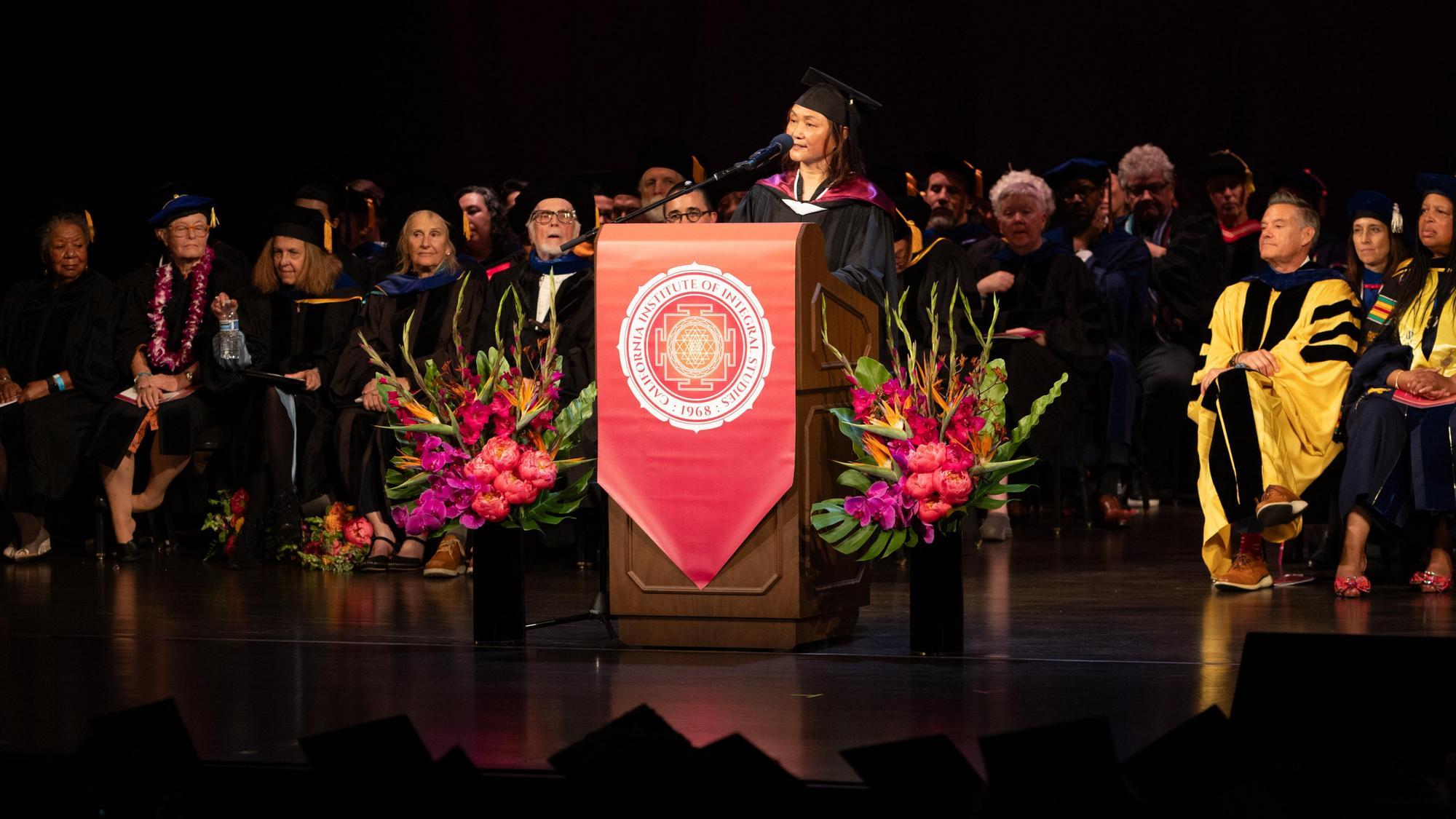
Follow the passion that brought you here. And above all, trust the journey—every single turn of the spiral.
Meihong Xu, Class of 2021, Integral Counseling Psychology, Author and Psychotherapist, Board of Trustees
That pull toward the inner life, she said, is what drew her back to school in her fifties. The ICP program was not about leaving the external world behind but about bridging it with the internal one: learning to sit with silence, to process shared pain, and to understand that “clinical wisdom is not just a set of tools, but a way of being.” As an ICP graduate, she took a moment to share her pride in CIIS’ community clinics, its strong licensure outcomes in California, the nation’s first university-based ketamine-assisted psychotherapy clinic, and a Mandarin-taught M.A. in Applied Psychology. These, too, are all parts of an integrated whole bringing healing to a fractured world.
She closed by turning to the age the graduates are walking into. While many institutions chase technical skill, she said, CIIS pairs intellectual rigor with embodied practice and the uniquely human capacities of intuition, empathy, and presence. “In a world of algorithms, you are the keepers of the human flame, the custodians of genuine human connection.” Her parting charge: “Keep your feet on the ground and your hearts wide open,” she implored them, and trust “every single turn of the spiral.”
Diallo spoke from the body, from history, from the specific weight of walking into rooms built for someone else. Xu spoke from distance, from philosophy, from a life that took decades to draw together. Yet they arrived at the same place from opposite directions. Diallo asked the graduates to take up the full space their lives had earned; Xu asked them to gather every fragment of who they had been into one whole self. Diallo called it letting your presence change the room. Xu called it trusting every turn of the spiral. Two voices, one invitation — and the Class of 2026 carried it out into the afternoon.
An endowed Drama Therapy scholarship honors a life of creativity, compassion, and service

Three CIIS students share the honest truth about what awaits you in graduate school — and why the surprises might be your greatest teachers.
CIIS' Clinical Psychology Psy.D. isn't for everyone — it's for a specific kind of thinker, clinician, and person. Here's how to tell.