What’s Your Burning Question? How One Professor Shapes a Completion Program at CIIS
Associate Professor Sara Salazar shares how CIIS’ B.A. in Interdisciplinary Studies creates space for students who have started and stopped their degrees to finally complete on their own terms.
August 27, 2026
Twenty-three years ago, Sara Salazar sat down in one of her first graduate courses at California Institute of Integral Studies (CIIS). Her professor, Dr. Lucia Chiavola Birnbaum, looked at her and asked a question no teacher had ever asked before: “What’s your burning question? What is it that you want to know? What is it that you cannot leave this classroom without exploring?”
This was a watershed moment. She had been given curricula, required to take certain courses, told which books to read. But no one had ever asked what she wanted to know. “It opened up so much for me,” she reflects, “as a student, as an educator, but also as a human being, to be able to step into that power.”
Today, Salazar is an associate professor and co-chair of the School of Undergraduate Studies at CIIS. She asks her own students the same question Birnbaum once asked her, certainly directly, and also in the ways that the whole program is structured toward individual inquiry.
The B.A. in Interdisciplinary Studies (BISO) program is built for students who, as Salazar puts it, “realize early on that the mainstream education system does not work for them.” It is designed for students who have started and stopped their degrees, sometimes once, sometimes many times over decades. Sometimes life intervenes and they have to stop. Other times, a department or school is simply not the right fit.
What Salazar hopes they find at CIIS is a program that allows them to bring “not only their full selves, but all of their interests.” Students typically have curiosities across multiple fields have not found a program where those interests can converge. The interdisciplinary structure is designed precisely for that interdisciplinary excitement. “They use our program as a place to look at the intersections of their academic interests,” Salazar says.
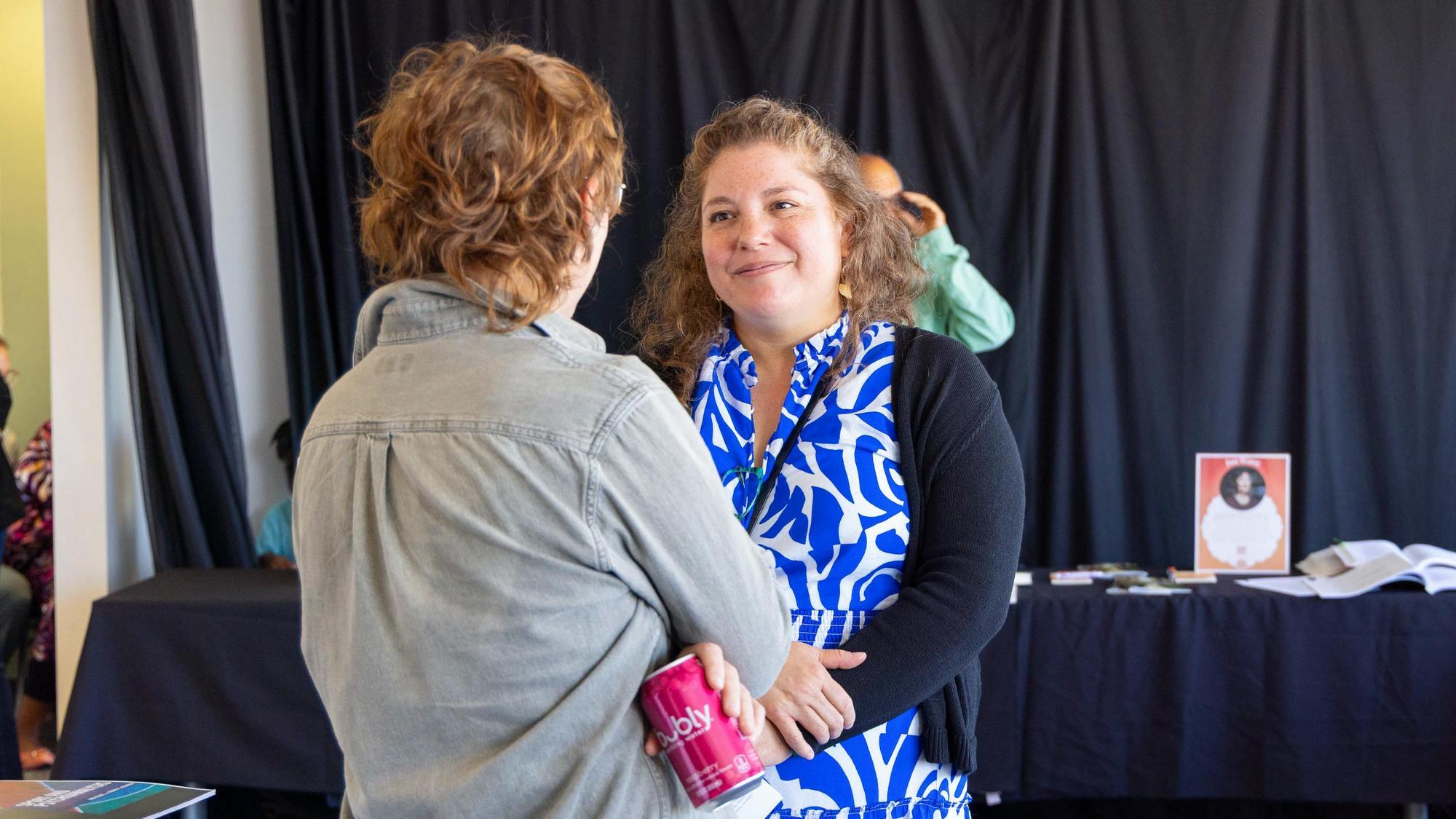
Image
Photo from Faculty Research Reception, May 2025.
What’s your burning question? What is it that you want to know? What is it that you cannot leave this classroom without exploring? Sara Salazar, Associate Professor and Co-Chair of the School of Undergraduate Studies
The program is rigorous, requiring one intensive calendar year of study for students who typically arrive with an associate’s degree. But it is also designed to meet students where they are. “Students who come to our program have a really good sense of who they are,” Salazar notes. They know what they want to study, and many have a clear sense of what they want to do with their degree when they finish. Others are not quite sure where their work is leading them just yet but by the 3rd semester they have built a strong academic foundation for themselves and are ready to take the next step. The program is designed to support them in the commitments they made, but also in the curiosities they may discover along the way.
The program operates on a cohort model. Students move through the year of core courses together, creating what Salazar calls “very strong communities of learning.” That structure, she believes, contributes to the program’s high graduation rate. “I hear from our applicants, this is an area that they really wish they had in other programs in other schools,” she says.
The program has been fully online since COVID, but the cohort model remains central. Students, Salazar says, do not experience their courses as “just distinct classes.” “They really feel held by our department, by all of the faculty working together, and by the institution as a whole.”
The faculty team includes three core members, including Sonya Shah and Charlotte Saénz, who have each been been at CIIS for about 20 years, along with longtime adjuncts, such as Zara Zimbardo, who have taught in the program for a decade or more. Before COVID, the team taught together in person. Now, though the format has shifted, the collaborative spirit remains.
“Each of my colleagues is deeply dedicated to their students, to their courses,” Salazar says, “and also they’re marrying the work that they’re doing in the world with what they’re teaching in the classroom. One informs the other.” At CIIS, she notes, students are encouraged to bring their whole selves, body, mind, and spirit. Faculty, she says, try to model that. “We bring our whole selves to the classroom. And you see that in the courses we teach, in the materials we select, in the assignments we have for students.”
Students, she adds, “very much appreciate seeing us walk the talk.”
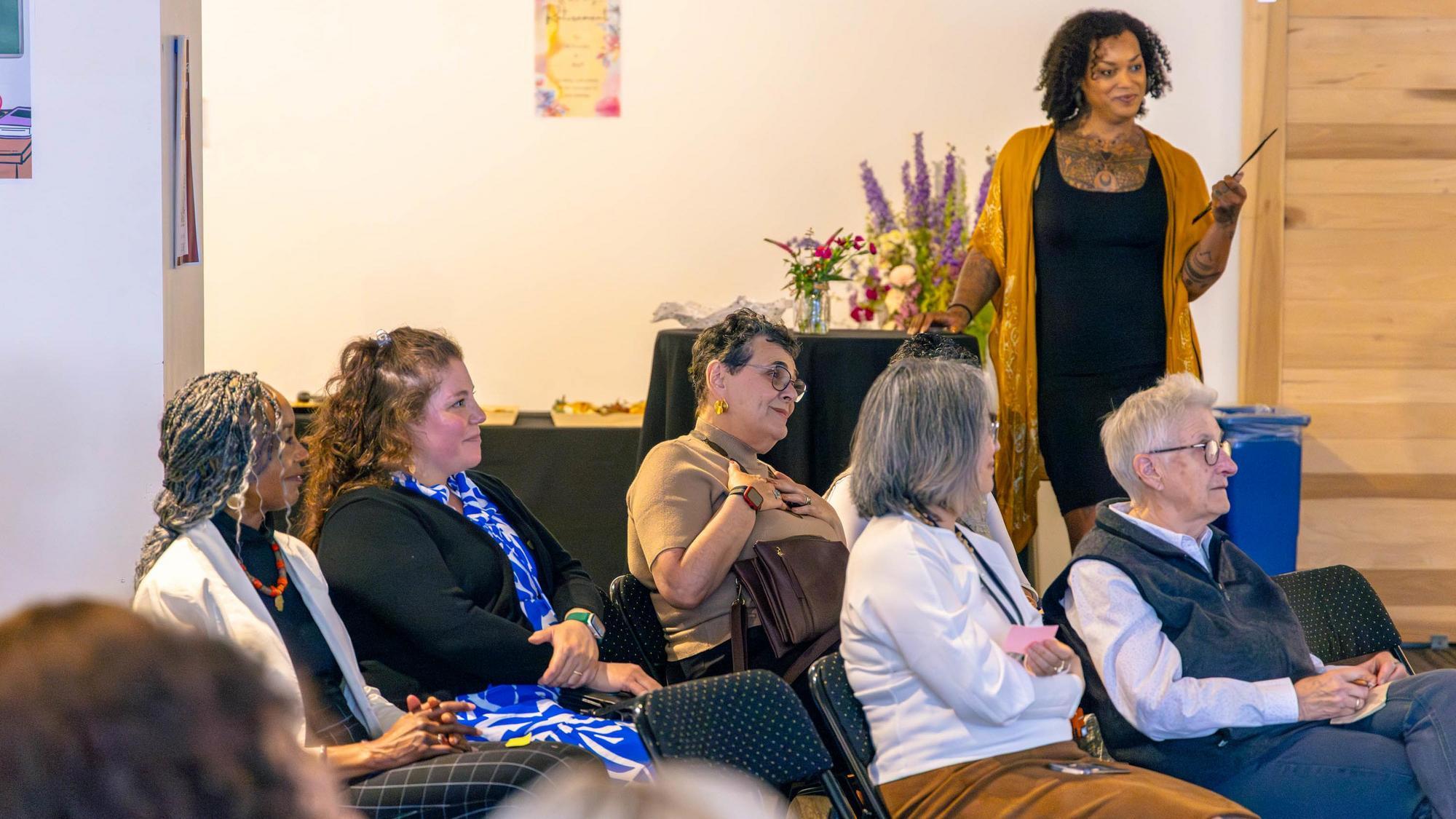
Image
Photo from Faculty Research Reception, May 2025.
We bring our whole selves — body, mind, and spirit — to the classroom. And students very much appreciate seeing us walk the talk. Sara Salazar, Associate Professor and Co-Chair of the School of Undergraduate Studies
There is, Salazar emphasizes, no single path after graduation. Alumni move into diverse fields. Many continue to graduate school in psychology, education, or social work. Some pursue certification to work in school districts or as counselors. Others go into city government, law, environmental stewardship, or nonprofit work. Often, students connect with nonprofits while still in the program, and the work they create in their courses directly impacts the organizations they join.
Salazar has been at CIIS for 23 years, first as a student in the Women’s Spirituality program, where she completed both her master’s and Ph.D., and then as faculty in the School of Undergraduate Studies for the past 13 years. She came seeking a place to explore Chicana spirituality and women’s studies, which were interests that did not fit neatly into any single department elsewhere at the time. CIIS, she says, felt like “an academic home.”
Image
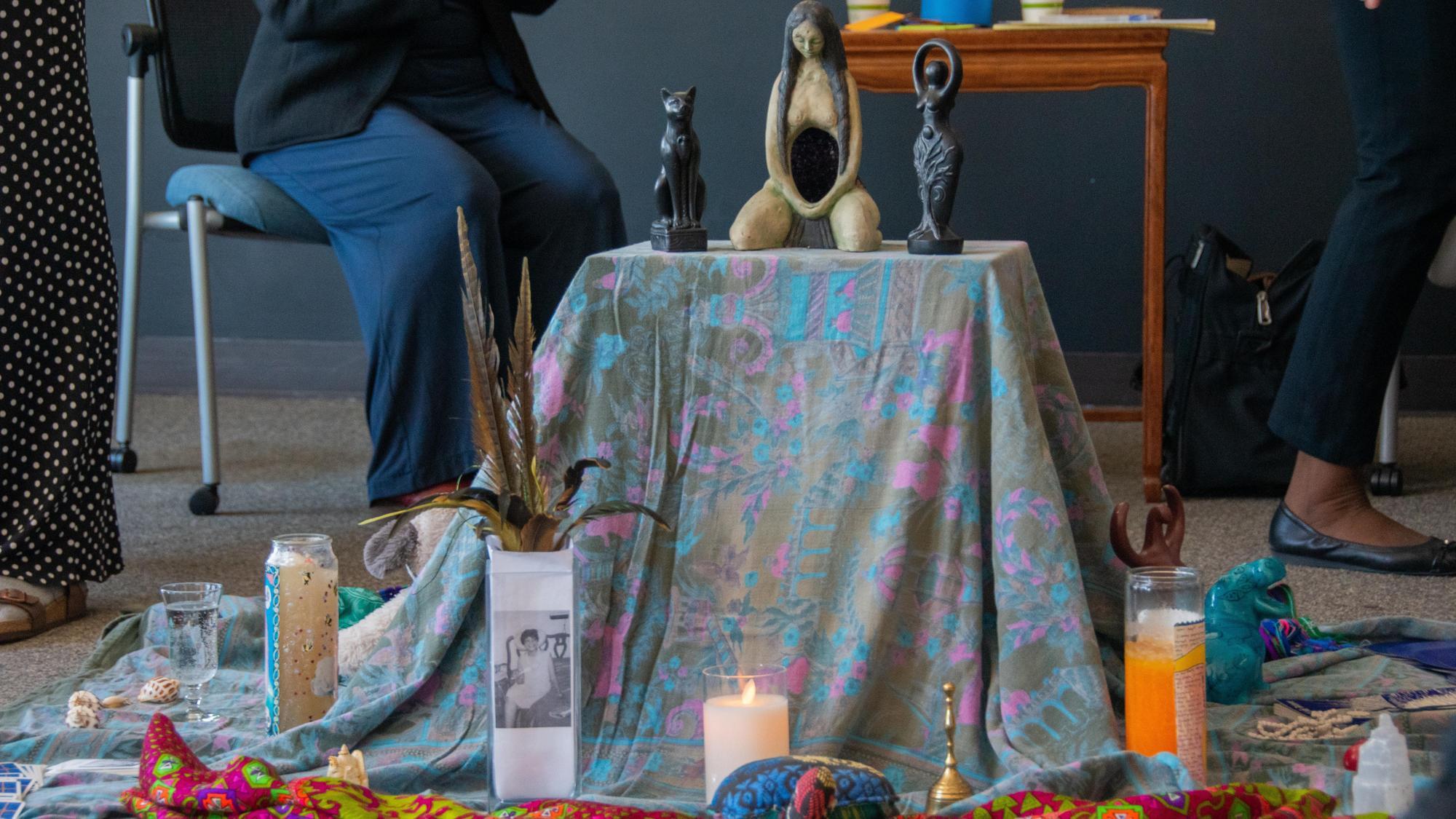
A place to honor teachers at the Women's Spirituality Retreat Spring, 2023.
They use our program as a place to look at the intersections of their academic interests. They create work out of those intersections. Sara Salazar, Associate Professor and Co-Chair of the School of Undergraduate Studies
What keeps her at CIIS, she says, is engaging with students who are “curious about themselves and about the world,” and who are willing to explore differences. She works with colleagues who are at the cutting-edges of their fields and are committed to fostering spaces where students can “connect and learn and grow together.”
The institution, she notes, offers students a range of resources — a Center for Writing and Scholarship, dedicated librarians, an Office of Student Accessibility Services, a dean of students who works closely with faculty, a robust team in the Division of Community Engagement and Belonging, and a Wellness Center that creates circles for students on the spectrum, students with ADHD, parenting students, students grieving, students seeking community.
Through all of it — the cohort model, the faculty collaboration, the interdisciplinary focus, the commitment to whole-person learning — runs a thread that connects back to that question Salazar was asked 23 years ago. What is your burning question? What do you want to know? The BISO program, at its best, is designed to help students answer that question for themselves. And in doing so, Salazar says, it helps build what CIIS calls “Beloved Community.”