Reflections on the Challenges and Opportunities of School-Based Therapy
School-based therapy can be a space for both healing and advocacy. Dr. David Cushman explores why.
August 13, 2026
Dr. David Cushman, Psy.D., one of CIIS’ core faculty members in the Clinical Psychology doctoral program, presented at the annual spring conference for the Society for Psychoanalytic Psychology.
He was part of a three-person panel titled “Bodies in the hallway: Institutional pressures on children and therapists in school-based therapy.” In this panel, two current and one former school-based therapists explored how processes of socialization, repression, and regulation of the body play out in K-12 public schools. At times, schooling conflicts with the aims of psychological freedom, creativity, self-knowledge, and agency central to psychotherapeutic treatment. Yet school-based therapy and school communities can also provide the relational groundwork for healing, transformation, and positive experiences of embodiment.
Dr. Cushman focused on how unstated power dynamics, rooted in histories of racist and ableist thinking, shaped the experiences of school-based therapists and their clients. He explored how therapists can notice and respond to these patterns, and suggested ways they can create new forms of relating and practicing. Below is a portion of his talk.
Critical Interpretation of the School System
When I recall my time doing school-based work, I start at the hallway. Being surrounded by bodies in the hallway was a frequent experience. Bodies which bounced off each other, bodies which smelled, and my body, aware of how I felt when I was in high school and the many ways that I often felt small and insignificant.
My clients, especially those with Black and brown bodies, were frequently not found. Dr. David Cushman, Psy.D., Associate Professor, Clinical Psychology
School-based therapy felt like it was marked by a dual tension of intense recognition and invisibility. When I would walk into a classroom to collect a client, 25 heads would swivel towards the door. I, and my client, were suddenly on display. My body would feel on edge, exposed. Other times, if a client was frequently absent from school and from our sessions, it would feel like I was chasing a ghost. Sometimes I would find them wandering the hallway, both wanting to be at the school but not in the classroom, a strange game of hide-and-seek. As renowned pediatrician and psychoanalyst Dr. Donald Winnicott said, “It is a joy to be hidden and a disaster not to be found.” I believe the success or failure of this game has much to do with race, Whiteness, and power. My clients, especially those with Black and brown bodies, were frequently not found.
San Francisco Unified School District (SFUSD) has a long history of racism, ableism, and xenophobia. While myself and my fellow clinicians would acknowledge the obvious racism that was plain to see in who was referred to special education, I believe my ignorance of the exact details helped me avoid facing being part of an institution that was conflicted (at best) about supporting students with marginalized identities.
Image
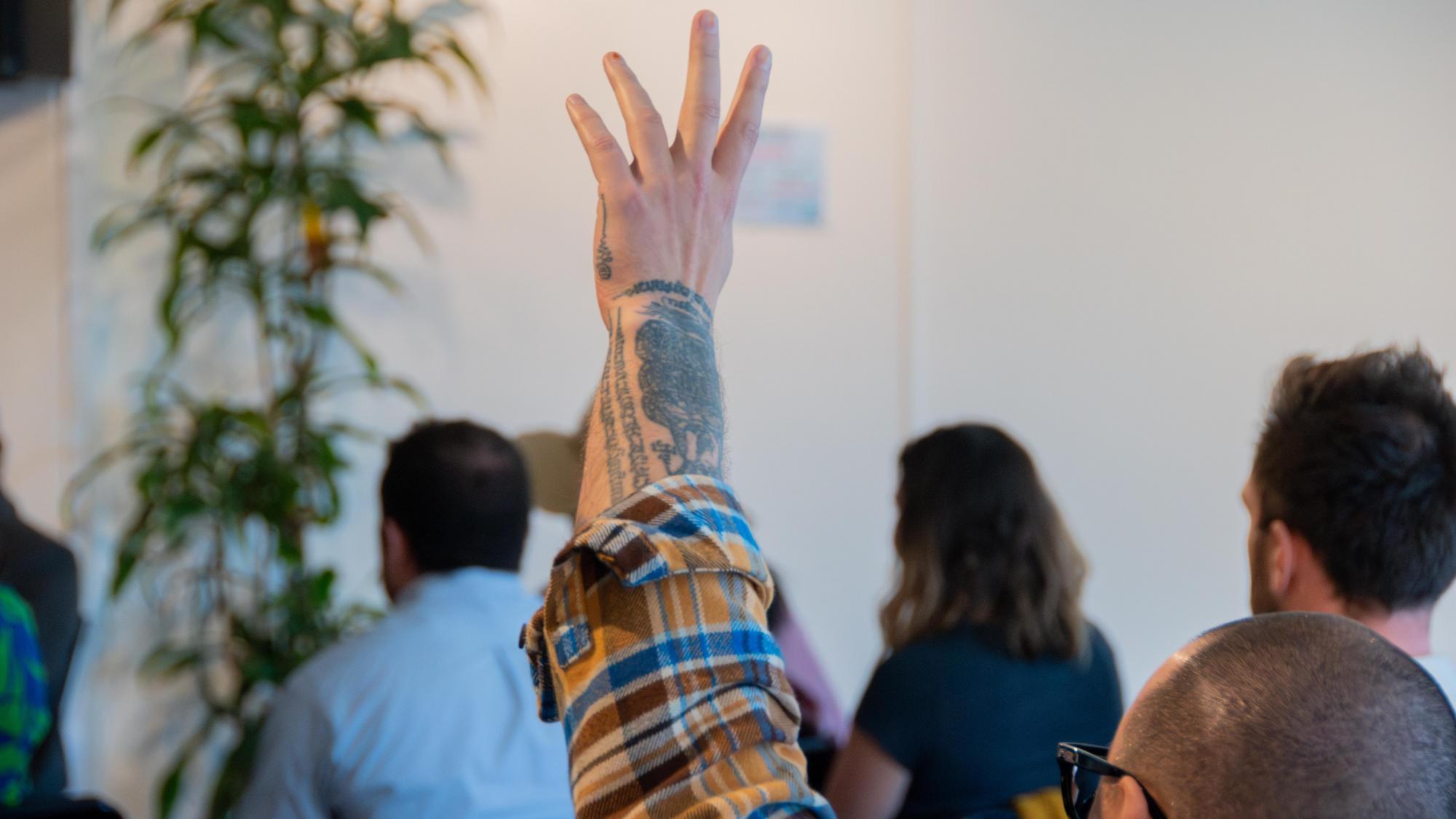
An attendee raises a question during the CIIS PsyD International Alumni Conference, "Notes From The Field: Pushing Depth-Oriented Psychology Forward", 2024.
Similar to what the Sheehi’s write in Psychoanalysis Under Occupation, school-based therapists are often pulled to individualize when there is a structural component to the struggle of their clients. This tendency has implications for how school-based therapists collaborate with school staff. Close collaboration can be beneficial.
However, being “part of the team” can pull the therapist to avoid noticing or commenting when the school is causing harm. It’s a fundamental tension within school-based therapy – how to build relationships with school staff while also advocating for one’s clients, and commenting on possible patterns of oppression and control. Potentially ruffling feathers may be worth it to try to be honest about the school’s potential complicity, and provide some of the youth, who often sense this complicity, that their reality-testing is intact, that they are believed and held.
It is a joy to be hidden and a disaster not to be found. Dr. Donald Winnicott, quoted by Dr. David Cushman, Psy.D., Associate Professor, Clinical Psychology
Returning to the themes of recognition and invisibility, my Whiteness factored into how I experienced them. I previously worked in a small therapeutic classroom within a larger school, an unwieldy attempt at creating a therapeutic environment. The classroom contained mostly Black and brown students and staff, all from similar neighborhoods in San Francisco, and I was totally ignored when I was in there. Students and staff would mostly act as if I didn’t exist – I felt unwanted and rejected. This continued for weeks, including when running into the group outside the classroom. I had to grapple with being an outsider, a White outsider, in a classroom that, while deeply struggling, was protective of the small community created between the staff and students. What I believe was required of me was to keep showing up and survive the ache of being mistrusted, which was likely something everyone else in that classroom had deeper experience in, while not forcing my way in. Gradually I was accepted, but it was on their terms, not mine.
We have to learn from their patients, to relinquish aspects of what we imagine therapy to be. Many of our clients and their families in school-based work have been told that they weren’t good enough or worth protecting. By learning and gaining something from our patients, we flip these damaging narratives in powerful ways.
The type of school-based therapy I am suggesting requires us to resist the temptation to sound smart. This pressure can create a deadened space, and leads to claiming knowing more about our clients than they do, pushing the therapy towards a retrenchment of power and control over minds and bodies.
One way to counterbalance this is by playing. Playing requires losing our certainty. I’m thinking of Winnicott’s quote, “The patient’s creativity can be only too easily stolen by a therapist who knows too much.” If we extend this to an institution like a school, we can easily imagine how both the therapist and the school’s need to know limits the patient’s creative capacity.
Playing requires losing our certainty. Dr. David Cushman, Psy.D., Associate Professor, Clinical Psychology
Image
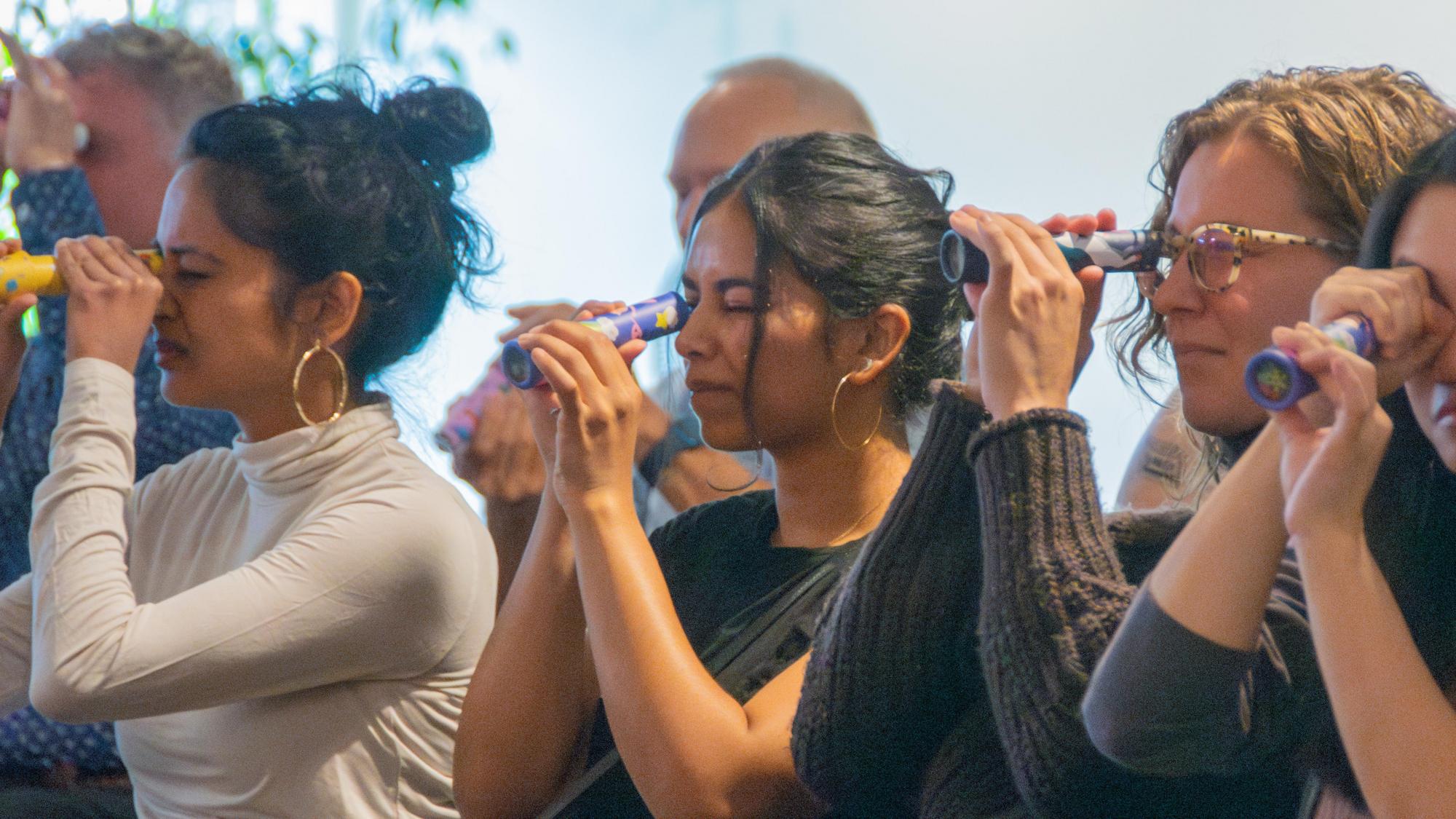
Students exploring with kaleidoscopes at the CIIS PsyD International Alumni Conference, "Notes From the Field: A Dialogue on Contemporary Practice of Depth Oriented Psychology," 2023.
I once wandered the hallway with a client who pretended the water bottle he had was full of alcohol, scaring the staff. While perhaps some may see a lack of boundaries on my part, I think this was him playing with many different themes, trying to see if someone could tolerate it and play back.
I invite us to imagine what school-based therapy could and should look like if it was tailored not for the convenience of the schools themselves or our comfort as therapists, but instead to be of service to the students and families we see. I imagine it would look very different than it does now.
Associate Professor Sara Salazar shares how CIIS’ B.A. in Interdisciplinary Studies creates space for students who have started and stopped their degrees to finally complete on their own terms.