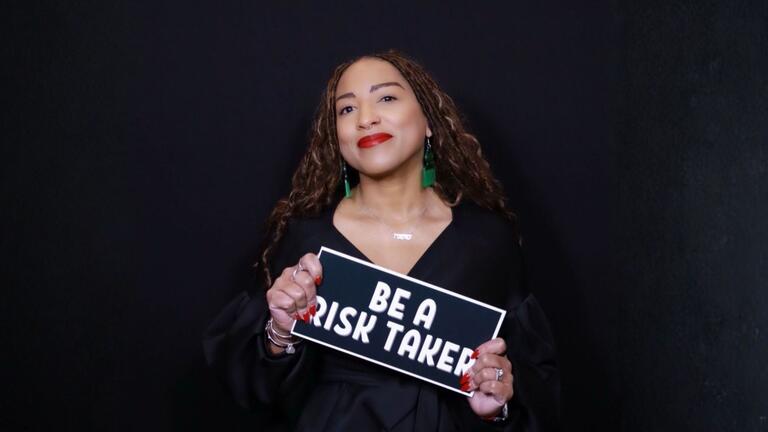
When Courtney Johnson-Benson began researching Ph.D. programs in human sexuality, she knew what she was looking for, but finding it wasn't easy. "There wasn't really a lot to choose from, which made my decision a little bit harder," she recalls. With only a few strong programs available, the question became personal: which would be the best for her personally and professionally?
For Johnson-Benson, a professional working in higher education and deeply involved in community activism, the decision had to make sense on multiple levels. The program needed to accommodate her current career. It had to align with her goals as a change agent. And critically, as a person holding multiple marginalizations, she needed to see herself reflected in the program. She knew CIIS fit her criteria on paper, but now that she’s actually been part of the program, have expectation and experience aligned?
Flexible in Practicalities and Purpose
When Johnson-Benson describes what she was looking for in a program, she focused on the guiding principles and approaches rather than specific boxes she needed to check. "I wanted something that wasn't very rigid and something that incorporated a lot of different lenses.”
A program's flexibility matters practically, allowing working professionals to pursue doctoral study without sacrificing their careers. It also makes a huge difference intellectually. A rigid program wouldn't serve students examining a field as complex and evolving as human sexuality. The inclusion of multiple theoretical lenses, critical perspectives, and intersectional frameworks reflects an understanding that sexuality cannot be understood through a single disciplinary approach.
The theoretical and critical studies frameworks she's learning are already reshaping her approach. "What I'm learning here is truly informing what I'm doing and putting into practice within my community and I'm grateful for that," Johnson-Benson says. It also shows up in her professional life as she navigates her responsibilities and interactions with others with fresh perspective.
Anti-Racist and Intersectional
What also drew Johnson-Benson to CIIS was the program's explicit commitment to social justice. "I really wanted to have an opportunity to be in a program that was working towards anti-racism, very inclusive, diverse, had an intersectional lens," she explains. "I believe that's how we move forward, specifically in the arena of human sexuality."
The program's reach beyond clinical practice was another draw. Coming from higher education herself, Johnson-Benson appreciated that the program wasn't designed exclusively for licensed clinicians. "It was wonderful to see a variety of professions represented in our cohort," she notes. This diversity of professional backgrounds enriches classroom discussions and reflects the program's understanding that expertise in human sexuality matters across many fields.
Being a historically marginalized person myself, just to keep it real, I really wanted to see myself in the curriculum — and I saw myself in the structure of this program.
Courtney Johnson-Benson, Class of 2027, Human Sexuality Department
For Johnson-Benson, the decision ultimately came down to recognition. "Being a historically marginalized person myself, just to keep it real, I really wanted to see myself in the curriculum — and I saw myself in the structure of this program."
A Cohort That Feels Like Family
The relationships formed in doctoral programs often become as important as the academic work itself, and Johnson-Benson's experience exemplifies this. "I always say it was kind of meant to be, and I know that sounds super cliché, but we mesh together so well and we come from all different walks of life," she says.
In just one semester, the cohort had formed deep connections. "It's incredible to see how we've grown over the past 3-4 years and how close we've become," Johnson-Benson reflects. The sharing extends beyond academic struggles to personal triumphs and challenges. "It's really become almost like a second family."
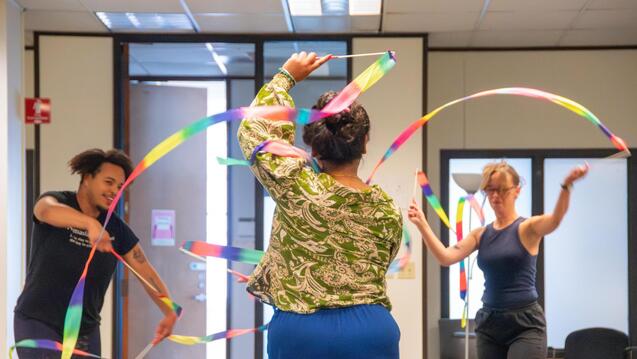
The intensive residency format, which balances the flexibility of online coursework with three-day in-person gatherings, strengthens these bonds. After spending time on Zoom and chatting over messaging apps, real face-to-face time becomes precious. Though the condensed format can be a radical shift, forcing students to learn in new and unexpected ways, Johnson-Benson reports that she emerged from residency "exhausted, but also super refreshed in the best possible way."
A Changing Trajectory
The knowledge, process, and community of CIIS’ Human Sexuality Ph.D. is already reshaping Johnson-Benson's vision for her future. "I'm really starting to think about what my future profession scope may look like. It's really changed the trajectory of what I saw as my future career, which is exciting and also kind of scary because you have this idea of what you're going to be doing and contributing in the world as a professional," she shares.
This openness to transformation — even when it disrupts carefully laid plans — reflects the program's emphasis on expansive thinking. For Johnson-Benson, the uncertainty is part of the excitement, as is the opportunity to likewise contribute something completely new.
"We're taught that we will create new knowledge," she explains. "The fact that I have an opportunity to have a distinct voice in academia that I can share with other folks to carry on, to really solidify this field as something that is impactful and integral into our everyday lives — just having an opportunity to further this specific academic field is just kind of amazing."
What I'm learning here is truly informing what I'm doing and putting into practice within my community.
Courtney Johnson-Benson, Class of 2027, Human Sexuality Department
For Johnson-Benson, creating new knowledge means strengthening a field that has direct implications for how people understand sexuality, identity, and human experience. It means producing work that other scholars, practitioners, and community advocates can build upon.
For those researching the program now, Johnson-Benson offers encouragement rooted in her own experience. "Even if you've struggled a little bit in your educational journey, there are always opportunities," she says. Passion and curiosity, paired with the support and flexibility of CIIS’ Human Sexuality department, make for a truly different learning environment.
Within ten weeks, Johnson-Benson could see how the program changed her own approaches and opened new avenues for thought and action. "The knowledge and the experience that I have here is just going to make me a stronger professional and a stronger academic leader.”