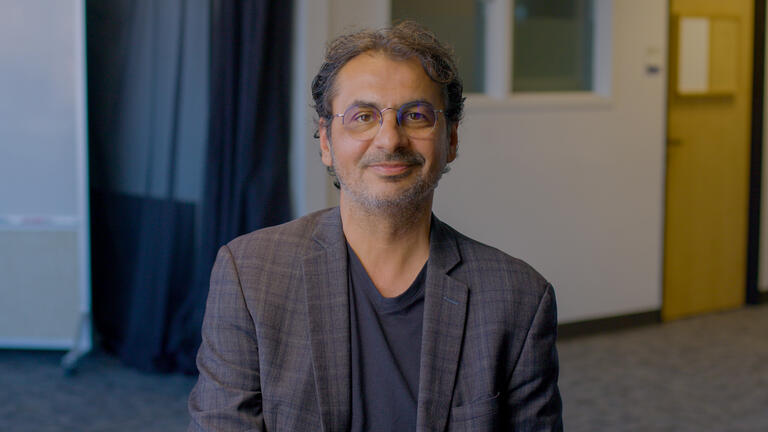
Cosmin Gheorghe is a senior lecturer at the School of Undergraduate Studies at California Institute of Integral Studies. Originally from Romania, where he trained as a physician, Gheorghe came to CIIS in 2000 to study drama therapy — drawn by the institution's integral approach to education. After earning his master's degree in 2002 and becoming a licensed psychotherapist, he has spent over two decades teaching students how to connect the dots across disciplines in an increasingly fragmented world.
Why Integration Matters
When Gheorghe was choosing between drama therapy programs, the decision came down to what kind of education he wanted. "I chose CIIS because it was offering the integral part of studies. I wasn't interested in ultra-specializing. I was interested in making connections between disciplines," he explains.
Gheorghe's personal background informed his choices, and continues to inform his teaching, in profound ways. Growing up in communist Romania gives him a unique lens on cultural systems and power dynamics. His cross-cultural and multicultural psychologies class tackles difficult truths head-on.
"Some of the most atrocious things that have happened in the world — war, slavery, the Holocaust, what's happening even now — are consequences of our inability to understand that we live in specific value systems, others in different ones, and they don't need to compete," he explains.
The most atrocious things that have happened in the world are consequences of our inability to understand that we live in a specific value system, other people in a different value system, and they don't need to compete with each other.
Cosmin Gheorghe, Senior Lecturer, Bachelor of Science in Psychology
The class explores fundamental human tensions. "We talk about the two big forces of life — the force of connection and togetherness, and the force of individuality and authenticity," Gheorghe describes. His comparative perspective creates powerful learning moments. "I grew up in a totalitarian communist system. It's interesting to see how when I bring these views, which differ from those of people who grew up in the United States, students open up and make connections, looking at the world from multiple angles. Most of the time there is an excitement of, 'I didn't think about it this way.'"
Learning Together
Students benefit immensely not just from the course material, but from each others’ perspectives, too. "Students come from all walks of life — people who have already had careers and are coming back to integrate the world in a way that is meaningful to them," he observes. "I believe we live in a world that is increasingly fragmented. The role of the undergraduate program here is to connect the dots in a meaningful way because there is what I perceive as a lack of meaning."
In particular, he notes how the intergenerational dynamic enriches the learning environment. "It's rewarding to see how younger people bring insight from the current era, and people who have gone through life for a while bring their own perspective and collaborate together," Gheorghe notes. "This diversity is especially meaningful in an era where diversity has become some sort of a bad word."
Faculty, too, are a dynamic part of the collaborative learning experience. "I think that's one of the best teams I've seen in a long time. It's a very cohesive team of people. It's interdisciplinary, and I like that we collaborate with each other," Gheorghe observes. "We have meetings in which we discuss how our classes are going to integrate with each other and with the greater value system of CIIS and with our goals of making a more meaningful world."
Graduating Into the Future
The transformation Gheorghe observes in students is partly in an integration of the academic and the professional, the abstract and the practical. "Students tell me this helped them in their profession or stimulated them to pursue graduate studies. I give examples from the practical world of doing therapy or coaching," Gheorghe shares. "Many students say, 'That was so helpful to see that it's not abstract theory, but something I can actually apply in my future job.'"
The program cultivates specific capacities that extend far beyond traditional psychology training. "Students gain an openness to look at the world behind the veils that surround it, in ways we're not used to. They also develop a systemic approach to life, work, and human connection — understanding deeply that we live in interconnected systems," Gheorghe explains.
Like their perspectives and experiences, students’ career paths vary widely. "Most students go on a psychotherapy track. Many attend CIIS for graduate studies. Others return to their current jobs and continue, hopefully in a more meaningful way, what they've been doing," he says.
Gheorghe is also focused on building bridges into the future. His research interests reflect his concern for how technology is reshaping human identity and connection. "I'm interested in how technology is redefining what it means to be human. With artificial intelligence, the definition of intelligence and humanity itself is being rewritten," he says. "I would like to see a world where these coexist instead of competing."
As long as you want to make the world meaningful around you, you're suited for the program. Authentic involvement is what this program creates and that's why people are attracted by it.
Cosmin Gheorghe, Senior Lecturer, Bachelor of Science in Psychology
His hope is that education can create alternatives to adversarial thinking. "The education I'm promoting hopefully contributes to creating a world that is multifaceted rather than fighting for power. It's important to understand how that happens and to not lose meaning in the name of being fashionable," Gheorghe says. "There's a place for being human and using technology. I'm interested in how multiple realities are created through technology and how that influences humanity."
So who should join him in this endeavor, and in the program? Gheorghe's answer once again emphasizes radical inclusiveness and the importance of approach rather than objective. "As long as you want to make the world meaningful around you, you're suited for the program," he says.
In an age of increasing fragmentation — of information, communities, and meaning itself — Gheorghe sees CIIS’ Bachelor of Science in Psychology program as offering something essential: a way to see the connections, to understand the systems, and to act with intention rather than unconsciously perpetuating patterns of division. It's an education not just for a career, but for creating a more integrated, meaningful life.