
M.A.-C.P. in Drama Therapy
Program Overview
Our Approach
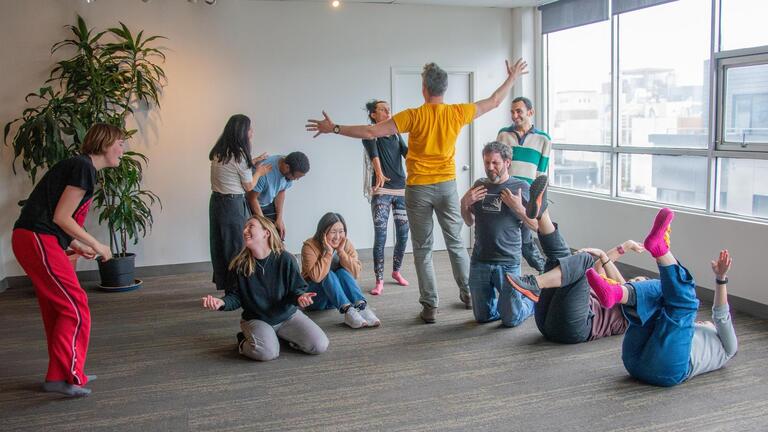
The Master of Arts in Counseling Psychology with a concentration in Drama Therapy is a primarily in-person program approved by the California Board of Behavioral Sciences. One of the first two drama therapy graduate programs recognized in the U.S., CIIS has been teaching at the intersection of theater, psychotherapy, and social healing for more than 40 years.
Drama therapy is the systematic and intentional use of drama and theater techniques to promote emotional growth and psychological integration.
The program is approved by the North American Drama Therapy Association (NADTA). Graduates are eligible to pursue credentialing as Registered Drama Therapists (RDTs) and licensure as Marriage and Family Therapists (LMFTs), with the option to complete additional coursework toward licensure as Licensed Professional Clinical Counselors (LPCCs).
Embodied and Experiential Learning
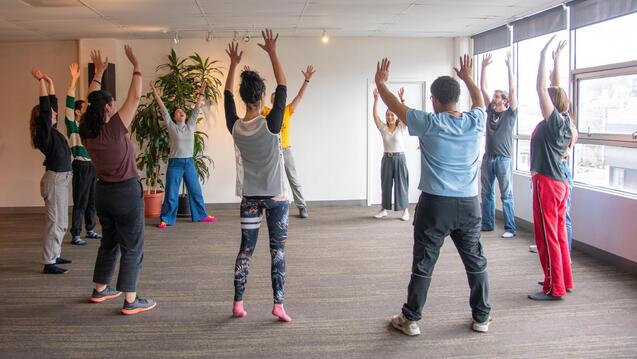
Drama therapy draws on a wide repertoire, including play, embodiment, role, story, metaphor, projective techniques, aesthetic distancing, witnessing, and improvisation. Most courses meet in person, pairing lectures with embodied, action-oriented experiential learning and hands-on practice. From the first semester, students move through the program as a cohort—a supportive learning community central to the educational experience. Through shared experiential work, students explore group process, deepen self-awareness, and practice therapeutic skills, experimenting, receiving feedback, and growing alongside peers.
Clinical Training and Creative Modalities
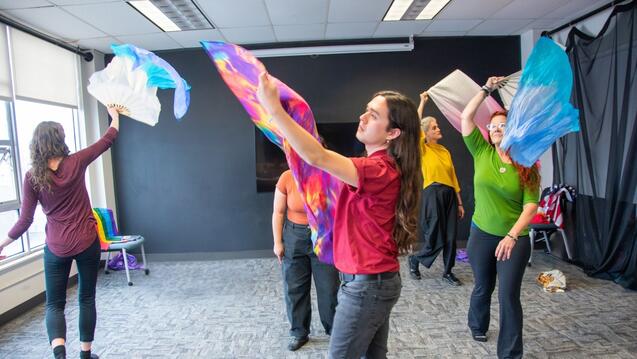
The program prepares graduates to become skilled master's-level licensed clinicians and Registered Drama Therapists. Students build a trauma-informed clinical foundation while exploring a range of drama therapy approaches, including the Integrative Five Phase Model, psychodrama, Developmental Transformations (DvT), and Drama Therapy for Social Change models. In the second or third year, students begin a supervised practicum in schools, hospitals, treatment programs, and community mental health clinics, integrating classroom learning into clinical practice.
Self-Revelatory Performance
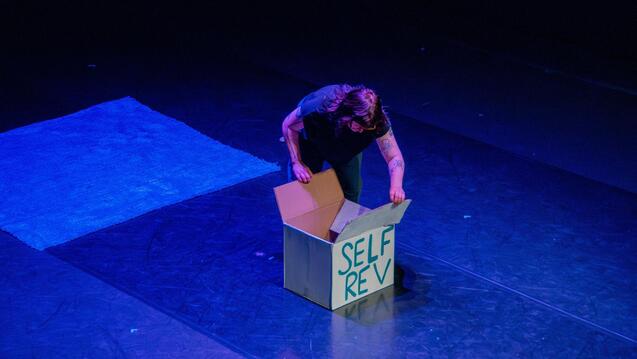
A signature capstone experience, Self-Revelatory Performance involves creating and performing an original live theatre piece based on a current personal life theme, integrating clinical and artistic identities into one act of creation, reflection, and witness. Students create a "mini Self-Rev" in their first semester; many later choose the full 45-minute performance as their culminating project. Developed over a semester with a drama therapist director and theatrical team, the piece is presented before a live audience—the student both artist and subject.
Career Paths
Our graduates are equipped to work with individuals, couples, families, groups, and communities across all age groups. Career opportunities span both clinical and nonclinical settings.
Clinical Settings:
- Community mental health centers
- Private practice
- Psychiatric facilities
- Speciality clinics (PTSD, eating disorders, substance abuse recovery, LGBTQ+ youth, domestic violence)
Nonclinical Settings:
- Schools (typically through counseling programs)
- Correctional facilities
- Corporations (consulting, training, wellness)
- Higher education (as faculty)
- Theaters and performing arts organizations
With additional coursework, graduates may also pursue licensure in California as Licensed Professional Clinical Counselors. To explore career pathways and learn more about Drama Therapy graduates, visit the Impact page.
Curriculum
Our curriculum blends clinical theory, embodied learning, and performance based exploration. Most students complete the program in three years, with some finishing in as little as two and a half.
Year One
- Foundations of drama therapy theory, process, technique, and practice, including the Integrative Five Phase Model, Psychodrama, and Developmental Transformations (DvT)
- Experiential, action-based coursework
- 45 hours of pre-practicum fieldwork
Year Two-Three
- Begin and complete clinical practicum and Case Seminar
- Continued coursework in psychological theory, clinical practice, ethics, and social justice
- Ongoing foundations of drama therapy theory, process, technique, and practice, including Drama Therapy for Social Change models, introductions or electives in Playback Theatre, Table-Top Roleplay, Advanced Integrative Five Phase Model, Advanced DvT, Role Method and Narradrama
- Pre-Integrative Seminar Proposal Writing
- Final Integrative Seminar and Capstone Project
Capstone Project Options
- Self-Revelatory Performance: Students create and perform an original theatre piece that explores a current personal life theme, using drama therapy methods
- Research or Theoretical Paper: An extended paper that investigates a topic relevant to drama therapy theory or practice.
- Therapeutic Theater Performance: A directed group theater production in a community or clinical setting that applies drama therapy methods to address therapeutic goals
- Video Documentary: A filmed presentation documenting clinical drama therapy work over time that the student has facilitated
Students are also required to complete 50 hours of personal psychotherapy with a licensed mental health professional and/or Registered Drama Therapist.
Featured Courses
- Drama Therapy Theory
An exploration of the theoretical foundations of drama therapy, as well as an examination of its major theorists, approaches, and core constructs such as play, role, ritual, improvisation, embodiment, projection, and aesthetic distance. Students study the interface of drama therapy with social justice work and other forms of psychotherapy, as well as variations of approaches used with diverse populations and their presenting challenges. - Drama Therapy Process and Technique
An experiential course demonstrating the process and progression of a drama therapy series from the establishment of a playful, creative environment to the development of in-depth personal and interpersonal work. Students experience Renee Emunah's Integrative Five Phase Model of Drama Therapy and are introduced to self-revelatory performance. - Drama Therapy and Social Change
An exploration of the transformative power of drama therapy in the social context, and of the role of the drama therapist as an agent of social change and justice. Four approaches are examined — the Acts of Reconciliation Project, Sociodrama, Theatre of the Oppressed, and World Work — with focus on how change occurs in groups, organizations, and nations.
-
Sample coursework for a two-year plan (60 units total)
Semester 1 | Fall
PDT 5602 Drama Therapy Process and Technique (3 units)
PDT 5501 Drama Therapy Theory (3 units)
PDT 5614 Advanced Improv and Playback Theatre (1 unit)
MCPD 5610 Therapeutic Communication (2 unit)
MCP 5201 Human Development and the Family (3 units)
Semester 2 | Spring
PDT 5603 Drama Therapy Practice (3 units)
MCPD 5604 Group Dynamics and Creative Arts Therapies (2 units)
MCP 6401 Research Methods (3 units)
MCP 5108 Psychopathology and Assessment (3 units)
PDT 5607 Special Methods: Developmental Transformations I (1 unit)
PDT 5628 Advanced Integrative Five Phase Model (1 unit)
Semester 3 | Summer
MCP 6502 Child Therapy (2 units)
MCP 5101 Professional Ethics & Family Law (2 units)
PDT 5626 Individual Drama Therapy (1 unit)
Semester 4 | Fall
MCPD 7602A Supervised Clinical Practicum: Case Seminar in Drama Therapy (2 units)
MCPD 5605 Family Dynamics and Therapy (3 units)
MCPD 5608 Psychotherapy Theories and Practices (2 units)
PDT 6604 Drama Therapy and Social Change (2 units)
MCP 6103 Multicultural Counseling and the Family (2 units)
MCP 6101 Human Sexuality (1 unit)
PDT 7709 Pre-Integrative Seminar Proposal Writing (1 unit)
Semester 5 | Spring
MCPD 7602B Supervised Clinical Practicum: Case Seminar in Drama Therapy (2 units)
MCPD 6605 Advanced Family & Couples Therapy: Action-Oriented Approaches (2 units)
PDT 5627 Trauma and Resilience: Embodied Approaches To Treatment (1 unit)
MCP 6102 Assessment and Treatment of Addiction Disorders (1 unit)
PDT 5605 Psychodrama (3 units)
PDT 6607 Special Methods: Advanced Developmental Transformations II (1 unit)
PDT 7710 Integrative Seminar: Final Project (3 units)
Semester 6 | Summer
MCPD 7602C Supervised Clinical Practicum: Case Seminar in Drama Therapy (2 units)
MCP 6233 Intro to Community Mental Health & the Recovery Model (2 units)

Entry Requirements
If you would like to learn more about this program, we’re here to help. Explore our program further with in-depth materials, discuss your personal and career goals at one of our open houses, or get in touch with our admissions counselors, who are ready to assist you in navigating the application process.
Required Application Materials
Your application is your opportunity to share who you are. To be considered essays and written responses must be your own authentic work.
Online Admissions Application: Begin the application process by submitting an online application and paying the nonrefundable $68 application fee.
Degree Requirement: An undergraduate degree (B.A., B.S., or BFA) from an accredited college or university.
Minimum GPA: A GPA of 3.0 or higher in previous coursework is typically required. A GPA below 3.0 does not automatically disqualify an applicant. CIIS will consider a prospective student whose GPA is between 2.5 and 3.0. These individuals are required to submit a GPA Statement and are encouraged to contact our Admissions Team to discuss their options.
Transcripts: Official transcripts from all accredited academic institutions attended where 7 or more credits have been earned. Transcripts may be sent digitally to materials@ciis.edu or mailed to CIIS in their official, sealed envelope. Transcripts from institutions outside the U.S. or Canada require a foreign credit evaluation through World Education Services (WES). CIIS will also accept foreign credential evaluations that are in a comprehensive course-by-course format from the current members of the National Association of Credential Evaluation Services (NACES).
Autobiographical Statement: A four to six-page introspective essay in which you reflect on significant childhood and adult life experiences that have impacted your personal and psychological development.
Goal Statement: A one-page statement of your professional interests, goals, or passions.
Two Letters of Recommendation: From academic advisors, professors or professional supervisors. Recommenders should use standard business format and include full contact information: name, email, phone number, and mailing address.
Background Outline: A one-page outline specifically listing your background/experience (if any) in: (1) theatre/drama (2) psychology (3) human services/counseling work, and (4) creative arts therapy. If you hold a degree in any of these areas, you can simply indicate that (for example, BFA in Theatre). For all other areas, list any courses, internships, or work experience pertinent to that category (or indicate "none").
Interview: Individual and group interviews by invitation from the program.
Candidate Selection
CIIS' Drama Therapy program attracts creative, motivated, and mature students who have already demonstrated a strong interest in the integration of theatre and therapy. Integrity, introspection, and dedication are essential attributes. Our students come to the program from around the world. Applicants must have a background in drama/theatre. A minimum of two undergraduate psychology courses, and volunteer or paid work experience in human services are strongly recommended.
Our program encourages and embraces diversity and places a high value on having students from a variety of racial and cultural backgrounds; other representations of diversity (including age range and nationality) are also important to us. We look at each applicant holistically. If you feel passionate about this field, we welcome your application.
Events and Info Sessions

Attend the Fall Open House to get to know your admissions counselors and learn more about CIIS' bachelor's, master's, and Ph.D. programs.



FAQ
-
Drama therapy is the systematic and intentional use of drama and theatre processes to promote emotional growth and psychological integration.
-
In Self-Revelatory performance, a performer crafts an original theatre piece that grapples with a current life challenge or theme, with the aim of gaining deeper understanding, wider perspective, personal healing, or some kind of transformation. The performer uses drama therapy methods in the process and within the performance piece. A majority of students choose the Self-Revelatory Performance option. Self-Revelatory Performances in our program tend to be psychologically astute, moving, aesthetic, authentic, and inspiring. They reflect students' skills in drama therapy; integration of academic and experiential learning; and the personal growth, perspective, self-awareness and multicultural awareness they acquired throughout their training in the program.
-
Theatre for Change is a project of the CIIS Drama Therapy program. The aim of the project is to educate and raise consciousness about issues pertaining to social justice; to give voice and representation to people of color and LGBTQIA+ people; to invite dialogue about oppression, privilege, in/equality, and alliance; and to encourage our audiences to fight injustice on personal, institutional, and societal levels.
Theatre for Change performance pieces grow out of improvisation; methods of drama therapy, Self-Revelatory Performance, Educational Theatre, and Theatre of the Oppressed; listening to stories within the group and at the Institute; and a lot of dialogue. Each original theatre piece is collectively developed by the troupe and director/s. Theatre for Change productions have also been performed at many North American Drama Therapy Association conferences. In 2012, the NADTA honored Theatre for Change with the Raymond Jacobs Memorial Diversity Award in recognition of outstanding dedication to diversity in the field of drama therapy.
-
The professional practice of counseling is a regulated occupation in the state of California. Coursework in the Master of Arts in Counseling Psychology program at CIIS and each of its five programs is approved by the California Board of Behavioral Sciences (BBS) to fulfill educational requirements toward the marriage and family therapist license (LMFT). Students also have the option to take additional coursework to fulfill the educational requirements of the professional clinical counselor license (LPCC). Students seeking licensure in California as an LMFT or LPCC must register with the BBS after graduation and successfully complete additional post-graduate supervised clinical associate hours and written examinations. See the BBS Statutes and Regulations PDF for additional information.
-
Our coursework and training is very similar or entirely portable to many states. However, each state has their own specific licensure requirements that include both academic coursework and clinical practicum hours that may differ from California’s requirements. Additional coursework or practicum hours may be required in other states, or the student can opt to pursue the LPCC, which is nationwide. You will have the full support of the Director of the Masters in Counseling Psychology Department, who will help you understand specific licensing requirements. We recommend too that you consult the licensing boards of the states you are interested in (outside of California) for the most up-to-date licensing information.
-
The Drama Therapy Merit Scholarships
Drama Therapy Program Merit Scholarships are awarded to several incoming drama therapy students each year. The Scholarship amounts range from $5,000-$10,000/year over 2 years ($10,000-$20,000 total). If you wish to be considered for this, please indicate that in your application to the program. [Formal applications are not required.]
Merit Scholarships are based on the following criterion:
- Outstanding preparation for the program;
- Excellence in undergraduate (and/or prior graduate) work;
- Relevant work experience or special projects; and notable promise in terms of potential future contribution to the field of drama therapy.
Applicants who, in addition to the above criteria, are re-locating from a geographical distance (which adds to their moving expenses), have strong financial need, and add to the diversity of our program, are given priority.
Candidates must have complete admissions applications by the January 15, 2026 deadline (for Fall 2026) to be considered.
Caroline Meister Scholarship Fund
We are delighted to announce this new endowment to our program.
Drama Therapy students in their 2nd or 3rd year of the program who are starting a Practicum may apply for this scholarship. One scholarship in the amount of $10,000 is awarded each year. The recipient may use these funds for any educational purpose including tuition, books, housing, etc.
Eligibility requirements: minimum 3.3 unweighted GPA or equivalent (if student has taken courses P/F) and demonstrated excellence in coursework and overall receptivity to learning.
Preference is given to students working at field practicum sites that serve clients from marginalized communities; students with demonstrated financial need; students with a demonstrated commitment to the field and who have constructively contributed to the program.

Take the Next Step
For over 50 years, CIIS has been at the forefront of education that integrates rigorous science, innovative scholarship, and social justice. You will learn from faculty at the forefront of their fields, local artists and activists, and a community of peers as passionate and dedicated as you. There’s never been a better time to be here – let’s build a healthier and more equitable world.