Jonathan Mathias Lassiter: Notes from a Frustrated Black Psychologist
In his latest book, How I Know White People Are Crazy and Other Stories, psychologist Jonathan Lassiter pulls back the curtain on the mental health system and reveals the hurdles that Black psychologists and students are forced to endure in the field.
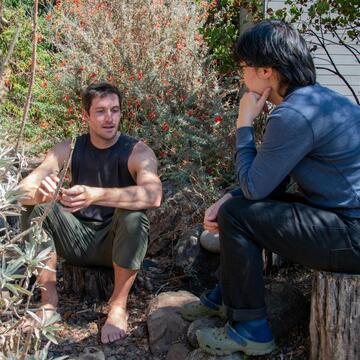
In this episode, Dr. Lassiter is joined by CIIS Expressive Arts Therapy core faculty Chevon Stewart, for a thought-provoking conversation exploring his experience as a Black gay man working as a psychologist under culturally insensitive supervisors and colleagues in America. They discuss how white ideology has harmed Black patients and how it dominates America’s mental health practices. Drawing from his research, and his own therapy, Dr. Lassiter shares the benefits we can all find when we center culture in our healing practices.
This episode was recorded during a live online event on December 4th, 2025. A transcript is available below.
You can watch a recording of this episode and many more episodes on the CIIS Public Programs YouTube Channel.
Tags:
Transcript
Click to Show/Hide
Our transcripts are generated using a combination of speech recognition software and human editors. We do our best to achieve accuracy, but they may contain errors. If it is an option for you, we strongly encourage you to listen to the podcast audio, which includes additional emotion and emphasis not conveyed through transcription.
Chevon Stewart: Hello, good evening, everyone. Welcome to our conversation this evening. We're here to talk about Dr. Lassiter's book titled, How I Know White People Are Crazy and Other Stories, Notes from a Frustrated Black Psychologist. So excited to have you here with us today and to have this discussion with you. So to get started, you know, we had a chance to meet earlier about a week or so ago. And I asked Jonathan about the... So you offered this playlist, right? And I was just so... throughout this book, you talk to... You talk through music, right? That was really, it sounds like supporting you through some of these times. So I wanted to start off with the songs that you chose. So I asked him what would be a song that you would want to use to start off our discussion together. And I'm going to ask us if we could just take a moment. You can have an internal focus if you'd like. I know it's the evening, so don't go too internal. We don't want you to go to sleep. But just have a moment to... I'm going to read some of the lyrics from Better in Tune with the Infinite by Jay Electronica. And some of you may already be familiar with the song. So you may also kind of play the song as I'm stating the lyrics. But just take in the lyrics for a moment. And... “So it's frustrating when you just can't express yourself. And it's hard trusting love to undress yourself, to stand exposed and naked, in a world full of hatred, where the sick thoughts of mankind control all the sacred. I pause, take a step back, record all the setbacks, fast forward towards the stars in a jetpack. My feet might fail me. My heart might ail me. The synagogues of Satan might accuse or jail me, strip, crown, nail me, brimstone, and hail me. They might defeat the flesh, but they can never kill me. They might can feel the music, but can never ever feel me.” So... I'm curious for you, Jonathan, as you're hearing the lyrics. I know this is a song that's very familiar to you. And I'm curious, one, just why you chose this song as your introduction. I have some inklings here, but... When you're hearing the lyrics, what is coming up for you?
Jonathan Mathias Lassiter: Yes. I do love that song. I played that song a lot on my internship. My clinical doctorate internship that I talk about, that I write about in the book. And that really speaks to this sense of pushing against what felt like an almost insurmountable force that was trying to stop me from fulfilling my mission, fulfilling what I know is my purpose in this particular lifetime. And so when Jay Electronica raps, it's frustrating when you just can't express yourself. And it's hard to trust enough to undress yourself, right? I was very much feeling that frustration. And that's one of the reasons why that's the sub uh title to the book. And then, you know, this sense of exposing yourself, I think that's something that I cultivate an environment for my clients every day, right? When I'm working with them, to feel comfortable to expose themselves. And I think that is the way that we all are able to heal and grow, is when we feel comfortable enough to expose ourselves, to expose ourselves to be seen and to be affirmed in the starkness of what is there. And so that just really resonates with me.
Chevon Stewart: Yeah, yeah, yeah. And to hear also that it was the inspiration of your title, right? The song. And I know my speaking Jay Electronica's lyrics may not do it full justice, but the words are just so, you know, are so powerful. And you can feel that level of kind of frustration. So you really cleverly, in your book, you took the Diagnostic Statistical Manual of Mental Disorders, the DSM-5, right? This text that's like, you know, the text across all mental health fields that we use and has this structure. And, you know, as we know, it is just a historical, the history of this text and kind of the harm, right? That this text has done particularly to historically marginalized groups. And you like, you flip the script on them, right? Like you had this moment of like, okay, I want to use this tool. And you give us this diagnosis of what you call the whiteness mindset in this book. And so you speak to it valuing individualism, competition and materialism. And I wanted to know if you could really break down the four categories for us here this evening of that mindset and then how you, just overall, how you define it.
Jonathan Mathias Lassiter: Yes. So that was intentional to flip the DSM on its head. And it's sort of… When I was a professor, I often talked to my students about knowing how to speak to each audience, right? And knowing how to speak to people in their language. And so I really wanted to highlight this mindset that I was seeing in my clients, I was seeing in the people around me that I saw in myself sometimes, but it had no formal name to it. And so I took what I was seeing and I formalized it into this thing that I'm calling the whiteness mindset. And it's based on, as I said, my lived experiences, also takes a lot of what's already been written by pioneering African central psychologists and scholars in the whiteness studies field to really codify in this diagnostic criteria because I really do believe that we can't heal from something if we don't know what it is, if we can't name it. And so the whiteness mindset is my way of pushing back against the sick thoughts of mankind controlling the sacred, right? And so the whiteness mindset is based on three assumptions. So a person with the whiteness mindset sees the world as limited, meaning there's not enough to go around. They see the world as fragmented, meaning it's an us versus them or divide and conquer. And third, they see the world as, from this annihilation perspective, meaning that they must kill or be killed, both literally and metaphorically. And when a person views the world in that way, then they develop a way of prioritizing the values of competition, materialism, and individualism. And if those are our values, then we develop an orientation to the world that both allows for the perpetuation of oppression as well as our silence when others are experiencing oppression. And in order to be silent and in order to perpetuate oppression, we also have to cut off parts of ourselves. We have to cut off our own emotions. And that, again, it goes back to that fragmentation piece. So that's how I'm defining the whiteness mindset. And when we look at the world around us, we see lots of evidence of that.
Chevon Stewart: Yeah, yeah. And I think, you know, you really offer us this great brain, right? That then, you know, we often talk about just wanting to have a label. First, being able to just know what that thing is, right? And I think you doing that and really kind of taking the shovel out and just like what all is encompassed within this and pulling from really African psychology, right? And these frameworks, you know, I hear you speaking to Dr. Linda James Myers, Dr. Lisa Spanierman, Dr. Kenneth Kyler, George Gordon.. Leary’s work, Dr. George Gordon Leary, and social work, Wade Nobles. The book really felt also like a good primer, a good introduction into African psychology theories and application, right? Through your lived experience, right? Like not only seeing the concepts, but really understanding the concepts at work. And so, you know, you talk about the whiteness mindset, but then you do give us this outlook on hope, right? Like, yes, this exists, but, you know, like, don't fear. Like, how do we kind of move through this? And I was wondering if you could speak to the seven Ma’atian principles, right? As that space of hope, if you could tell us a little bit more about that.
Jonathan Mathias Lassiter: Yeah. So when we think about, and I'm glad that that came through in the book, because you're right. It is my attempt at introducing African-centered psychology to a broader audience in a way that is digestible. I want to take a step back before I talk about the seven principles of ma'at, to talk about why I think that's so important to introduce African-centered psychology to a broader audience. African-centered psychology as an academic discipline has been studied and researched since the 1970s, right? We have the founding of the first ethnic psychology organization in the United States, the Association of Black Psychology in 1968. And since then, there has been a multitude of scholars and a whole field discipline of research that unless you are fortunate enough to be exposed to an African-centered psychologist like I was, you really don't get exposure to in mental health training. I used to tell my students all the time, I say, what you are studying, other people will call it psychology. Your professors will call it psychology. But it is not psychology. It is Eurocentric psychology. There are actually psychologies. However, the whiteness mindset is perpetuated in the minds and perpetuated through work of the powers that be of this Eurocentric psychology and who determines the curriculum that we all are exposed to and have to master. And that does not affirm so many of us. Those curriculums do not affirm us. African-centric psychology is just one culturally explicit psychology that attempts to do that for people of African descent. And so I really wanted to, I like that. That's why I thought it was so important to do that. Now, the seven principles of Ma'at are based in ancient Egyptian philosophy. And so those principles basically were guidelines for how to live. So real, real quickly, you know, they believe that, some Egyptians believe that when you pass away in your physical form, you would then go on to a afterlife. And in that afterlife, you would go through this heart feather ceremony and it would be the goddess of Ma'at there. And you would have to weigh your heart on a scale and it would be balanced with this feather of Ma'at. And so one of the ways to make sure that your heart was lighter than that feather was to live by these seven principles. And so that's order, balance, reciprocity, propriety, harmony, justice, and truth. And if we live like this, then we would be prepared to join the realm of the ancestors. And so I see those principles of Ma'at not only about the afterlife, but again about guidelines for how to live. And so I wanted to present those as an alternative to some of the more individualistic psychological strategies that were often taught about healing. I wanted to take it to a more value center and a more collective communal way, values that really prioritize the interpersonal and the relationships rather than just some internal process.
Chevon: Yeah, yeah, and I think the relational aspect, the communal aspect really comes through within those principles, right? And it really comes back to centering within the African psychology framework of centering the family, of the community, of this interconnectedness. So I appreciate you really sharing that piece of history because I think it's important as we're going through the next set of questions to really have this kind of understanding, both of these concepts as well as the whiteness mindset concept. So through your book, you offer us 12 chapters divided into three sections. My life ain't no crystal stair. All I want to do is be a psychologist and whiteness is a mental health problem. And I feel like you're giving this developmental kind of walkthrough of yourself as a young boy, right? And going into now you're a mid-career psychologist. And I was just wondering, was there any one moment or moments where you were just like, I need to write this as a book? I was just curious of when this moment happened for you, because you're capturing all these different moments. But yeah, I was just wondering, was there a conversation there? Was there some reflection in a room? I don’t know…
Jonathan: Yeah, no, thank you for that question. So I guess what you're asking about, at least the way I'm interpreting what you're asking about is the genesis of this book, the idea of the book. And so that really, well, one, I always knew I wanted to write a book. I grew up as a book nerd, you know, a bookworm, a huge nerd, always reading. And I have always been a student of Black American history. And so I grew up learning about scholars like W.E.B. Du Bois, right? I grew up learning about Benjamin Banneker, Fannie Lou Hamer, Lorraine Hansberry, all these people. And once I got to early college years, I was introduced to the work of Bell Hooks and Cornel West. And when I was reading their works, what I loved about it was that they had these very deep, liberatory ideas that they were communicating in a very straightforward way. And so at that point, I was like, I want to do this. I want to do this one day. Right. And so I didn't know exactly when I would do it, but I knew I wanted to do it. And I knew I wanted to do it about mental health because I felt like that was my calling because I had seen the effects for my family and myself. And once I started learning about mental health for Black communities, I was like, this is what I want to do. And so it wasn't until though I was on internship and at the Indianapolis VA, and I write about that in the book, and was experiencing just racism, right? Just experiencing racism and going through these health problems as a result of the racism, you know, stress has a very negative effect on our bodies. And I was feeling a lot of that. And however, at the same time, I was reading a book by Toni Morrison called Whiteness in a Literary Imagination. It's one of her nonfiction books. And basically in the book, she was going through and she was looking at all the images of Blackness and whiteness in early American literature. And so I said, oh, I think I want to do something like this with psychology. Because again, all the psychology and, you know, I'm a student. So I knew those theories, right? I wasn’t half slipping, half stepping on those theories. And so I was like, I wonder how Freud and Young and all these people think about Blackness, think about whiteness and culture and what does it mean? You know, what does Abraham Maslow think about these? You know, and so I wanted to start to do that. And then that took me to critiquing the curriculum that I had been exposed to, which again was a very Eurocentric, culturally narrow curriculum that was presented as universal. And I think that's my real gripe, is that if you want to do a Eurocentric psychology, cool, but make sure you are applying it to that group. Don’t then say, don’t take the eurocentric off of it and say it’s psychology and make it universal. That’s where we run into harm, that’s how harm happens. And so I'm so, so, after reading Tony Morrison's book, I wrote an essay called whiteness in the psychological imagination. And I published it on a website for a think tank. And that was sort of it. And then I went on about my graduated, went on about my postdoc. And I did an academic book, a co-edited volume, Black LGBT Health in the United States with a colleague, Dr. Lourdes Follins. And then I got into academia, became a tenure track professor and got, went down the path of peer reviewed articles, because that's the currency there. But again, this idea to do a book was always in the back of my mind. And so eventually I had got a little bit of, I felt like I had enough emotional space to say, OK, I want to revisit this book idea. And so in 2020, during the pandemic, I said, I want to I want to revisit this book idea. And I was like I want it to be on the New York Times bestselling list, right? And so that was, my goals have changed now. But at that time, I was like I want to be a New York Times bestseller. And so I said, I asked Google, how do you get your book on a New York Times bestsellers list? And Google said, well, you have to have an agent first. And so I did. I asked Google, how do you get a literary agent? And so that really started me on my path. And it was my agent. Big shout out to CeCe Lyra, who is my literary agent extraordinaire. I really, really am so grateful for her. She, it was her idea to not have it be so academic and to be more of this format of stories. She said, you know, you have such an interesting life. How about you explore these things through these stories? Like, what, what were, what were the lessons you learned? And so by thinking about the lessons that I have learned that I wanted to share with a broad audience, I thought of the stories that illustrated those. And then that whiteness mindset criteria came to me and I said, I want to explore this through stories. And it was very important to me to make sure that those stories were very much vivid. Using a lot of descriptive language to really highlight the imagery and also emotionally provocative, because as mental health providers, we know that it's when we get to the emotion that people can then start to heal and grow and change. And so I wanted to do that with the work.
Chevon: Yeah, yeah. And I think your intention comes through, right? In the book with each chapter, right? You really, I think, kind of demonstrate these parts. And so I think my next set of questions is just kind of walking us through. You're giving me a good segue to go into my next questions. Thank you. But, you know, in My Life as a Crystal Stair, you speak to, one of the things you speak to, is really early on having this diagnosis of sickle cell. Right? And really what I felt was like a juxtaposition with this... You give us this history of your father, right, growing up in the South and you growing up in Georgia. And you talk about this internalization of the whiteness mindset. And at one part, you say, “My father valued protection and strength. And I was more drawn to the world of fantasy, arts and emotions.” And I was just wondering if you could speak to this idea you mentioned of cultural misorientation and how that was, you feel like, emerging within your relationship for you and your father.
Jonathan: Yes. So, yeah, so you're right. That first part is really like the background. Again, the stories that I share are very personal for my life. And I really wanted to start at the beginning. And the beginning for me, again, very much an African-centric way of thinking is our ancestors. And so I wanted to start with my grandfather and his story and my father and how that influenced me and then move from there. And so that My Life Ain't Been No Crystal Stair, that is a line from a Lakeston Hughes poem that I grew up loving called Mother to Son. And so in that, I wanted to, in that very first chapter, you're right, I said that he valued protection. And I was much more about the internal world of emotions, arts and imagination. And it's true. I think that given the context of my father and his upbringing, again, he was born in 1955. His father born in the 1920s, I believe. And so, you know, he, that's a very different world that I was born into. I was born in 1983 in Georgia. My father's born in the 50s in Georgia, his father, decades before that in Georgia. So those are very different timeframes. And the context is so different. And so my father was born into a world of blatant racial violence and pain. And he and his father really had no recourse. There was no hope for justice. At least, I mean, we still have a lot of racial violence and things like that. However, at least we still have a hope for justice. There's some sort of formalized process that we may get some justice. You know, of course, people still being acquitted of stuff, but you know, that's another story. But but that wasn't even the case for him. Right. And so in order to protect himself and his family, he said, OK, you got to be bulletproof. You have to be impenetrable. You can't ever lose your top and you can't ever show weakness. And that was his thing. And I relate that to cultural misorientation because that is one of… The upsetting thing about the whiteness mindset is that it really strips people of their humanity and calls that inhumaneness desirable. And what I mean by that is that my father thought that not having emotions was a desirable thing. He thought it was a strength. And that's not true at all. And from an African center point of view, we actually know that there have been several African communities, I'm thinking about the Dagara tribe right now, that really looked at gender and the role of men in this case as much more fluid, much more vulnerable and strength was more holistic than just no emotion. In fact, strength was being able to show up as one self authentically in all of our emotions. And so that's the cultural misorientation. My father and so many generations of people of African descent, the descendants of those enslaved Africans, lost their connection to their original culture and was misoriented towards this Eurocentric ideas of what masculinity were.
Chevon: Yeah, yeah. And I hear you as you're speaking, really speaking to like the sense of vulnerability, you know, being able to be vulnerable, show yourself being transparent in what's happening in the process as strength. Right.
Jonathan: Yes!
Chevon: So, yeah, yeah. So there's another moment where you speak to the whiteness mindset within the Black church setting and who God wants me to be, right? And at one point, you said, I think I was just struck by these two statements. “We went to black churches to rinse the residue of whiteness off of us each week. This cleansing was somatic, rhythmic and melodic.” And I think I was curious, like, as you're talking about this from, you know, Black Southern church and I imagine then this is like mid 80s, 90s, you know, like, I was curious now, just where do you feel like these spaces exist for us today? Where do you see that within our contemporary? I don't know if contemporary, but just today in our world, like these spaces of, because, yeah, it just brought that thought to my mind.
Jonathan: Yeah, no, thank you for that question. And I feel like those places are few and far between now. I feel like they have been systematically stripped away from us. You know, people are still going to church. It's not at the numbers it used to be. And church has also been, has become more of a tool to capitalism than it has been in the past. And so that's also, turns a lot of people off from church and other religious organizations. And I think for the for, for black communities, for some folks who weren't in church, nightclubs and things like that used to be that communal space. However, now it's hard to find a space for black and brown and melanated people to congregate, right? And so it's really hard to have those, those, those spaces anymore. And so I really don't know of communal spaces. I mean, besides maybe online, but in person communal spaces, I think those are few and far between. I think that is a that, that's, that's, that, that equates to a lack of resources for us as a community. I was having a conversation not too long ago, and someone was asking, Are we our ancestors, you know, that's a common popular saying among some black folks like we're our ancestors. And I said, I don't think we have the same tools and resources our ancestors had. And one of those being these spaces to congregate and to be in our bodies, to be in the music, to be expressive and to really let go, in a safe space, in a communal safe space. And I think that's a real detriment to us.
Chevon: Yeah. Yeah. And I think just in hearing you say that it's bringing… So, I'm a fan of Janet Jackson. And I saw in the book that you mentioned at one point, doing choreography like you were doing choreography to Janet Jackson and there are these little moments where you talk about dance, right, and music and, and I was just wondering about, you know, when you're talking about this, being able to really express yourself and having these spaces. I was wondering about the role of the arts for you during this, during this time, right? And what art practices you were using, if you can, if, if you held on to those practices or have they shifted over time.
Jonathan: Yeah, so again, this goes back to our roots right as people of African descent. As people of African descent, there really is no separation between mind, body, and spirit. Right, all of these things were the same. We embody our health in our rhythmic foot tapping, in our dance. We invoke the spirits through our voice, we healed each other through the vibration of our humming. So none of these things were sort of like performative. And they were not uncommon. And so for me, without even knowing it, right, those expressive ways of being have always been important to me. I grew up as a child listening to, you know, 80s and 90s, RnB and pop music and things like that, right, so I've always been, had a, had a affinity for the music that was expressive and people that can sang, not sing. There's a difference, right?
Chevon: Yeah.
Jonathan: And, and I've always loved to dance and when I went to high school, I started to train formally in modern dance and jazz dance and African dance and, and hip hop. And so you’re right, I eventually started teaching dance as well and yeah that J Janet has always been one of my favorites, I remember when I auditioned for my fine arts high school, I auditioned with the pleasure principal dance. So yeah… But, but, but these things are again, are not just for the stage. They are, they are tools of being, they are tools of connection. They are tools of healing, and I think, unfortunately we moved away from that.
Chevon: Yeah, yeah. And, and, and… I think there's a part of me, as I'm hearing, right, this, these are all, these are all things that are very much embedded, right? Within our culture and, and over time we've, and really in this kind of Eurocentric Western mindset they get separated out. I was wondering about how you use the arts to support you in navigating the whiteness mindset, right? Because I hear it, I feel like I hear it in your book when you, there are these moments of, of talking about dancing out some of the stress that you are feeling. And so, I don't know if there are any other moments that you care to share how you use the arts?
Jonathan: And yeah so again for, for my own personal well being, I use it all the time, right? I'm dancing in my kitchen, I am singing in the shower, all of these things, right? In my, in my professional practice that comes out through a very intentional focus on the body. One of the first things I asked my clients in each and every session is, where am I finding you emotionally right now? And what I mean by that is not just a verbal label, but I break it down for my clients, I say, I want to know what you're feeling in your body, what are the bodily sensations. I want to know what thoughts you're having, and I want to know that emotional label. I want to know all, all of those. And again, sometimes clients don't have a label. And this even becomes even more important then, to go into the body. Okay, so then tell me what you're feeling about. Well, and sometimes people because of our capitalist society that it so much focuses on the external. Sometimes people don't know how to get in touch with their body. So I find myself doing body scans, or doing imagery work, right, with my clients to help them really get into this embodied space that roots them into a process to open up the pathways for healing. And so that's the way that I, that it comes out and I try to use it intentionally in my current clinical work. There is an on the horizon I see a much more, an expansion of that work to include more rhythmic use of dance in a traditional way that I use it at home. A few years ago I had the opportunity to co-facilitate a workshop with one of my college friends who is now a mental health colleague. And we did a whole workshop where all we did was put on music. And I asked people to just move and dance. So however they want to move and dance. And then we processed. Okay, what was, what was that? What did you get from that? What's happening for you right now? Is there anything you want to share? Maybe there's nothing you want to share, right? And then we would go to the next song, and I just say, just let the song minister to you. Let it, let it, let it dictate what your body does. And at the end of that workshop, people were speechless, because they knew that they had had a real healing experience, but it was something like they had never experienced before. And it was something that was hard to describe is that, I know something happened. I don't know quite what it is.
Chevon: Yeah, yeah.
Jonathan: And I think that's what true healing really is. I think, you know, in Western society we're hyper verbal. But we don't always need all of that.
Chevon: Yeah, yeah, yeah, thank you for sharing, right, your professional practice and how that comes out within your work. I really, as I was hearing you speak I was like, sounds like expressive arts therapy, sounds like DMT, welcome. Welcome to this side of the world. But that, you know, that experience, and I wanted to just take a moment to come back to… You offer us like several moments of really also seeing how the whiteness mindset comes up within your postdoctoral work coming into San Francisco and really entering into the LGBTQ community there. And, and also, you know, this kind of intersection of what it means to be a black gay male living in San Francisco, as well as interacting with different racial and ethnic identities, right? Specifically highlight interacting with the Asian community and kind of talking about… I think what I was hearing as… Well actually I think you said it best so let me not paraphrase but “Whiteness mindset can be internalized and perpetuated by anyone, regardless of their racial or ethnic identity or appearance. This mindset has convinced some people of the global majority to scapegoat other marginalized groups from the global majority as the cause of, to their disadvantage.” Yeah, so I'm just wondering, I guess the question is there, can you talk more about how the whiteness mindset was impacting you at that time?
Jonathan: Yeah, so I'm going to take you back and take you back to 2008. And I'm moving from New York, I had been in New York the year prior. Doing AmeriCorps volunteers and service to America. And I was doing health education at a hospital up in the Bronx and during that time I applied to graduate school I got in and so I was going out to San Francisco to attend the California School of Professional Psychology. And I'm so excited. And my dream is coming true. I'm going to get to be a psychologist right and this is the first step. So I'm so excited. But first, I have to find a place to stay. And so I’m staying with a friend of mine, a college friend of mine, and he had moved there the year prior to do an MFA program at University of San Francisco. And so I'm staying with him. While I look for, for housing. And I go to my first appointment. Well, back up with just a little bit. So before I was using Craigslist to find housing. And so I'm calling people. Hi, I'm a doctoral student. I'm looking for housing. Here's my budget, I see that, you know, this is what you're charging. I would love to come by see the room. Oh, you're going to be studying, what are you studying? I'm studying psychology. Oh, that's so great. Come on by, come on by. And if you like it maybe you can move in tomorrow you know all of these very encouraging, very encouraging. So, I get on the Muni. And I go out, and I get to my first viewing appointment. And I'm ringing the doorbell. And there's no response. So, I'm looking at my map quest directions because 2008 so it's a map quest I printed them out. I'm looking at my map quest around like, this is, yeah, this is the address. And I ringed again. And someone peers out and they say, What do you want? And I said, Oh, I'm, I'm Jonathan I called and talked on the phone. I'm here to see the room. Room, no rooms available! Slam the door in my face. I know. Again, I'm looking at map quest address and look at it. So I don't think anything about it, just think it is a weird fluke. So then I go to the next place. Hey, I'm Jonathan. Oh, you're Jonathan. Yeah, I'm Jonathan we talked on the phone. Oh, the rooms, the rooms been rented. Okay, wow. Things happen fast out here I guess it’s San Francisco. I go to my third appointment. Oh, you're Jonathan. And at that point is when it clicks and I said, Oh, this is, this is anti blackness. They knew a person named Jonathan was coming. They did not expect that person to be black. And it really hurt me because everything I have been told about San Francisco is it’s so liberal. Everyone's welcome. And not only was I being discriminated against, I was being discriminated against by people from Asian communities. And I don't want to overgeneralize. But these people who I was going to rent a room from, they all happen to be Asian. And so I was being discriminated against by people from the Asian communities who in my mind, again, you know that term POC, right? We’re people of color, we all experience racism, right? We should be allies. No. And so what that taught me was that there's a pecking order. And to some of the people from the global majority I use that term intentionally because globally speaking, melanated people are the majority. People from the global majority look down on other members and oftentimes it is black people as people of African descent, who are at the bottom of that hierarchy. And it really really hurts. But I’m being…, again, that goes back to the whiteness mindset that tells these people, there's not enough to go around. So if you want access to these resources, be like us. And that us is the white, white people, right? Don't be like them. However though, being like those white people, one you're never going to be like that, right, they're never actually going to accept you. But that's taking you further away from your culture, rather than if you embrace your culture and embrace community with people who actually share more of your interest. And it's interesting because as a professor I've had several students of a lot of different backgrounds from people of the global majority, whether that's from Pakistan, Vietnam, Chinese, etc. And they have told me openly, Yeah, in my country, black people, they're thought of as lazy, not valuing education. I had one of my doctoral students share with me, and I was glad she shared it with me, I wasn't offensive, but she said, she was a Pakistani woman, and she said, my mother was concerned about me studying with you. I have a PhD and I'm well published. Why is your mother...
Chevon: Right, yeah, yeah.
Jonathan: You're studying with me. Right? So it's that internalized whiteness mindset that it's phenotypically promiscuous to borrow a term from Cornel West. Anyone can be infected by that mindset and perpetuate it. And it's a shame. It's a shame because again, that's that divide and conquer. And it leaves us all oppressed.
Chevon: Yeah, and it's really, as you said, that scarcity mindset, right? And so I think I share with you, I had a very similar experience when I was out there and I was like, oh, this is, you know, this feels pervasive, right? And so I have, you know, we have just a few more moments. I have, I think, two more questions that we can get to. And one is, you know, you made reference to this earlier about your internship and being out in Indianapolis and really, you know, having this moment of one, where you didn't get the internship right away, right? And then you got the internship and then you just had this moment of being asked to do this diversity project. And then you were asked to redo the project. And you speak really to the impact that had on your physical and mental health and stress in it. I just was curious if you could maybe speak to this for about, you know, I feel like this is something that many students from the global majority experience. And what were ways for you of, you know, we know that you've made it, right? You have, but, you know, through that, like, what were you doing to really support your physical? Like, what were the supports that you had? What were the supports you wish you had? Like, that level of stress is something that's very common, I feel like, for many students, so…
Jonathan: Yeah, one of the things that I've been so grateful for, I earlier talked about originally hoping to be a New York Times bestseller. And don't get me wrong, I still welcome that. However, my focus has really shifted to the book reaching the audience, that it will benefit, that it will touch. And in that regard, I've already had so much success because I have so many people emailing me, DMing me, saying, I feel seen. Oh my God, thank you for writing this. Someone said it is intoxicating in its honesty. Right? Because this is, as you said, the experience of so many people from the global majority, and especially Black people, right, who are trying to get an education. And isn't that a shame? We're just trying to get an education. We're not. We're not doing anything else.
Chevon: Yeah, right.
Jonathan: We're just trying to get an education. So, so, yes, so I really did not have any supports for my mental health and well-being, while experiencing so many overt and covert racist attacks on me while I was there. It was one, it was environmentally racist because it was just out of probably a department of 20 psychologists, there was one Black woman. And I think she was the only melaninated person there. And in my cohort of three of us, it was a small cohort, there's two white women and then myself. So I'm already isolated just environmentally and really the only sort of source of connection of community that I had was with people who worked in the cafeteria, janitors, you know, and they would, and nurses, and they would always be so happy to see me coming. And they'd be like, oh, hey, how you doing today, Jonathan? Yes, Jonathan, Jonathan, you know, Jonathan's in the, in the doctoral program. You know, they were so happy and proud of me. And, and I think maybe, maybe that was something that helped me hold on. But outside of that, no, I, I think my response was to just what my father wanted me to do, pop it up and push through. And I think that's because that's what I, that's what I felt that was the only option I had, because I did not feel that they really cared about me, even though they were saying it out of their mouths, but none of their actions said it. And I wish that I would have had at least one other person from the global majority who could have been an ally, who could have went to bat for me. That's one of the things that when I was a professor on the doctoral program, I was adamant about go, I was ready to go to war. I think Vince Staples has a song called War Ready. I was war ready. I was like, you not messing with none of my students. It's not happening.
Chevon: Yeah, yup.
Jonathan: Like you could fire me, but we going down fighting. And I wish I had had that. I wish I had had someone to say, y'all need to change this training curriculum. This is to Eurocentric. Who is this supposed to serve?
Chevon: Yeah.
Jonathan: But I didn't have that. And I suffered, I was in and out of the hospital already have sickle cell anemia and stress is horrible for sickle cell anemia because it makes you more susceptible to pain, excruciating pain. So I was in and out of the hospital going to see my doctor that year. And I was having panic attacks and didn't even know it. It was a really hard year.
Chevon: Yeah, yeah, yeah. But, you know, I'm hearing that through it, right? That you kind of you, you, what you've learned from that is who you want to embody. Right? And being a mentor and support to students. And I imagine perhaps also for, for clients if they're coming, you know, coming in with these similar experiences and, and finding the strength, right? And in that way, when we're talking about really our ancestors and gathering and being vulnerable and sharing that and yeah, I guess as we're we're looking at shifting and closing out. I'm just thinking back to kind of what we talked through today. And as I'm reflecting on this book, you really are embodying the strength, right? As you're sharing these stories, that vulnerability really comes through in a way that, as you're speaking, that many people can relate to who are going through training in psychology, in expressive therapies, in counseling, you know, like just being of the global majority and and having frameworks that may not represent who they are, who their clients are, right? So you, when I, going back to this song, we were talking about how you wanted to end, what song you wanted to close out with. And I know I'm not going to do Lupe Fiasco justice. I have the lyrics here. I have the lyrics here. I'm going to read it. But, you know, I do encourage you all to, if you don't know this song, The Show Goes On, you know, to YouTube this out, to then listen to it so that you have a fuller sense of how he is embodying this song. But Lupe says in one part of the song, “So no matter what you've been through, no matter what you into, no matter what you see when you look outside your window. Brown grass or green grass picket fence or barbed wire never ever put them down. You just lift your arms up higher. Raise until your arms are tired. Let them know you are here, that you're struggling, surviving, that you're going to persevere. Yeah, ain't nobody leaving. Nobody's going home. Even if they turn the lights out, the show is going on.” And when you hear that, I mean, I think you need to hear it with all the instruments and all the liveliness of the music video. But when you hear that, the same question, what comes up for you and why you wanted us to close with this thing?
Jonathan: Because that's our story. That's our story as people from the global majority. That's our story of people who have been harmed by the whiteness mindset. That's the story of people who, in some ways, are even benefiting from the whiteness mindset, they too are also being harmed by it as they benefit from it. The path of growth and healing, which is as healers, we have accepted as our journey. It is a journey of getting up and trying again. It is a journey of being hurt and using that pain to push us forward. It is a journey of persevering. That's why I love that song so much, because it really, really speaks to that journey. And in that journey is triumph. Every time we take a step forward, we are winning. And I love that for us.
Chevon: Yeah, yeah, yeah, yeah. Let’s take that in for a moment. I want to just thank you for, again, your vulnerability and sharing these stories with us, and for your time with us this evening. And, and we will, we will close out. Thank you all for attending this discussion. And we, we hope to get your sales up so that you can continue to move forward with your work.
Jonathan: Thank you. Thank you so much.
Thank you for listening to the CIIS Public Programs Podcast. Our talks and conversations are presented live in San Francisco, California. We recognize that our university’s building in San Francisco occupies traditional, unceded Ramaytush Ohlone lands. If you are interested in learning more about native lands, languages, and territories, the website native-land.ca is a helpful resource for you to learn about and acknowledge the Indigenous land where you live.
Podcast production is supervised by Kirstin Van Cleef and hosted by Alex Elliott at CIIS. Audio production is supervised by Lyle Barrere at Desired Effect. CIIS Public Programs are produced by the Office of Events at California Institute of Integral Studies. If you liked what you heard, please subscribe wherever you find podcasts and connect with us on social media @ciispubprograms.
CIIS Public Programs commits to use our in-person and online platforms to uplift the stories and teachings of Black, Indigenous, and other people of color; those in the LGBTQIA+ community; and all those whose lives emerge from the intersections of multiple identities.