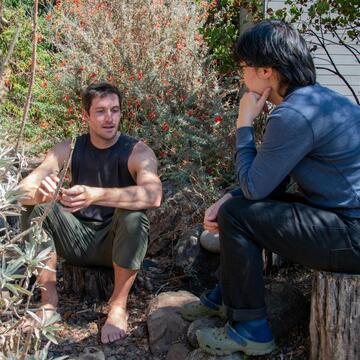
Rowen White: On Indigenous Seedkeeping and Food Sovereignty
Seedkeeper, author, mentor, and founder of Sierra Seeds, Rowen White is a passionate activist for Indigenous seed and food sovereignty. With the increasing industrialization of our food and the erosion of biodiversity within cultural contexts, Rowen works to guide and mentor mindful eaters and food/seed sovereignty leaders in their capacity to lead, vision, and nourish a deep-rooted transformation. For Rowen and many others, cultivating a culture of belonging needs to be at the heart of food systems change—inviting a diversity of perspectives and voices, cosmologies and values.
In this episode, Rowen is joined by CIIS Associate Professor of Anthropology and Social Change Michelle Glowa for an inspiring conversation exploring Indigenous seedkeeping and food sovereignty.
This episode was recorded during an in-person and live streamed event at California Institute of Integral Studies on November 19th, 2025. A transcript is available below.
You can watch a recording of this episode and many more episodes on the CIIS Public Programs YouTube Channel.
Tags:
Transcript
Click to Show/Hide
Our transcripts are generated using a combination of speech recognition software and human editors. We do our best to achieve accuracy, but they may contain errors. If it is an option for you, we strongly encourage you to listen to the podcast audio, which includes additional emotion and emphasis not conveyed through transcription.
Michelle Glowa: Well, thank you so much Rowen for joining us here tonight and joining us in this conversation. I'm so grateful and excited for the time that we have here tonight and that we're going to get into exploring your work and your thoughts on indigenous food sovereignty and the efforts to cultivate change in contemporary relationships to food systems and relationships to plant relatives. Before we dive into some of your work that you've done and work that you've done with many others, the collective efforts that you've engaged in, I'd like to ask about your background and how you came to this work.
Rowen White: Yeah, absolutely. So, for those of you who don't know about my background, I come from a very small community called Akwesasne, which is right on the New York-Canadian border. I was actually just talking to Michelle about how we have a very complex political landscape, which is that we have an international border that runs right through our community. So half of our community is in so-called Canada, in the provinces of Quebec and Ontario, and then half of our community is in so-called New York State. So that's where my people are from. I'm Snipe Clan. I come from a long, long line of people who have stewarded the earth and made good connection to our traditional ways that are heavily steeped in reciprocity and relationality with the earth. But I grew up at a time where there was, again, a lot of cultural upheaval. My grandparents were the last in my family lineage to live and grow up on a farm. It was their generation that was taken away to residential schools as a part of, sort of the assimilation tactics in the last hundred or so years. My grandparents were the last in our family lineage to speak Mohawk as a first language. So our language is called Kanienʼkéha. It's a beautiful, sort of earth-based grammar of animacy language. And so there was this severing of not only our language, but our culture and that sort of tradition of land stewardship that happened at my grandparents' level. And so in some ways, it's interesting. I'm sure many of you who are here in the audience also have legacies of diaspora in your lineages. And we also have diasporas as Indigenous peoples here whose homelands are on Turtle Island but still live in a diasporic way because of the impacts of colonization over the last several hundred years. So when I came of age, I always, you know when I was younger, I always wanted to sort of get my hands in the earth. I was always asking my mom to plant pumpkins in the backyard or I would do this thing where I would get into the pantry and crack open this big vessel of cornmeal and sort of immerse myself and get it all over myself. And my relatives were always saying, oh, like that's a throwback to your great grandma, Anna Jacobs, who used to grow these amazing gardens or my great grandma, Rena, who was known in our community for feeding and nourishing us. And so in some ways, again, these seeds of memory, these seeds of knowledge, they sort of get tucked into our genetic memory, our blood memory. And so that was something that as a young girl, I was always wanting to, to plant gardens, even though we didn't live on a farm at that moment in time. And so I ended up, at 17, I ended up leaving home and ended up on an organic farm in western Massachusetts where I was sort of taken under the wing of several amazing organic farmers and began to sort of open up this doorway or this pathway to, you know… Now nearly three decades, I've worked with seed keeping and indigenous seed sovereignty. I ended up on this farm where we were… There was a previous student that had worked on this farm that got really into heirloom tomatoes and the, the bio cultural diversity that exists in, in tomatoes. And so there was this garden where there were 50 different types of heirloom tomato seeds that were being grown in this patch. And as a 17 year old girl, you know, I knew nothing about this. Like I knew tomatoes came in round and red or maybe in a can, you know. And so I ended up apprenticing in that garden and, and learning like paging through all of these seed catalogs and seed packets and reading the names and the families and all of the, the stories that were held with these seeds, the cultural memory that was held with these seeds. And it was then and there like reading these stories of tomatoes that had come from Mesoamerica and had crossed the Atlantic several hundred years ago and had taken root in villages in Spain and Italy in a way that I think we can't even really imagine Italian food without tomatoes now. But tomatoes have only been in Italy for a couple hundred years, right? It's actually an indigenous food to Central and South America. And then reading about these histories of the same tomatoes a couple hundred years later, traversing back across the Atlantic Ocean in the pockets and vast coats of immigrants coming from Italy and Spain over to the New World, you know, throughout places like Ellis Island and those people wanting to carry with them the taste of home, right, like the taste of the cooking pots of home of bringing those seeds as a way in their own sort of migration patterns and their own diaspora to have a little flavor of home. So that was, the tomatoes were my first teachers. They were my first like kind of seed aunties or seed grandmas and ended up, like I can still so palpably remember being on this New England dusty farmhouse floor paging through all those different tomato varieties and beginning to think, What were the foods and seeds that fed my ancestors, right? Like what were the, you know… Because we had stories growing up in the long house and growing up in our cultural spaces of the three sisters and of grandma moon and our creation story and all of these, you know, ways in which these foods came to us, but I didn't, I knew them in concept, but I didn't know them intimately. Right? Like I didn't have this intimate connection with them, even though just a, you know, a short reach to my great grandparents generation. They still had that, they still had that relationality to those seed varieties. And so I remember asking myself that question. You know, What were the foods and seeds that fed my ancestors? And little did I know that opening up that doorway of inquiry would again take me on a 30 year pathway of, you know, I immediately went home to my home community in upstate New York and southern Canada and began to ask elders and who some of whom are now ancestors about, you know, what were the seeds and foods that our people, you know, raised and what are the heirlooms of our of our community? And I ended up finding this old... It's like probably, like the 11th floor of the UMass library. I ended up finding this old book that was called Iroquois foods and food preparation, which was written around the turn of the century in like 1906 by this white man named F.W. Waugh. And he was a part of what we call salvage anthropology, which was a time and place where they literally thought that we as native people were going extinct. And so they were rapidly documenting our cultural traditions and our histories and our cultural ways. And so he sat with the women in my community and documented recipes and seeds and food traditions. And in the back of this book, there were some photographs of some of the seeds that he had encountered in 1906 and in a more recent public sort of publishing of that particular book, they had kind of done some coloration of those photos. And so I photocopied those two pages from that book or maybe it was four pages and it became sort of a scavenger hunt for me. I ended up taking those pictures and sitting at kitchen, you know, kitchen tables, sipping coffee, eating good food and putting those in front of elders. And pretty soon there would be these little mason jars or coffee cans or baby food jars coming out. And, oh, you know, we know this one or so and so has this red corn or this blue corn or this multicolored corn and recipes and cultural memory and ceremonial significance of these seeds started to sort of come out. And pretty soon as, you know, 18, 19 year old woman, I began to have this bundle of ancestral seeds that were returning home to me. And so in some ways I was taking them into my bundle and finding my way home through food and seed, finding all of these, this cultural rematriation, this reconnection to these ways that my great grandmother knew and beyond, but that hadn't been given down to me by my mother, right? And so as I took those back to the fields where I was growing in Western Massachusetts, they took me through a very unconventional rites of passage. That's why I always say they were like my aunties and my grandmas helping to grow me from a young woman into a mother eventually. And they were like, I always say, I thought that I was growing them, but they were growing me, like those seeds were growing me into my understanding of what it means to be Mohawk, what it means to be an Indigenous woman, what it means to be a good relative. They taught me so many things, they taught me how to be a mom, you know, and how to care for things in a good way. And so I'm forever indebted to the generosity and the reverent curiosity that they inspired at a young age, you know, coming of age at a time where, you know, there was a lot of disconnection. There was a lot of mental and physical health issues in our community. And when those seeds started to come back to me, there was, you know, again, this was in the late, in the late 1900s, let's say. I'm dating myself. But there was not a lot of young people, these elders who were pulling these seeds out, who had kept them alive against all odds. There were not a lot of young people like myself coming home and asking about them, right? And what we can recognize is that in one generation, those seeds can disappear, right? Those beautiful seeds, the memory that goes along with them, all of that. And so they were so thrilled and excited that somebody like myself was young, was interested, was that next generation stepping up to keep those seeds alive. And just in the last 30 years of being on the seed path of learning and apprenticing with those seeds and learning from them and them guiding my way, this whole food, Indigenous food sovereignty movement really has flourished and grown and taken root. And now we're seeing young people and old people alike recognizing the importance of our communities, reclaiming our relationship to food in a good way and land in a good way. So I feel so blessed. I could have never imagined that one summer on the farm, you know, apprenticing with seeds and foods would have turned into this multi-decade adventure that I still feel like I'm a student of those seeds and of those foods and still really take good care of those ancestral seeds. But the incredible part is that, you know, from that, I'm a mother, so I have an 18-year-old and a 20-year-old, and they were raised entirely on a seed farm. So they never had to ask the question, who were the foods and seeds that fed my ancestors, because those seeds were on their table every day, right? Like those foods and seeds were sort of steeped into their childhood, right? And so what we can recognize is that in just one generation, we can repair and remitrate these traditions. And so in some ways that can offer us a little bit of hope, you know, because each one of you has a story just like mine inside of you, those seeds of your ancestors that are longing to reconnect to you and longing to hear your voice and longing to know you and to be stewarded by you. You all descend from people who have incredibly storied traditions of food and seed. And so, yeah, there's a lot of hope in that restoration. So, yeah, that's a little bit of my background.
Michelle Glowa: Thank you. Thank you for sharing some of your path to how you've come to this work today and your relationship to the tomato and how that really opened the doors in some ways and the generosity of that plant. And then these ancestral foods that now you've carried with you into your work today. And I'm curious if you could talk to us a little bit about Sierra Seeds and the work you do there and maybe how it relates to those original seeds that you were receiving at the dinner table or the kitchen table.
Rowen White: Absolutely. Absolutely. Yeah. So, you know, Sierra Seeds really grew out of, it grew out of a number of different conversations. I mean, the origin story of Sierra Seeds is that it started at a seed swap, right? And so when I was on maternity leave with, my daughter was just a babe in arms, I was, you know, learning how to be a new mother. These things are not easy. You know, there's a lot of growing edges. There's a lot of emotional ups and downs. And I remember feeling like prior to that, I'd been managing a big CSA farm. I drove a tractor until I was like, giantly pregnant, just had a very agrarian pregnancy and was teaching as an adjunct professor at Hampshire College, teaching about indigenous food systems and seed sovereignty. And so, you know, there was this quiet shift in early motherhood that I think I struggled with. Like I struggled with sort of the isolation of being a mother in this culture and in this society. And so, you know, when my daughter was just young, I started to say, you know, I'm ready to be back out in the world, you know, back farming and having my hands in the earth and with the community. And so I started hosting these annual seed swaps and bringing people together of all different backgrounds to share and trade and swap seeds. And this idea of Sierra Seeds sort of emerged. So we were on the West Coast. We had moved out here while I was on maternity leave. My husband does work in forestry out here. And so, again, a long way from home, you know, sort of how do I reconnect in meaningful ways? And again, the seeds sort of extended their generosity and their hand to say, well, like, go find the seed people, go find the people who you want to connect with. And so we steward 10 acres on our farm, but we are adjacent to several hundred other acres of forest and wildlands. And so we ended up hosting a seed swap, having some beautiful conversations about... Essentially, you know, the conversations were around trying to understand what seed sovereignty and seed resiliency means inside of the local food movement, right? So in the early 2000s, you know, there was a burgeoning local food movement. I mean, there still is, but that was like kind of the, the word that everybody's using local food systems, you know, durable local food systems. But nobody was talking about seeds at that time. Like, what role does seeds play in a durable, regenerative and local food system? And so that was something that I was bringing to the conversation in our watershed and in our seed shed was thinking about... We can focus on local food, but if we don't understand what seed resiliency looks like in our community, like where the seeds coming that feed and nourish our communities. And that our farmers use to plant the local food, then we're missing a huge chunk. And part of that is that when we work with bio regionally adapted seeds that adapt to a very specific microclimate and ecological conditions, they're, they're better suited and, you know, require a lot less inputs, require a lot less, you know, water and all of these things in our in our food systems. So we were having these conversations about that. So we founded, originally had founded Sierra Seeds as a cooperative. So as a seed cooperative, where many people in our community were re-engaging and re-integrating seed stewardship back into their farms and, and then sharing those seeds outward in our community, amongst farmers and gardeners. Originally, we had designed it so that there would be, we did big seed giveaways and seed distribution. But what we recognized was that there was a need for building seed literacy in our community and really deeply engaging in the mentorship aspect of the work. So it was less about, you know, something that's interesting that I think not a lot of people realize is that the idea of a seed company, like, you know, the idea of that you would plant a garden and before you plant that garden, you'd get online and click onto Johnny's or High Mowing or any of these online seed companies and add to cart and get a seed order. That concept of a seed company is less than 200 years old. And humans have been engaging in an agroecological dance for over 10,000 years. You know, humans have been co-evolving with plants in this domesticated way. So if you can imagine that timeline of 10,000 plus years of people, you know, being, I think, being domesticated by plants, right? Like humans are actually being domesticated by plants. It's not really the other way around. And, and I've been saving seed and sharing seed and what, in an act of what I call grandma science, like all of our grandmas did that. We knew how to save seed. It wasn't something you needed a PhD for. It wasn't a specialized science. It wasn't something that was removed from the farm. So you have all of this millennia of, of that happening. And then in just a short blink of an eye, that relationship gets severed, commodified, you know, moved into a capitalist system where now farmers, if you go to any farmers market, you know, locally, regionally, nationally, most every farmer that you talk to really doesn't save any seeds on their farm at all, right? It's, it's been in a blink of an eye. And so there was this conversation about how can we slowly begin to reintroduce and reintegrate seed stewardship back into our farms and gardens in a good way? And what role could an entity like Sierra Seeds as an indigenous seed bank, as a mentorship rooted organization play in, in rehydrating that in those farm and garden landscapes and, and demystify it? And so our mantra has been, It's not just enough to grow good seed, but we need to grow good seed stewards, right? Because this work is intergenerational. Like the bundle, like let's just go back to the bundle of seeds that I have and carry in our seed bank, the ancestral ones and many other seeds that I've gathered over the years that I've been doing this. But those seeds will outlive me. You know, if we do it right, those seeds will outlive me as a human. And so it's my responsibility as a seed keeper to raise up, whether it's through my kids or through mentees and students that I work with. It's my responsibility to raise that next generation of seed stewards so those seeds can live on into the future.
Michelle Glowa: Yeah.
Rowen: So that was the vision of Sierra Seeds. It was to just create a learning space. We do immersions like, you know, week long seed keeping immersions where people just get their hands in the dirt and get to learn it all. We do online cohorts and learning spaces. There's a lot of different ways in which we can engage it. But it's just so beautiful to witness. I, people come onto the farm and they get their hands in the dirt or they are shelling corn or threshing, you know, amaranth seeds or doing all this. And it just, again, rehydration is sort of the word I always use because it just rehydrates something old and ancestral and deep in every single person who gets their hands on the seeds. And it's so beautiful. It's so healing. It's so incredible to witness the transformative power of seeds when people get them back in their hands. And I was just at Cabrillo College about a week ago doing a seed keeping workshop and there was about 50 folks in that space and just the joy and the, you know, the creativity and the hope in that space when people get their hands on seed. Because, again, all of us, we had aunties and grandmas and uncles and grandpas who were doing this work in a good way.
Michelle: I'm feeling that rehydration just talking about it. I'm feeling that joy. But also want to return to your discussion of the development of seed companies and that fracturing and disconnection from the practice of having seeds in our daily life or in our normal life. I want to ask you about sovereignty and seed sovereignty, indigenous seed sovereignty, and just how you see your use of sovereignty in this case in a world where sovereignty can mean many different things in different political contexts.
Rowen: Yeah, absolutely.
Michelle: What does it mean for you?
Rowen: Yeah, that's a great question. So, you know, I guess we'll back it up a little bit, which is that I've been in, you know, as indigenous peoples, we're in a conversation about sovereignty from day one, right? Like it's, we, being an indigenous person is a very politicized reality in modern day, you know, Turtle Island. I grew up, daughter of attorneys, indigenous attorneys who do land and water rights activism. So my parents worked for Native American Rights Fund. I grew up in a conversation about, What is political sovereignty, what is economic sovereignty and how is that tied to the land and our relationship to it? So I feel really blessed to have been raised by good people and raised around a lot of amazing humans who recognize our responsibility to continue to exercise our sovereignty and our rights. And so, the branch off that tree that I took, was this, this activism route around food sovereignty. And I just want to give some historical context, because I think it's important. You and I were talking earlier in the green room about, like how, how we got to this place where we even have to use the word sovereignty and we even have to exercise that political sovereignty in this time. So I come from people who are part of a Haudenosaunee Confederacy, which for some people you may know of as the Iroquois Confederacy. It was a stronghold of six plus nations in the Northeast who really banded together. Thankfully, prior to colonization had banded together under this great law of peace to to, to create intertribal and intercultural solidarity, which ended up becoming our saving grace when when those first colonies arrived and the colonial presence arrived in, in, in a multitude of ways because we were banded together in solidarity and working together. So we had political leverage, right? At that time. But what ended up happening was that there was sort of the struggle. There was the French Canadians who were colonizing in a, in a particular type of way that was more integrated. They were doing sort of like the beaver trades and all of the ways in which French Canadians and Indigenous peoples were, there was like a more integrated sort of vision of what that sort of society could be. But the British colonial forces had a very different approach to, to colonization on Turtle Island. And at the time of the American Revolution, the Haudenosaunee Confederacy was actually really split, between some siding with the loyalists and saying we don't want this emerging nation to take root on, on our ancestral homelands and then some who were in support of, of, of this new government. But those who dissented and who were actively pushing against sort of the, the emergence of this, this American nation, George Washington sent orders to General John Sullivan into our territories and in our communities. And the one directive that he gave was to burn down our cornfields and was to burn down our, our food caches. And so what we have, the reason why I say that, is that from the jump of this of this country, from the inception of this country, there has been a movement and a colonial tactic to dismantle our food systems, to disempower us, to disband us, to create disruption so that we wouldn't have the political power to stand up to them, right? We see it, burning our cornfields, of slaughtering the buffalo on the plains, right? There was this movement to dismantle our food systems. And so part of this indigenous food and seed sovereignty movement is to understand the inherent power that resides at the heart of every seed that resides inside of our own autonomy and self-determination to say that this is how we feed and nourish ourselves. Because we know that the results of that dismantling of those indigenous food systems, you know, centuries ago, resulted in the infiltration of a type of system of nourishment or a, you know, a food waste distribution of foods that are literally killing us in, in, Indian country, right? We have high rates of heart disease, obesity, diabetes because of the Western foods that have been introduced into our community. And so this indigenous food and seed sovereignty movement is about reclaiming our power, our agency, our capacity to say that we have choice in what types of foods we bring to our table, the power that they imbue us, the dignity that they bring into our communities. And the cultural integrity that they inspire. So the work that I ended up doing out of, out of sort of my college track, was my thesis was about the inextricable relationship between indigenous food waste revitalization and cultural revitalization and language revitalization and how they're so inextricable. And so, yeah, part of this indigenous food sovereignty movement, sovereignty being this sort of political power is that, you know, they want to disempower us by dismantling our food systems. So how can we engage in power building by re-engaging our food systems and seed systems in ways that align with us in culturally aligned and relevant ways? And so there's just such a power in witnessing and watching a lot of our, through the Indigenous Seedkeepers Network, a lot of our allies and partner organizations and grassroots groups are engaging in a holistic cultural revitalization with language, with song, with dance, with ceremony as a part of re-engaging a holistic indigenous food waste system. So there's just a really beautiful power building that's happening as we reclaim what it is that nourishment looks like to us in our communities and how do we ensure that for generations to come?
Michelle: Yeah, thank you for sharing that. It also makes me think about, in your writings, how you talk about how the seeds don't belong to us and that we borrow them from our children. And I'm curious how that may be relevant to how you see your relationship to land and waters more broadly.
Rowen: Yeah.
Michelle: And in a current cultural moment dominated by capitalists and colonial world perspectives that are more oriented towards the ideology of private property, which tells us we can say this seed is mine, this farm is mine, this is my property, which I can control. How do you see seed sovereignty work forging a different path?
Rowen: Yeah, I mean I think part of this is, you know, the work that I do in my writing, the publication that I do on SubSac is called re-seeding imaginations. And I think we are in a crisis of imagination right now in terms of with our food systems and with our seed systems. I think we've been handed, again, a capitalist, patriarchal system of, you know, within our food, even within regenerative ag, even with organic ag, the way it's been infiltrated with a very particular orientation of a type of relationship, proprietorship, hierarchy, right? In terms of our relationship to land, part of this work with Indigenous Seedkeepers Network was a vision to restore the tribal seed commons, right? That there was a commons, that these seeds, again, as you said, the seeds do not belong to us. We borrow them from our children, right? The idea that seeds could be owned, that they could be patented, that they could be modified without consent is absolute insanity to us as Indigenous peoples. But we live inside of a culture where all of those things have been normalized, right? There's this really, yeah, destructive, exploitative and extractive relationship that the dominant Western culture has with land, with seeds and with food. And so part of this work of restoration of the commons is to uplift and resource and empower Indigenous farmers, Indigenous seed keepers to re-narrativize and tell the story in a different way, to say that it doesn't have to be this way. I say this often, and I think this is a powerful sort of fact or a reality, which is that Indigenous peoples are 4% of the global population living on about a quarter of the Earth's land base, right? And that's been a marked reduction from where Indigenous peoples have lived. Historically, there's been an incredible amount of land loss, but we live on 25% of the surface of the Earth. But in those communities, Indigenous communities across the globe, 80% of the world's remaining biodiversity exists in those places, right? And there's maps that show this beautiful connection where Indigenous communities are enclaves of climate and cultural sanity, where diversity thrives. I often say that diversity is the root of our resilience, if we don't have that biocultural diversity to continue to be able to adapt to the changing face of Mother Earth, that we're in significant peril as a human race, right? And so part of this work is to continue, again in this idea of reseeding imaginations, is continue to model and show in small, brave and beautiful ways, the ways in which we can tell the story of dignified resurgence in our communities and share that beautiful model of relational agriculture and relational land stewardship. In ways that, perhaps it's just like seeds, like one seed turns into 100 and 100 seeds turn into 1000. We sow those seeds of imagination and show the dominant culture, this is possible. This type of food system and food landscape that is relational, that is rooted in kinship, that's rooted in reciprocity, that's rooted in abundance, that's rooted in care and compassion and healing is possible. And this whole other nightmare of an industrialized food system is not sustainable. It will be an extinction burst that we will see and flash in real time. But those of us who are keeping these traditional Indigenous foodways alive, that will sustain beyond this time. And so part of this is just utilizing story and art and song and all forms of cultural expression to share to the wider world that this type of way is possible. And that the restoration of the commons is possible, that a different way of orienting to seeds and foods. We have seed songs in our communities that tell a story, that sing a story to the plants themselves about their generosity, praising them for their generosity. There's the seed song that I carry in my bundle from an Anishinaabe midwife and elder that speaks to them. They say, Come in your own time, sacred seed. We humbly implore you that you might give us good life. And what's inherent in those words, like when you hear them in the Anishinaabe language, is that it's establishing the type of relationship that we have to those seeds. Which is that it's not like, I harvest you when I want to and my timeline and my needs and my own thing, but it flips that, right? And it says, come in your own time. And this word, Maajii ishkwaa, that's the words in Anishinaabe, it's actually the words that a midwife would say to a woman in labor, to the baby coming. And it would say, come in your own time, little baby, right? Come in your own time, little seed. And those of us as seed keepers, we're plant midwives, right? We're stewarding that edge between life and death, between the death of the mother plant and the birth of all these beautiful little baby plants. But it's reminding us that we are indebted to them as seeds and as plants. That we humans are actually in the whole ecosystem and in the whole sort of matrix. That we are indebted to them and that they give their abundance and their generosity to us when they're ready in that time. And so there's just these subtle cultural shifts that are happening when we inspire Indigenous leadership in organic food spaces. I've been, for better, for worse, inspired to have leadership and facilitation in intercultural spaces. Because we know that the dominant industrial system, even when they co-opt and adopt practices like organic or regenerative, that when they're still rooted in this relationality of dominance or hierarchy where the humans are better than the plants themselves, then that can never sustain a resprouting of the commons. That could never sustain a culture of agriculture that will long outlive us in that way. And so that's why I'm always advocating for Indigenous leadership, Indigenous storytelling. And a reminder that every single one of you that's here today, no matter what your background is, comes from traditions and stories of reciprocity and relationality with their food. And all of us are, there's not a single one of us that's untouched by the grief of that diaspora and what that means. We all want a different way. We all want a food system that recognizes kinship and reciprocity and recognizes that we are doing this with our ancestor vision on behalf of the children who are yet to be born.
Michelle: Yeah. And building off of that, in my work in spaces and community gardens and community, herbal mutual aid projects that really focus on that kinship orientation towards plants and the relationality elements, I see gardeners and herbalists really talking about how that relationality teaches them the responsibility…
Rowen: Totally.
Michelle: To the plants and the responsibility to think about the futures of those lands and motivates people to act in defense of those spaces.
Rowen: Absolutely.
Michelle: And I wonder how that shows up in your work?
Rowen: Yeah. I mean, I think it was Grace Lee Boggs that said, you know, we're moving out of the epoch of rights and into the epoch of responsibility, right? And that little shift of saying, like, I have these rights versus as a human, I have this responsibility, right? To be a good caretaker, to be a good land steward, to be a good relative, to be a good neighbor. I think in this country, we focus so much on our rights and less about our responsibilities in that way. And so, yeah, I mean, I think all of this is, again, the plants are growing us, you know, the land is growing us. And we're seeing that in California, too. I mean, I don't want to, also don't want to just dwell on the domesticated foods and seeds that we are in relationship with, but just in terms of our understanding of the responsibility to be in good relationship with all of the elements, right? With the fire, right? The way that fire has co-evolved on this land with the acorns and with the pine nuts and with the forest. What is our responsibility to be in good kinship and relationship with all of those elements? Because Tyson Yoncaporta, who wrote this incredible book called Sand Talk, and he has another book as well. He said in that book, Sand Talk, he said, move with the land or the land will move you, right? And we're at that time where if we're not moving with the land, we're not moving with the seeds, we're not listening to the ways that they evolve and grow, that, you know, there'll be collapse, there'll be destruction, there'll be devastating wildfires, there'll be ecological disasters. And we're seeing that in real time. And so part of this is going back to seed time, right? To this different pace of how we engage in the work. The seeds will outlive all of us. It's just a matter of whether we humans continue to listen and be in right relationship to them.
Michelle: Well, I want to go back to your discussion of art and your engagement with art and poetry and song and ask you if you can speak about your short film, Seed Mother Coming Home and the work of seed matriation.
Rowen: Yeah, absolutely. So quite a number of years ago, I met Mateo Hinojosa from the Cultural Conservancy and we were starting to cook up this idea of creating a little love poem to the movement. You know, the rematriation movement, I will say, as well as the land rematriation movement, it's dynamic, it's layered, you know, there's a sort of, I guess, romanticized veneer of this work. And then underneath it, there's a lot of gifts and shadows, right? Of like the messiness, the grief, the soakedness, the intensity, the immensity of what it means to metabolize and to digest the grief of disconnection, the grief of, you know, rematriation only needs to happen when you have diaspora, right? They're like sort of like if you were living in diaspora, that's why we have to rematriate seeds and people to seeds and seeds to land and people to land. And so we ended up writing this, co-directing and writing this beautiful love poem. It's an eight minute short little film. We worked with a local indigenous artist to do some animation. We used a lot of the seeds from our farm. They're sort of in the credit rolls. We actually credit all the different seed varieties that have starred in our movie. You can find it on YouTube, on the Native American Food Sovereignty Alliance YouTube channel. But we, you know, I did the voiceover. It was sort of a prose poem, kind of love poem to the movement. We had kind of hoped to do a feature length film. In fact, right now, one of my colleagues and sisters from home, Gajajuni Fox, actually just did a feature length film all about our original seeds for PBS. And so it's just now airing on PBS. And so I'll definitely share some of the information of that film with you all. But it really is just telling, there's a larger movement of indigenous peoples restoring their connection with the earth and restoring their indigenous foodways and needing seeds to come home to them, like from various places where they've traveled, whether they're in museums or seed banks or universities, and finding those seeds and bringing them home again. And so we were sort of sharing some of the beautiful collective stories. There's a number of different seed farmers that we highlight in this film. But it also, like part of it is sharing the intimacy and the vulnerability of this work. So we focus a lot on, you know, here in the Bay Area, we have Sogorea Te Land Trust, and they're doing incredible land rematuration work. And, you know, all across Turtle Island, there's many of us who are engaging in this work. But what we don't remember, what we, I think sometimes we fail to recognize is that while we're doing this big collective work of rematriation, we're all going through very intimate, vulnerable, intense and grief soaked individual journeys of rematriation. Like the story I told to you all, right? The story of, you know, that my grandma, like literally had her language beaten out of her and was told that her cultural ways and her being Mohawk was a stain or a sin, right? And that that was something that was no longer good. But here, just a couple generations later, I'm rematriating myself back to our language, rematriating myself back to the land and back to seeds and in a good way. And there's been beautiful celebratory moments and there have been absolutely like rock bottom, grief soaked aspects of that. And I think part of us wanting to put that film out there was to show not only the beautiful celebratory moments, but also showcase the needed vulnerability in this work, that we need to be vulnerable in these movements. We need to be able to create safe and brave spaces that honor the trauma, you know, and be trauma informed in our approach to this work and make sure that people are well taken care of as we walk this rematration path.
Michelle: Yeah, thank you for sharing that. And I really want to sit with what it looks like to be vulnerable together in movements. And I'm curious to hear more about your work with the Indigenous Seedkeepers Network. And I remember a couple of years ago, you speaking about the, whoever they called the hubs, the cooperative seed hubs and the development of those seed hubs in different parts of the country, bringing people together around their practices for seed rematriation and seed work.
Rowen: Yeah, exactly. I mean, the whole thing is that we can't do this work alone, right? Like, you know, we can have our little gardens and our little community plots, but it's only in building community and building that network of support and solidarity and relationality is this work going to sustain and thrive. And I have a very, very strong commitment to creating spaces that honor intercultural solidarity and connection. Like, I think in this time, you know, in a time of, you know, a political environment where there's a push for divisiveness and political divides and cultural divides that we have to push back in that all kinds of ways. And some of that is recognizing that this work is intercultural, that we all live here on Turtle Island, regardless of, you know, many of us have grief-soaked stories of migration, immigration and diaspora, but we all live here. So it's our, all of our responsibility to continue to work towards building a more relational landscape of nourishment. So our commitment at Indigenous Seedkeepers Network was really looking at creating these cooperative seed and food hubs where that were intergenerational spaces where people could come and gather and reconnect in meaningful ways to the land, to seeds, to food preparation, to like hunting and foraging and medicine making and, you know, all of the various things that contribute to our diverse food landscapes. So, for instance, about 12 years ago, we had an opportunity to engage in a land rematration work with, between my tribe at Akwesasne and a place called the Hudson Valley Farm Hub in Kingston, New York. And the Hudson Valley Farm Hub is a very well-resourced sort of incubator farm, but they thankfully felt the responsibility to engage in not only a land acknowledgement or a conversation with the Indigenous peoples whose ancestral lands that they were farming on, but to act on that in meaningful ways. And so 12 years ago, we planted the first of a dozen rematration gardens there on that land. In a significant way, we had taken some corn seeds so that initial, and I want to say this and you all might think it's crazy, but I had gone to that land and to that place to visit a friend. This was kind of before the idea of the seed rematration garden had emerged. And we had had this beautiful gathering at Onondaga, which is in our Haudenosaunee communities, is the keeper of the central fire. So we have six nations and the Onondaga keep the central fire. So we'd had an intergenerational gathering of Indigenous seed and food practitioners dedicated to the seeds and dedicated to these conversations about what does it mean as a community, as a collective, as a confederacy to really dedicate resources and time and energy towards the restoration of our seeds for the benefit of future generations. And I came away from that gathering and ended up going to a friend's farm, a non-Native friend's farm, and staying for a couple of nights because he had a seed library and I was kind of curious how they did sort of things over there. I was kind of in learning mode and I remember sleeping that night and there was this basket of seeds that I had, there had been a seed swap at that gathering, and these beans, these two bean varieties were like, we're staying here. You know, that was their message to me, was that they were going to stay here. And so that morning I talked to my friend Kay and I said, these beans don't want to leave here. So I'm entrusting them to you. Why don't you grow them this year? And I drove, I was driving back across the country with my two kids. They were young at the time. And I remember getting a call probably about a week later and he said, you'll never believe this. But I think those beans set something in motion because he had gotten a call from this Hudson Valley farm hub saying, we got this idea that we wanted to engage in a Native American seed sanctuary garden on the farm and start to engage in meaningful land acknowledgement and rematriation. And I was like, those beans have been up to something. And so they got to work, I guess, and sort of sent messages far and wide. And we planted those bean seeds along with the first crop of, so there had been this red corn, this Mohawk red corn that had gone nearly to extinction in our communities. And my seed elder, Steve McCumber, had rescued that seed from an elder at Kahnawake and had grown it out from two cobs of corn that were left on the whole face of the earth and had grown it into a sizable little basket of corn and had shared that corn seed over to me. And I had grown it from a small amount into about an acre of corn. And so when we had that inaugural seed rematration garden at the Hudson Valley farm hub with our tribal seed members, we grew that original red corn and ended up having like 2,000 pounds of this red corn that had gone from the brink of extinction to just a vibrant amount of corn. And so we subsequently engaged in that seed rematration garden over the last dozen years which initiated a relationship with some philanthropists in the region, who over several sort of plant generations, several seasons of us growing this land rematration garden ended up donating over a couple of years over $4.5 million back to our home community to the Akwesasne Freedom School, which is the Akwesasne Freedom School is one of the longest standing language and culture immersion K through 12 schools in the country. So they operate in language, is in a mission to bring back first language speakers of our Mohawk language again. And so it's an immersion environment from kindergarten, you know, upward. And so essentially that money went to renovating a building that was on a 160 acre farm adjacent to the Akwesasne Freedom School campus. And we were able to create one of the first cooperative seed hubs on Turtle Island that was intergenerational, that was engaged with this cultural revitalization school. And now we have classes, culinary workshops, seed keeping workshops, planting workshops, kids and elders alike working together in this seed and food hub, which provides a model for some of the other food and seed hub development that we're doing across Turtle Island. And so that's a success story. And I really pay homage to those beans and corn and those seeds who really catalyzed, you know, and really rehydrated something in the hearts and minds of all of the people, native and non-native alike, who leveraged whatever resources they had in that moment, whether it was the cultural memory and the cultural knowledge or the resources and the wealth of both money and land to catalyze that to eventually end up in this model where we can build something. And that's a model I think that's replicable within native communities. But there are bodies of culture and communities of culture all across Turtle Island that could benefit from building these type of cooperative seed hubs in a good way.
Michelle: Yeah, that's such a wonderful story and wonderful to hear the success story of it. And I'm curious also if you would speak a little bit more to the alternative economic models that you're thinking about with the cooperative.
Rowen: Yeah, yeah. So a big part of our work is that it's relationality over transactionality and recognizing that a part of our cultural teachings and bundles is that we are, our seeds are our relatives, our land is our relatives, they're not commodities, right? And so we're thinking outside the box in terms of indigenous economic development and cooperative development that begins to uncouple this exploitative and extractive way of sort of selling seeds or doing that. So initially we're doing a lot of grant writing to sort of underwrite the capital campaign. But as we move towards the future, we want to decrease dependency on some of those nonprofit, industrial nonprofit complex grant cycles and create some, whether it's like right now there's some food hub development all over northern New York. Another project called Skywoman's Forever Farm is a berry farm that's being rematriated in ancestral homelands in Schoharie Valley. And there, so there's like this idea of each farm hub producing the foods that grow best in their region and then doing trade. So restoring those trade routes and restoring those barter routes. So, okay, we have the berry farm, we have the meat, the three sisters, and reestablishing these trade routes in a good way. So again, we don't have it all figured out, but there's a real commitment to engaging in a food and seed distribution system that pushes back on the commodification and the extractive nature of the capitalist system. And a lot of people will say, well, it can't be done. The capitalist realist myth that, I always say like people can imagine, more readily imagine the end of the world before they can imagine the end of capitalism, right? Like that's something we struggle with. And so I think we really need to push back on that and look into indigenous communities on the way that food and seed and nourishment has been shared and distributed in ways that are outside of the capitalist sort of blindfold that we have on these days.
Michelle: Absolutely, yes. Well, to end my questions for you, I just want to ask if there's any call to action or items that you would like folks to think about moving forward?
Rowen: Yeah, I mean, I think the most important part, you know, we always get questions of like how can I help? Like how can I get involved? And I think the most important call to action is for each and every one of you who are guests here on Turtle Island, what are the ways in which you can connect and establish meaningful relationships with the tribal communities in the region where you live? Whether that's through Sogorea Te Land Trust, like paying your land taxes, engaging with reciprocity and giving back to the tribal communities that are still thriving and living here under this colonial project. But the other call to action is more intimate, I think, and that's part of this like kind of stitching it back around to the story that I brought in to the beginning, which is that if every single one of you who came here to listen, you know, whether you're in person or online, can think about that question that I asked myself when I was 17 years old, which was what were the foods and seeds that fed my ancestors, right? And that we all have an opportunity to leave this space and to think about one food plant that your ancestors cared for, prayed alongside, lived alongside, prepared in their kitchen, and find some sort of reverent curiosity to reengage in a meaningful relationship in that way, whether it's, you know, making a little altar to that plant in the middle of your table or planting it in a little garden or in a pot on your balcony, like just reengaging with an ancestral plant in a meaningful way. Just, there's something small and brave and beautiful in that act. And that, you know, it's like the seed, it's like something so, I call it an intimate immensity. Like it's something so small but so big in that act. And if I hadn't have done that, you know, I wouldn't be where I am. And the just immense amount of healing and care and just lived experience that I've gained through being willing to accept the invitation of those plants to grow alongside them. And so that's kind of the call, the like intimate call to action to you all is to leave the space with that question in mind of what were the foods and seeds that fed my ancestors and take one tiny step in the direction of rematriating yourself and reconnecting yourself to those plants and seeds in a good way. Because I think when we do that, I think sometimes we often don't think, I think we undermine the power that happens in those tiny intimate acts. Like our activism can be big and loud, but there's something so powerful about the little intimate small little ways in which we make change in the world. Whether it's just in our small little groups with our families or with our communities that I think is really powerful and profound in times like these.
Michelle: Well, with that, we're going to close. Thank you so much for joining us tonight. Thank you everyone for joining in the room and online. Yes, thank you.
Rowen: Thank you all.
Thank you for listening to the CIIS Public Programs Podcast. Our talks and conversations are presented live in San Francisco, California. We recognize that our university’s building in San Francisco occupies traditional, unceded Ramaytush Ohlone lands. If you are interested in learning more about native lands, languages, and territories, the website native-land.ca is a helpful resource for you to learn about and acknowledge the Indigenous land where you live.
Podcast production is supervised by Kirstin Van Cleef and hosted by Alex Elliott at CIIS. Audio production is supervised by Lyle Barrere at Desired Effect. CIIS Public Programs are produced by the Office of Events at California Institute of Integral Studies. If you liked what you heard, please subscribe wherever you find podcasts and connect with us on social media @ciispubprograms.
CIIS Public Programs commits to use our in-person and online platforms to uplift the stories and teachings of Black, Indigenous, and other people of color; those in the LGBTQIA+ community; and all those whose lives emerge from the intersections of multiple identities.