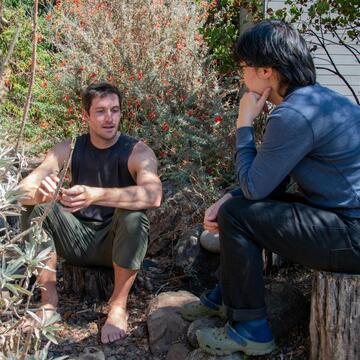
Francis Weller: On Caring for Our Souls in Uncertain Times
In this episode, CIIS Philosophy, Cosmology, and Consciousness Professor Sean Kelly has a deep and fortifying conversation with psychotherapist and author Francis Weller.
Together they explore ways of moving together through the anxieties, difficulties, and sacred transitions of 21st-century life. Featuring insights from Francis’s latest book, In the Absence of the Ordinary, this conversation frames our current era as a rough initiation—an upending experience of profound trauma and transformation that demands us to reorient our ways of thinking, being, and relating.
This episode was recorded during an live online event at California Institute of Integral Studies on September 10th, 2025. A transcript is available below.
You can watch a recording of this episode and many more episodes on the CIIS Public Programs YouTube Channel.
Tags:
Transcript
Click to Show/Hide
Our transcripts are generated using a combination of speech recognition software and human editors. We do our best to achieve accuracy, but they may contain errors. If it is an option for you, we strongly encourage you to listen to the podcast audio, which includes additional emotion and emphasis not conveyed through transcription.
Sean Kelly: Wow, okay, here we are.
Francis Weller: Okay.
Sean Kelly: Well, this is the first time that Francis and I meet, which is surprising because there's such overlap in our core interests and preoccupation. So it is a great pleasure to be able to spend some time with this very rich book and to start to get to know you. I'm sure there's much more than what I could glean from here, but I think I have a good sense of your soul essence from reading this book, which draws so masterfully from depth psychology, alchemy, core principles of indigenous spirituality, ecology, and your many years of clinical practice as a therapist. So yeah, really, really rich. Highly recommend it.
Francis Weller: I do too. Yeah.
Sean Kelly: Yeah, so I have some questions, but you know, I'm not bound to them. But let's see where it goes.
Francis Weller: Let's start with those and see what comes out.
Sean: Okay. So the first thing is the subtitle, In the Absence of the Ordinary, which I've thought about for a long time. I'm sure the same is true for you, but at least for me, if I remember when I was a kid, there were things that were ordinary that just about everybody I knew experienced as ordinary. They're not ordinary anymore. I mean, it's hard to find that. But I would like to know what you mean by the ordinary.
Francis: The absence or the ordinary?
Sean: Whichever you choose.
Francis: Well, the title kind of emerged over the last eight years, I think, when COVID hit. There was a tremendous disruption in what we assumed to be ordinary. Even going to the grocery store or getting together with friends. Everything kind of got disrupted. But I think that was just the warm-up band. Where we're heading is also into a place of great disruption. And the things that we assumed, the things that we counted upon, the things that we relied upon, they're hard to find right now. So the idea of the absence of the ordinary means we have to drop to a different octave to begin to understand how to respond when the archetypal ground begins to shake and tremor and disappear. So the invitation in this time is quite different than going along in the ordinary. The ordinary doesn't, in a sense, demand much from us. It is the loss of the ordinary which signals to the soul that a different quality of response is being asked for. And that's what this book is about. That's what my whole life has been about. Yeah.
Sean: So I guess some things, even in our idyllic childhood times by comparison, some things were ordinary but difficult then, too.
Francis: Sure.
Sean: There was death, there was suffering, first noble truth, and so on. And in our own times, I agree with you, by the way. Hopefully we can talk about what is not ordinary anymore. But I will often get people responding when I bring that up, that, well, there's always been suffering. So what's different about our times relative to just the first noble truth of Buddhism, that all is that there is suffering, unavoidably pervasive suffering as part of the human condition? So what's different about our times than the universal human truth of suffering? I wonder.
Francis: It feels to me like the magnitude is different. And I think also the collapse of the cohesion that we relied upon. So when there was trouble as a child, typically there was something that could catch you. It feels a lot like free fall right now. Like the connective tissue that allowed community to survive and thrive doesn't seem to be as available at this point. In other words, what I think is happening, or partly what's happening, is the fiction that we've been adhering to around individualism, around heroics, around strength, around muscle, around domination and control, all those fantasies are cracking. They need to crack. They need to collapse. They are not sustainable to life. So I think there's a lot of what's happening.There seems to be, again, a deep invitation for a ripening of our imagination. What is being asked of us in this time? I'm not saying I have the answers to that, but I am saying it's inviting us to drop into another mode of perception, another mode of engagement, that the old modes don't work anymore. In other words, we could imagine that we've been on a three or four thousand year pathway of ascension. We love things rising up. We love things going up. Economies, we won't go too far into that question, but we love things going up. We've reached, in a sense, a pinnacle of ascension. Right now, we're on a long, steep decline of descent. And so the heroic impulse has reached its maximum, I think. And what's being invited now is a soul response, which responds to those invitations to depth, to grieve together, to do ritual together, to get close to one another, to hold community as a principle, not as an ideal, but as a principle. I mean, there's, we use the language of community all the time, but in reality, it's very threadbare. We're still dominated by the ideology of individualism. So it's hard to even create communities that cohere, that know how to response. But I think that is the invitation of this time.
Sean: So by we, I gather you mean, for example, the dominant cultures of the so-called developed world…
Francis: Yes.
Sean: …in general, and maybe in particular, the dominant culture of this country, the United States of America, right?
Francis: Yes.
Sean: Okay. Because it clearly wouldn't apply to much of the global south or to…
Francis: No, no.
Sean: … people in Gaza right now or to Congo. So those are different we's. So maybe this is making clear to me who maybe your ideal reader is.
Francis: Yeah, I'm working on a piece right now that I'd hoped to have finished for this collection, but it's too hard a piece to write, so it's taking me a long time. It's called At the Heart of All Our Sorrows, An Excursion into Emptiness. And I could track most of the sorrows we're dealing with right now, economic, social, racial, ecological, to the depth of emptiness that exists in a white society. We are an empty people in many ways. There was a movie that just came out a couple of months ago called The Eternal Song. Anybody see that movie, by the way? A couple of you? Yeah. Awesome movie. Painful to watch. What it is is the SAND, Science and Non-Duality Organization, they went to 13 cultures around the planet to interview them to see what is the legacy of colonization. And it was incredibly painful to watch. But also on some level, it was very reassuring to see that while they went through enormous suffering, the Eternal Song never got lost. It went underground. The rituals went underground. The language went underground. The traditions, you know, all of those things went underground. For white society, I'm going to grossly exaggerate here, but for white society in general, that was severed. We lost the relationship to land, to language, to culture, to ritual, to myth, to story. And what have we done in place of that richness? We substituted what I call secondary satisfactions, power, rank, privilege, colonization, dominance, empire. These are capitalism. These are all symptoms of emptiness. And for the large part, we don't talk about that. We're an abundance culture, even in psychology. We focus so much on what we can gain, how much we can grow. But we don't stop and ask, what are we trying to address here in this emptiness? Does that make sense what I'm saying? And this emptiness is so pernicious, it is now seeping across the planet. When I spent some time in West Africa, the young men in particular, were trying to become Western. They would wear watches even if they didn't work, because it was a sign of that kind of acquisition and growth and power. The jeans, the t-shirts, the tennis shoes. But they don't know that what they're building that on is this edifice of emptiness. And if we were to address that collectively, we would weep for a thousand years. Because the harm that has come out of this emptiness has been so pervasive. No one has been untouched by the impact of this emptiness. Now we could spend the rest of the night just talking about this one thread, but I don't feel that's what we want to do. But does this make sense what I'm saying? Yeah. Okay.
Sean: Well, let me let me pull on this thread a little bit more. Yeah, because, so reasons for grief, right, suffering, how are we suffering? We're all suffering in our own uniquely, often private ways that only we can experience. And then there are various forms of shared suffering. One thing that, one level that the big We, the human species as a whole, regardless of class, social status and so on, is suffering, is the unraveling of life, complex life itself.
Francis: Yes.
Sean: That it sounds almost absurd to say that. And many people say, what do you mean the unraveling of life itself? But it's a fact. You know, we're, we're in the accelerating phase of the sixth mass extinction of species. The last one was 66 million years ago. So there's that. And in that connection, you quote this amazing line by Paul Shephard. What happens to our soul life in the absence of the others? And so who are the others? The others are the other than humans. And just on the way here or earlier today on the radio, I heard about a study that's just come out about, from Oxford Dictionary, where they're, they're getting rid of some words like, like…
Francis: Oh, yes. Alder. Beach. Raven.
Sean: Blossom. I'm not sure what, but they're getting rid of a whole slew of words to do with nature to make room for words related to technology and AI and so on.
Francis: Yes.
Sean: And part of that story was tracking the decrease in the use of these words and the shift in the meanings of them over the last two centuries, but accelerating in our own times, right. So now and you all know that we're in the age of the Anthropocene so-called. But more and more we spend, we, I'll say I spend more, so much of my time looking at my computer screen. So the others are literally dying, the other than humans. But even within the human, where are the others, the face to face encounters the real community when so much is mediated by a screen? So, so that line from Shephard, I have a question for you. How is this absence of the others showing up in your, in your practice?
Francis: Let me lay out the quote for you, because what Sean's bringing in is really important. The passage was from a conversation, an interview that was happening with Paul Shephard by Jonathan White, for a book called Talking on Water. And I don't remember the question that was asked of Shephard, but his response was: The grief and sense of loss that we often attribute to a failure in our personality is actually a feeling of emptiness, where a beautiful and strange otherness should have been encountered. Can we just think about that. We were back to emptiness again.This is another factor of that emptiness, is the loss of the others.So I'll say that again, the grief and sense of loss that we often attribute to a failure in our personality. See, Shephard was smart. He knew that we would psychologize this. We would make it about something in us.Is actually a feeling of emptiness where a beautiful and strange otherness should have been encountered. So we don't in our myths and our stories and our writing and our psychology, we don't talk about the exploits of mouse or the wily activities of raven or coyote. They're not in our language anymore. The others have been basically silenced. Except maybe in a dream, sometimes you might have a critter come through to speak to you. But for the most part, the others have been silenced. So that, the example of the dictionary, I came across that a few years ago, but a book by Robert McFarlane called Landmarks in which he cites this study, he collected place words from all over Great Britain. And then he began to understand that so many of the words of the children's dictionary were disappearing. And being replaced with words like broadband and chat room and, you know, MP3 player and as if that other world doesn't matter. As if it doesn't exist. And so what happens, you know, when we feel this emptiness, maybe part of what we are feeling is the absence of Fox. The dialogue with the Redwood.You know, the caress of Wind. So in this loneliness that we're feeling in this isolation that we're living in, when it's now technology and maybe a human face now and then. We are being reduced to what our wider soul life was meant to occupy. And again, what do we do with that loneliness? We occupy it with busyness, with shopping, with addictions, you know, with wealth, again. All of those secondary satisfactions will never make up what the soul yearns for. Right? It will never substitute for what we evolved with for 300,000 years in this intimate synchronization between the human and the more than human world. And suddenly, quite suddenly, that conversation has ceased. For the most part. I'm not saying everybody, but for the most part, if we look at our collective cultures, that conversation has been silent.
Sean: Yeah, so there’s, there seems to be a paradox at work here. On the one hand, whether we're conscious of it, I say we again, I try to avoid, whether I'm conscious of it or not. Or put it this way. Yeah, I occasionally become conscious of the fact that, this is a time of what some people call the great dying. Massive loss that is, that I can't really take in. Occasionally I can take it in and it just shatters me. But I get glimpses of this great dying. So this death that, that is being created, is being replaced by a wasteland where there once was the, this unparalleled diversity of life forms, the greater Earth community for the past hundreds of thousands of years, is disappearing in our times. So there's a literal wasteland being created. It's a great dying. And so you talk about the soul loss that corresponds to that external dying, is a, is a death of the soul. And yet, you write, “soul draws us downward, into the geography of vulnerability, tenderness, loss, intimacy and death. To know soul is to feel our wild entanglement with all things, revealing our ongoing relationship with the anima mundi, the soul of the world.” So I find this a fascinating paradox. Would you like to say anything about that?
Francis: Not really.
Sean: [laughs] Just let the beautiful words speak for themselves.
Francis: No, I would just say that part of the dilemma, which you, I think really pointed out, Sean, is that we're being asked to face the sorrows of the world alone. And I don't know about you, but there's no way on Earth I can turn my heart fully open to what's happening on the planet, unless we have community, unless we gather to grieve together. The problem with this grief, which I call the third gated grief, which is the sorrows of the world, is that they're unsolvable. Most of the sorrows we have in our life, you know, the loss of someone we love or a relationship ends or over time, it resolves to some degree. Not to say we don't still have an ache, but what we're facing around the planet is unsolvable. We will not resolve this grief in our lifetime. I talk about the period we're in right now as the long dark. We're in the long dark.And the long dark is going to be at least two generations. We're not going to see the end of the long dark. We won't. But we have our spiritual responsibility to those who might make it. If the species does persist by some radical change in our perceptions and our ways of living on the planet, if that happens, we have an obligation, at this point, to do whatever we can to sustain what's still here, and to plant the seeds of what we could call living culture. We don't have living culture. We have a generalized society, but we don't share rituals together. We don't share songs. We don't share stories. The things that make living culture happen. So we're facing that situation, oftentimes in far too deep a sense of isolation. So, again, that's been a core part of my work is to try to reanimate the original matrix. I'm sure a lot of you probably, oh God, what's his Rick, Rick Hansen. A lot of you know Rick Hansen's work, right? And he's a wonderful neuropsychologist and doing a lot of work with practices to help deal with trauma and difficult emotional states. And I've taken quite a few of his classes as part of my CEU course. I'm in one of his classes one time and I'm loving the practices. The practices are wonderful. But I realize these are all introverted individual practices. For several hundred thousand years, the context for the healing response to trauma was communal. And that cadence again, sorry to keep using this language, but we've lost that cadence. And the We again is mostly white European descendants. So that's again part of our dilemmas.We don't have the shared means by which to respond to what is befalling all around us, you know?
Sean: Yeah. And as you know, for the greater part of the homo sapien journey, up until quite recently, actually, there were, there were social ritual means, particularly rites of passage that helped, particularly the male individuals. Of course, women had and had their rites of passage, rites of initiation as well. But as many anthropologists and, you know, Joseph Campbell, for instance, have remarked that it was this right of pass..,the rights, the initiation rights for young males were necessary for them to become adults. And many people have observed that the world is dominated by men and the vast majority of whom have yet to become adults, even though they're whatever age they are. Right?
Francis: Yes.
Sean: So these uninitiated males who therefore act out these unresolved traumas, unresolved childhood traumas, intergenerational trauma and so on, without, without being able to channel these energies usefully for the benefit of the community. So you can see I want to transition here to your your, your your, your thinking on rights of passage, rights of initiation. So I didn't have any rights of passage. I had in my own case, a kind of, what you described as rough initiation, a rough initiation at 13 with high dose psychedelic experience without any preparation, without any context, without any real knowledge, without any support and so on. Now, this was typical of young men of my generation back then. So there was a kind of in that sense, it was a cultural generational initiation that was, served its own purpose. But it was rough. And it took me many years to, to try to integrate that experience. So could you maybe share some of your thoughts on the distinction between rough initiation and also its relation to trauma and how each one relates to death?
Francis: Mm hmm. Yeah. The first premise is that initiation is not optional. Even in the absence of formal traditions and formal rights of passage, the soul will take you to the edge of your own ripening, which again is no guarantee that you will ripen because a lot of these people that we're talking about have gone through traumatic things, but they haven't metabolized that trauma into something that ripens them into mature adults. In the old way of understanding initiation, it was never for the individual. Had nothing to do with your personal growth, your, you know, making you a better person. It was an act of sacrifice on behalf of the greater good to which you now hold allegiance. So societies didn't, in a sense, give a shit about whether or not you were psychologically growing. They want to know, would you show up for the watershed? Would you show up for the salmon? Would you show up for the children? Would you show up for the welfare of the community? You were being ripened for that purpose. Now, in the absence of formal initiation, psyche will still take whatever material comes into your life, traumas, losses, sorrows, and use that material in the old alchemical language. That is the prima materia. That's the prime matter that psyche will use to help to deepen and mature you in one way or another. The problem that we come, run into, is that formal initiation is what I call the contained encounter with death. There is no initiation if there's no possibility of death. That is part of what signals to the initiate that we're in a territory of deep gravity. I could end up, you know, that word gravity has the same root as the word grave and grief. That I could end up in that other world through this process of initiation. So something had to die, right? So a contained encounter with death means that the elders, the rituals, the land, the community, the place itself, held a containment field where this deep work of transformation and transmutation, rough initiation on the other hand lacks all of those ingredients. So when you go through a traumatic event, you're undertaking the exact same thing in some ways as an initiate. There's three things that happen. There's a severance from the world that you once knew. It's like when you mentioned the cancer help program that I work with. When the cancer patients show up for that week, the first thing I tell them is that you're going through a rough initiation. And it gives context to what's happening for them. That the world that they once inhabited is gone. The moment that diagnosis was made, you're no longer that healthy, carefree, you know, everything's fine. I'm going to get up tomorrow and do whatever I want. That world ends. That's the first thing that happens in initiation. Second one is there's a radical alteration in your sense of identity. So when they come to the program, they say, I don't know who I am anymore. Well, that's actually the purpose of initiation. To, in a sense, loosen the fiction of who you thought you were. So that something new might emerge and establish a broader, wider, deeper sense of self. And the third thing that happens in true initiation is you can never go back to the world that was. Now, one of the things that we do in our medical systems, and I think in our psychological systems to some degree, is we're going to try to get you back to where you were .I remember, I wrote in The Wildage of Sorrow, this man came into my office after a fairly significant heart attack. And all they could talk about was getting back to work. You know, it's like, I want to get back to work. And I finally said to him, I'm afraid you're going to waste a perfectly good heart attack. You know, what if your heart doesn't like what you're doing? What if it's protesting? What if it's saying to you this is not what we need or what we want? So I think this crisis we're in right now, is a rough initiation. It's most, for the most part, uncontained, unheld by elders or ritual. So we have to ask, what is this crisis asking of us in terms of initiation? And can we get through it? What will we need to do in order to get through this initiation? And you write a lot about that.
Sean: Well, I mean, one way that's been helping me think about it is something that seems different in the collective human experience ,is that not only humans, but the whole Earth community, so the humans and what's left of the others, the whole Earth community is being drawn into a collective planetary near-death experience. This is what's happening. So even those who are completely insulated with their money and high privilege, there's a part of their being, I'm convinced, can feel it. And maybe that's why they really need to insulate themselves even more. Because we are obviously, there is no being that is separate from the web of life. And if that web is starting to fray, we are, we, the Earth community now, the whole planet, is being drawn to a collective near-death experience, which means that the Earth community is undergoing, is being drawn into an initiation, which is fascinating. So when I remember that and try to think of it and feel myself as part of this Earth community, I have at least that container. I start to become aware of that container. But I want to transition a little bit to what you write so beautifully, drawing from alchemical imagery, about the vessel, the alchemical vessel. So the Earth is our vessel, obviously. Our, by our, I mean all life on the planet. That thin, thin layer of the atmosphere is the outer bounds of the collective vessel that we all share. And it's heating up, literally, and it's on the threshold of some collective initiation. But those of us with the privilege and luxury to become conscious of that, have the opportunity to engage in that process through our own unique individual situatedness, which requires some skills and signposts, which I think you've offered in a beautiful way, including this root metaphor of vesseling. So could you say something about what you mean by, well, or I could read that beautiful passage.
Francis: You can start with that.
Sean: Yeah, okay. Because it's a really lovely passage. Well, there's, first of all, there's this one line that's also lovely. I'll just read this. “Held in a vessel of our making, shaped by vigilance and compassion, our grief is slowly ripened into a tincture of medicine for the waiting community. So that's really lovely. Here, you'll get more of it here.” So Francis is drawing from, if you know anything about alchemy. And so the alchemist is seeking transformation within the vessel. And in order for that transformation to succeed, certain things need to happen. Right? So just take this in. “We are asked not only, not solely, to endure our times of grief, but to actively engage the materials, the weighty lead of loss, the black pitch of regrets, the salt mines of old wounds, and cook them slowly into a rich substance. The offer of attention keeps the material in the vessel warmed. Grief, left unattended, turns cold, hardens, and congeals. In this state of neglect, there is no possibility of movement. We become a chronic carrier of grief, permafrost forming in our subterranean lives. We are deadened and dulled when grief remains untended. We are asked to bring our warmth to the material and slowly allow it to cook.This is the work of alchemy.” So there's a lot there. It's very beautiful. But maybe you could say a little bit more about some of the specific virtues and skills and actions that it would be good to try to cultivate in this process of vesseling.
Francis: Well, I think one of the core premises of that whole process is the idea of keeping the material warm. Our relationship to grief is often not very warm. It's pretty chilly, if not all right cold and distancing. So the first invitation is to approach your sorrows, to come into some proximity, but not with evaluation and critique, but with curiosity and a certain degree of warmth and kindness. What I love about the vesseling idea, which I got primarily from James Hellman, was that the alchemists weren't in charge of what happened in the vessel. Their job was to tend the vessel. So whatever material is in the vessel, it wasn't their job to determine its outcome. It was going to become what it wanted to become. So what if we attended our grief that way, our sorrows, not to get through them, but to get by them, but to see what they want to become. What does this ripened grief actually teach us? One of the things it does teach us, is about connectivity. When we gather for our grief rituals, the very first thing we do after our singing and movement, is to have people share one thread of sorrow that they came in the door with. And by the end of going around the circle of 30 or 40 people, I'll ask the question, was there any sorrow shared that you couldn't relate to? Of course not. You may not have had a child die or someone die by suicide or lost a marriage or whatever, but you can relate to it because in the commons of the soul, we all know loss. So I can relate to yours, even if it's not mine, it's ours. Part of what I'm trying to teach in those moments is the idea of letting go of the individual fiction of my sorrow and coming into the collective field of our communal cup. This is our sorrow. So in a sense, what we're doing is building a vessel, a village, to hold the fierce edges of this raw loss and raw grief. But until that containment field is there, it won't move. So we can do a part of that on our own. When people come to see me in my practice, I'm retired, by the way, which is quite lovely. But when people come to you, come to me, I say to them, this is a good place to learn to tolerate contact with your grief and to learn to tolerate someone witnessing your grief. But ultimately, you'll need a much larger holding vessel because your psyche is waiting, waiting for that resonant signature that was shaped over hundreds of thousands of years, that's still in our psyches. Jung said that at the core, he said, what we need to be in touch with is the unforgotten wisdom at the core of the psyche. I love this idea of the unforgotten wisdom, that even, as I said earlier, that even though white society has basically severed those things, it's still in our deep ancestral memory field. So that when we do a grief ritual, I've heard many, many times at the end of the ritual, someone will say, you know, I've never done anything like that before in my life, but it felt oddly familiar. So what is that familiarity? You know, that we've inherited this rich lineage in our deep time ancestry that remembers being encircled together, that remembers singing together, that remembers being side by side in front of a shrine sobbing together, wailing, sharing our outrage, our anger about violations and betrayals and suffering, so that the vessel is what, in a sense, initiates, well, let me say that differently, grief initiates the action of creating the vessel. And that once the vessel is generated, then the work can begin to happen. In other words, there's two things that have to happen for grief to move.We need containment and we need release. Well, if you're doing this by yourself, you can't do both jobs. So what happens is we end up becoming a permanent containment field for our sorrow. And so we recycle. Anybody ever go to therapy? Two of you? Okay. What do we do in the therapy? We're recycling stories of loss and sorrow. So psyche is still waiting for something to happen, some vessel to be created, in which the heat will be provided so that you only have one job, which is to release. You know, that's our job, is to release the grief. Again, part of why I love working with grief so much is that it actually allows us to finally become current. How rarely are we really current? We're still chewing on old bones and old stories. And now as I work with it more over the past 25 years of doing grief work rituals, I begin to see that much of the current I'm carrying isn't mine. It's ancestral. I'm still dealing with, I mean, my wound in my lifetime has been shame. That's the wound I carried. And for most of my life I carried that, well, that's mine. That's my story. Well, it didn't begin with me. It began generations and generations ago. I'm the current curator of this wound. It's up to me to work with it. But it didn't start with me. It began a long time ago, a long time ago. What I've been waiting for is an adequate holding space for that to be held. And that's what I see happening every time we gather for ritual space. Psyche soul recognizes that cadence, that frequency, and then can begin to do its work. Part of the beauty of the ritual process, when you go down to the shrine, you're always accompanied. You never go down to the shrine alone. You're always being witnessed and held. And then there's this marvelous moment of returning to the village. And you are greeted robustly and thanked. How many of you have ever been thanked for your grief? No? No hands there. We were aching to hear someone say, thank you for doing that. Again, when we get out of the individual mind and into a village mind, I realize that what you just did helped empty my cup, too. Even if I didn't grieve today, I go home feeling differently because we wept. Right? Not just me, but we wept. And it's in that process that I think there's much more room in our hearts and our souls to feel that there's a possibility here. I have no idea if I answered your question about that.
Sean: Oh, sure. Yeah, no, that was good. That was good. Well, maybe since we're still on grief here. There's one line I'm pretty sure. Yeah, you're I'm pretty sure you're quoting our mutually beloved, the late Joanna Macy, who is sure smiling down on us right now or smiling up because she actually likes to, like to think of her. She'd like to think of herself as being woven, rewoven back into the web of life. So one of her famous lines is that you quote is, “loving the world is an act of courage.” On the flip side of that also is grieving, allowing ourselves to feel and express our pain for the world in whatever form, is also an act of courage. And so, yeah, I'm wondering what we can, what we can say about that, how is, obviously courage and grief, courage, the root of the word courage and the French courage from the coeur, so heart. So grief obviously rests in the heart. So does courage. So what can we say here about courage and courage for for, for what? I guess courage to show up with the grief, but maybe also courage to, to declare our love for the world. Maybe. I don’t know. Would you like to say anything about that?
Francis: No, I think that's true. I mean, why do we grieve? We grieve because what we love has been harmed or it's disappeared or it's been silenced or it's, you know, we grieve.There is no separation between grief and love.
Sean: Yeah, that’s right.
Francis: I mean, why do we grieve? Because we chose, we risked loving something. You know, the first gate of grief that I write about is that everything we love, we will lose. Good news, huh? I mean, everything we love, we will lose either by their disappearance or ours. You know, there is nothing that's immune to that truth, whether we call that impermanence in the Buddhist sense,or we recognize that that's simply the fact of our existence, that we get to hold on to nothing. And people say, well, I get to hold on to the memories, right. And the sweetness of that love is, only if you honor the rights of grief. Because if we shut the heart down to avoid the grief, the love is also, in a sense, numbed and emptied. So there is, our work with grieving is also the way we say, this is my work of loving. I love and I grieve. They are, like I wrote, they are sisters, eternal sisters. There's no separation with those two realities.
Sean: That's beautiful. And Joanna really helped me see that, how our grief is the flipside of our love for the world.
Francis: Absolutely.
Sean: And that, our love for the world, is the demonstration of our inseparability from the world, our attachment. So we're attached to what we love. And to be attached means you're actually not separated. There's a sense in which we're not separated from that which we love. And this is a bit of a paradox. I mean, it hurts so much because it feels like we're separated. When your lover or your child or your homeland, when you're separated from it, it's a real separation. And I wouldn't feel that agony unless I were still connected in some way.
Francis: Right.
Sean: Right? So this is the other, to me, the sweetness in the grief that in a Buddhist sense points me in the direction of dependent co-arising or inter-being, as Joanna would call it. So yeah, I'm just speaking to myself, reminding myself. When that wave of grief comes, remember, ah, that's inter-being.
Francis: I remember, I think I wrote about this as well in the grief book. There's a man in his mid-80s, came to a talk I gave down in Southern California. And I had been told prior to the talk beginning that his wife had just died, like two months ago. And at one point, he was an Austrian engineer. So at one point he raises his hand and he says, what is the one, two, three of grief? I want to be done with this. And, you know, I knew what he was referring to. So I said, I can't accept the premise of your question. It presupposes an ending to your grief. It will not end. It will change over time. It will become a bittersweet remembrance. But this is how, this is the new relationship you have with your wife. It looks like this. And if you can honor that, you can stay close to her. And he got teary at that point. He said, I think I can do that. You know, we are so inhospitable to our sorrows. We don't know how to be gracious to them. We don't know how to befriend them. That's why I write a lot about the apprenticeship with sorrow. We have to take up a lifelong apprenticeship. And this apprenticeship, I like the idea because it speaks to a long, engaged study. When you become an apprentice, this isn't for a weekend workshop. You apprentice sometimes for five, ten, fifteen years to become a master crafts person. Whether it's a weaver or a carpenter or a painter. And in soul language, the apprenticeship doesn't lead to mastery. It leads to elderhood. And that's why there's so few elders in our streets. We haven't undertaken this apprenticeship. We haven't kept a faithfulness and a fidelity to our sorrows, long enough for them to reshape us, into someone who could stand and look at the young ones in the eyes and say, I see you. I see the grief you're carrying. I see the pain that's in your eyes. And I feel how alone you've been with it because my generation disappeared. And they need to hear that. I've heard that hundreds of times from the young ones coming to our gatherings.
Sean: So there's a wonderful metaphor that you use in the book. A medicine bundle for the long dark. I love that. So if you imagine going into the long dark and we have our medicine bundle and you, yeah, you, you mentioned three. I don't know if it's a Buddhist thing, but you, you often give sort of, when you talk about something, you give a list of three or four things for, for each item. So it's very helpful reading it. Do you want to say something about your medicine bundle for the long dark?
Francis: Yeah, I think it's really important. I mean, how many of you have ever, you know, in the past years have ever felt overwhelmed by what's happening in our…
Audience Member: Never.
Francis: Never? God, you guys are amazing. So I think we feel, we feel overwhelmed. We feel powerless. We don't know how to respond. We don't even think we have a response. I remember I was up in British Columbia giving, during the weekend up there, and Friday night we gave a talk. And towards the end of the talk, this young woman stood up and says, What's the answer? What's the answer to this? I said, There isn't one, but there is a response. And each of you must decipher the response you were being asked to make and then make it. That's what all of us are being asked to do. So the idea of the medicine, the long dark is, like I said, probably going to be at least two generations. I was asked to write the forward for a book by Duane Elgin. People know Duane, Duane’s work.You probably know Duane? Duane, back in the 70s, his first book was Voluntary Simplicity. Do you remember that? OK. Anyway, the book is called Choosing Earth. And he asked me to write the preface for this. I said, Oh God, I didn't want to write it because it meant I had to read the book. And this was the most difficult book I've ever read because he goes through, decade by decade through the 20 seventies. And from what he's gathered over 50 plus years of study, forecasting what each decade might look like. And my friends, we're in the long dark. This is not going to be an easy ride. It will be difficult. So for us to enter into and engage the long dark in any meaningful way, we need to know we've got medicine. We have ways that we can respond to what's happening here. We're not empty handed. We're not bereft. We actually have what we need. And I started writing about the medicines for the long dark. And I realized something surprising that we, not only, what do we need for the long dark, but what do we bring to the long dark, that we each have medicine to bring to the long dark. And then most surprisingly, I found there's medicine in the long dark waiting for us. So let me just give you the ones that we need for the long dark. The first one is friendship and community. I mean, I said earlier, there's no way we can face what's happening in private alone, in isolation. We must have some felt sense of otherness alongside of us, both human and more than human. I go outside my house frequently and just sit with the redwoods and the oak and the bay trees there. And they're a source of great support and solace.They've seen civilizations come and go, you know, so they know about the long process of holding vigil.The second thing we need is imagination. Now, I follow Jung and Hillman in their ways of understanding imagination. Imagination is not something you do. That's fantasy. You know, I can fantasize about being on the beach and, you know, having a nice drink and how sweet that is. That's lovely. Fantasize away. But what imagination is, according to Jung and Hillman, is that it's something that we become permeable to. It's like at night when you go to bed, you don't dream. You are dreamt. You're a character in the dream. So I would say soul or psyche is dreaming you in that dream state. So what the invitation here on imagination is, can we become permeable again to the dreaming Earth? The Earth itself is a dreaming creature. And if you look around the planet, you see iterations of that dream in such profuse variety. But the values are all the same. The values are cross-cultural. Around the planet, of those societies that have survived for 10,000 years or 15 or 100,000 years, like the San people in South Africa, how did they do that? But part of what they did is stay attuned to the dreaming of the planet, of the places that they were at. So the Earth was informing them about the songs they needed to sing or the rituals they needed to do, or the practices that will allow there to be a reverential relationship between the human and the more-than-human world, that allowed them to survive. There's a term in the Inuit tradition called kartsaluni. And kartsaluni translates, sitting quietly together in the darkness, waiting expectantly for something creative to burst forth. I think that's a beautiful idea for us right now. We're not going to think our way through the long dark. That thinking is kind of what got us into the trouble, right? So we need a different mode, we need to become receptive to the dreaming. So what the kartsaluni, the Inuit, they were the whaler, they were the whale hunters. And they could not go out to hunt until they were given a song by one of the whale people. So that's deep listening. That's attunement. That's receptivity. That's tapping into the imaginal world and letting the imaginal become how we conduct ourselves. Like for the Aboriginal people in Australia, they said that the imaginal world is the real world. And when we abandon the imagination, when we abandon the imaginal, this world corrodes. And when you look at the sixth great extinction, this is all part of that corrosion. We have lost the imaginal world. We don't pay attention to that. And the third thing that we can bring as medicine is what I call the trail on the ground, our deep time ancestral inheritance. If we go deep enough into our own memory bank, into our own archaic psyche, the elements are there, to create living culture. Again, we recognize it when we're in it. Let me just say one more thing. Part of what these things are meant to do is to fortify our sense of belonging. That we are part of this sentient world. That we belong here. And part of the work that we need to do is not so much always be looking for places of belonging, which most of us spend our lifetime doing, trying to find places to belong. But we have to also then become a house of belonging. That it's our job. Again, this is part of our maturation, right? Part of our being elders is to also offer places of belonging to others. There's a wonderful term I came across from Kathleen Dean Moore in her book, Great Tide Rising.The term is refugia. And she was a philosophy, environmental philosopher, professor at University of Oregon. And she went with this group of scientists up to Mount St. Helens many years after the massive blast that devastated the whole area. The scientists were basically 100% convinced they would find nothing there. The pyro, was it pyroplastic? Is that the right word?
Sean: Pyroplastic, maybe?
Francis: Something like that? The debris field was so thick, like 10 to 20 feet thick, that they figured nothing would show up. Well, guess what happened? They found these little lees formed by the debris field where a fern was growing. Or a little pocket of space where a mole was bringing up seeds from deep underground. They called these places refugias. Places of safety where life endures. Again, between kartsaluni and refugia, that's medicine my friends. It gives us a way of holding what's happening. It gives us a way to imagine that what we're being invited into right now is going to require friendship, community, imagination, remembrance. We live in a time what I call, where the two primary sins of Western society are amnesia and anesthesia. We forget, and consequently because of our forgetting, we go numb. So what if we could begin to remember again what our place is here, what our work is to be here, and consequently out of that coming out of anesthesia into aesthetics. So the word aesthetics is anesthesia, and that has to do with beauty. And just being able to take in the beauty of this planet is also part of, in the old Greek language, beauty preceded love. You fell in love because of the allure of something. And we also have to then take back in the beauty of this planet so we can fall in love with her again. At the end of our grief rituals, I say, we didn't do this just for ourselves. We didn't do this just so we felt better. We did this so our hearts would be less encumbered by decades and generations of sorrow, so that our hearts might feel open again to fall back in love with our neighborhoods, with our friends, with our families, with our communities. And with the heart aroused, who knows what can happen.
Sean: Did you rehearse this as a last line?
Francis: Totally.
Sean: We've reached the end of our time. Thank you so much for coming here tonight…
Francis: Thank you so much.
Sean: ..and those of you online for being with us.
Francis: Thank you.
Thank you for listening to the CIIS Public Programs Podcast. Our talks and conversations are presented live in San Francisco, California. We recognize that our university’s building in San Francisco occupies traditional, unceded Ramaytush Ohlone lands. If you are interested in learning more about native lands, languages, and territories, the website native-land.ca is a helpful resource for you to learn about and acknowledge the Indigenous land where you live.
Podcast production is supervised by Kirstin Van Cleef and hosted by Alex Elliott at CIIS. Audio production is supervised by Lyle Barrere at Desired Effect. CIIS Public Programs are produced by the Office of Events at California Institute of Integral Studies. If you liked what you heard, please subscribe wherever you find podcasts and connect with us on social media @ciispubprograms.
CIIS Public Programs commits to use our in-person and online platforms to uplift the stories and teachings of Black, Indigenous, and other people of color; those in the LGBTQIA+ community; and all those whose lives emerge from the intersections of multiple identities.