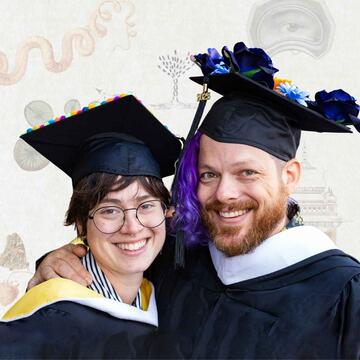
Cindy Shearer: On Sustaining Your Creative Life
With rejection and intense commitment being such integral parts of any artist’s life, many struggle to stay with the creative process. Author and CIIS Faculty in the Interdisciplinary Arts program, Cindy Shearer has spent decades helping artists stay with their craft. In her book, Stay with Writing, Cindy encourages writers to understand themselves as artists, and for artists across all mediums to learn about themselves from writing. She offers practices for artists across mediums to help sustain and live a creative life.
In this episode Cindy is joined by theater artist Emlyn Guiney. Together they dive into the nature of artistic practice, meaning-making, failure, and ways to reconnect with yourself, your art and your process.
This episode was recorded during an in-person and live streamed event at California Institute of Integral Studies on March 5th, 2026. A transcript is available below.
You can watch a recording of this episode and many more episodes on the CIIS Public Programs YouTube Channel.
Tags:
Transcript
Click to Show/Hide
Our transcripts are generated using a combination of speech recognition software and human editors. We do our best to achieve accuracy, but they may contain errors. If it is an option for you, we strongly encourage you to listen to the podcast audio, which includes additional emotion and emphasis not conveyed through transcription.
Emlyn Guiney: Hello. Hi everyone. Welcome to those in the room and those online. This is such a treat.
Cindy Shearer: For sure.
Emlyn Guiney: I am usually producing the events and so I get to be up on stage in our glorious chairs and talking to, talking to Cindy which is really just delightful. I'm very excited.
Cindy Shearer: And my great honor, my great honor to be able to talk to you tonight. Thank you so much for agreeing to do this.
Emlyn Guiney: Yay.
Cindy Shearer: And thank you to all of you for coming.
Emlyn Guiney: Yes. So this is gonna be a fun conversation all about artistic process and nurturing that, dealing with the ups and downs of that. And I thought as a way in, I would, I would ask you sometimes a thorny question for those of us in the arts which is when you get the question so what is it that you do? How do you answer that?
Cindy Shearer: Yeah great question and one that I, you know, I'm always asking other people what do you do? So let me see if I can answer it. I think I do a lot of things and I think one of the things that is kind of instrumental in the way that I talk about writing and work in the other arts is that understanding that many of us hold lots of capacities in our lives. Among them, that we are artists or artists writer, and so just to be clear here I think of writers as artists. It's been one of my really strong pursuits in developing the MFA to get writers to understand that they are, they are literary artists. That's the phrasing I used to use and so when I use the phrase artist I'm always talking about writers as well as anybody who works in other mediums. But for me what I do mostly these days is write and I really write from a perspective in, in, actually I do mostly two kinds of writing. I do some fiction writing but when I work in nonfiction, I really work a lot in the perspective of trying to understand what we do when we make creative work. I'm super interested in that. I've been exploring that a lot of my adult life but particularly since we started our MFA in 2009 and you know my book, my book reflects that, it reflects that idea of that I'm trying to be in the process and I'm also trying to observe and explore the process. I do sometimes still make work in text and image. I did a piece for the new book and, and I can talk more about why I do that, but I do that less more professionally right now and more as part of that process of trying to understand how and why I make art.
Emlyn Guiney: Yeah yeah. I asked you that because you have a really great way of talking about art making that feels both expansive for people to really just embrace the multitudes within an artist or a writer and, and yet you also offer that specificity too. Can you say more about artists as writers?
Cindy Shearer: Yes.
Emlyn Guiney: And writers as artists?
Cindy Shearer: And writers as artists, yeah, I mean for me like a foundational piece for me in, in, in the, you know, being an artist is the, the what you make and the why you make it and those things really apply across any medium or form. You know if you've ever been to one of my MFA info sessions you hear me talk about this but you know a lot of the origins for me was as a young writer I got really interested in the work of Gertrude Stein and I spent time when I was in London in graduate school, going to the British Library every day getting Stein's manuscript or you know connecting to her manuscripts and books and trying to understand. For me she was one of the first people to raise the idea that writing could be more than writing, like, that it could have a visual capacity and I began to explore that some in my own work so the origins go back, at that time I was 22, I'll just be clear I'm not 22 anymore. I haven't been for a long time but it's lived in me since then and and over many years has morphed in a lot of, in a lot of different ways a lot through connections to other artists but I think the value for writers in particular is, we're all taught to write when we're kids, we're, you know, we're taught to, you know, here's a topic sentence and build your paragraph around evidence and that kind of thing and so it disconnects us from the idea of being makers. I mean for me being an artist is being a maker, like I actually prefer the word maker in many ways and so a lot of the ways I'd like to talk with writers and think about writing with writers is about that idea of being a maker. What's the unique thing that you're making? What's the original thing? What's the core of what you're trying to get at in what you do? I think everybody does that across the arts. For me, you know, I work in text and image and I've gotten really comfortable over you know 20 some years of working with artists across so many disciplines, so I have an insight, doesn't mean I have an expertise but it's the same, you know, my goal for everyone is like what do you make and how do we help you to get to the the essence and the best work that you can do as a maker.
Emlyn Guiney: I think that's so great, I like that, I just want to be a maker, I just want to say that because for me, I'm coming from a lens of, you know, doing theater work for so many years but within that of course I'm doing like all these other visual arts and things like that and I find that so often those of us who have gone through artistic training or arts training we get really boxed in by, you know, the training like needing to really define your art and define who you are and then define the kind of art you do and for, you know, for someone like me I remember I started to, the list started to get really long and specific, okay I'm a theater artist no I'm an actor I'm a director and producer no I'm a theater artist working in experimental theater physical theater doing devised work and at a certain point what happens if you feel like you can't, one of those boxes doesn't fit anymore and then you have like an artistic identity crisis and I think what I really appreciate about the the writing that you're sharing in this book and your concepts here around maker, is just allowing yourself to be a maker and to let that evolve and to let other art forms fly in and out to let that change and adapt and I think that's so, it's so helpful and I wish that the 20 year old me had heard that earlier on.
Cindy Shearer: And in certain ways it's kind of both and right, I think, it's like yeah you do, you do, you do want to be able to do that. I am, like the, like I mean if we walk away with anything tonight I would love that it's this idea that specificity matters, detail matters and so being able to define yourself in a, in a clear way, yeah, I am a theater artist but I'm interested in devised forms I work I care about that, like, for me it's, the core of it is what do you care about and how does the definition arise from that, and how do you create the possibility for growth within that? Yeah so I am that thing because I think often people, especially, you know, people who are trying to figure out what is the next step for them as an artist? What I find is it's like yeah I'm this and I'm this and I'm this and like yeah how in a year or two year period do you work with that but if you're willing to accept a definition and really land into it and see where it can take you, I mean, let that definition lead you to possibility is kind of the way I would play with it.
Emlyn Guiney: Yes, right I love that, letting that lead you to what comes next and what could come next, yeah. Can you share more about writing with images and writing a scene?
Cindy Shearer: Sure, yeah, I mean, I think my favorite question to anyone who's writing is, what do you see? You know I think often particularly in academia these days we lead people to concepts or ideas or to stances and that sort of thing and there's value in that, there's a lot of, I mean, it's important to understand what you value and, and to bring that valuing into the work but I think in my own experience, in my own life and in the many failures that I've had and in what I see with people who are trying to develop projects, whether it's in academic programs whether it's because they have a book project that they have a contract for, or they're trying to get a contract for, it's that it breaks down because they can't really, lack of a better way of saying it, embody it. They can't really step all the way into it and seeing is a way to do that. In the book I talk about this, how I learned that from my friend Elliott Coleman, my mentor and friend Elliott Coleman, who had had a stroke and, and so in the later part of his life when I met him he was a poet, he would write the poetry by reciting it and someone, one of us, would record it. And so you could see as he was working through the images in the poetry how, how he could see them. And by seeing I mean literally see, like I actually think, can you see what you want to show on the page and can you reach for that? But at the same time, I mean, the way I call it is can you see into it? Can you see what it's about for you? And so for me that's the core of working between writing and image. If you create an image, it's an opening, it's a way to say this is the thing that I've made and what is it for me? What is it that it's telling me? What am I in conversation with? What am I trying to reach for in that image? It's like, you know, if I tell a story and the red shoes are an image in it, if I start to see that story through the red shoes it tells me something, A, about why I was wearing them, it tells me something about where I might have been standing in relationship to other people, it might have been that my aunt who was also in the room was there and then I start to think about, oh my aunt and the influence she had on that event ,suddenly the story becomes, has the potential I'll say to become much deeper and richer because I've stepped all the way into an image and images for me, a lack of a better way of saying, it's like a context, it's a context that can inform the work. If I'm willing to get to know it, I can play with it and work with it and most often add to the writing.
Emlyn: Beautiful, yes, I like that a lot and I felt like I could, I don't identify as a writer, as a maker for sure, but not necessarily as a writer though I write in certain other ways and what I was feeling when I was reading you talking about, like, I could go in that way, the scene, the images and working, and it's also very somatic too. There's a, especially in the ones, you know, obviously there's images that we can, you know, make up and see, but in memory, then comes that, you know, the, the senses come back in and the body comes back in, I was like noticing that throughout when you were talking about seeing and and going towards the image so that was really, that felt really cool and accessible to me.
Cindy: That was something that I was thinking about when you were talking earlier about being a theater artist but doing visual work and, and that kind of thing. Like I think one of the real opportunities about being willing to connect beyond whatever your given art form is, let's just say writing because that's, you know, something that I've been, I, that I've been writing about but the idea that you can do these things not necessarily because you are good at them but because of what they can give you for the process that you are good at or you want to be good at, like again that's why I think it connects to the whole definition thing. Yeah I am a theater person, I am a theater artist, I do X Y and Z in that realm but I can make images, I can use the process of making images, I could take photography, I can write, I can do all these things to help me and that's why I think it's important to be in conversation across the arts because then you do those things again, not that you necessarily have to always be good at them but when you engage in conversations with others around the arts, you, you get insight to what makes them good at it, what makes their process. Like the way I like to say it more than good or bad is it gives you insight to what makes them a genuine maker in that, and you can apply that a little bit or a lot, other way, in other words it's not about doing it as well as they do, to use that kind of language, it's about getting that insight and letting that, you know, help you in certain kinds of ways.
Emlyn: Yeah, yeah, I love that you, you said something in your book around exposure to other art forms and artists creates possibility and I think it's coming back again to that same idea of like, what is the inquiry and also like how can you open that up in various ways whatever the ways, whatever ways are calling to you and I think that's so important because we tend to box ourselves in and think, you know, this is the, this is the, the path of this particular medium, this is this is how we're successful in this, this is how we do that and, really, you're inviting us to be much more in relationship with our work, with ourselves, and with play.
Cindy: Exactly.
Emlyn: And you talk a lot about play.
Cindy: Yes, yeah, so one thing, if you don't mind me saying, I don't, I don't want to take credit for something that's not mine, so it's my friend my colleague Chris Bandenberger, who used that idea, that art, that could putting art and artists in conversation with each other leads to possibility, I just use it in my work so kudos to Chris and, and, yes, and in relationship to what you're saying, that's very much why, you know, we want to be in this conversation across the arts, like, I think the idea of play is is fundamental. For me play is, you know, it is that thing that leads to opening, I'm gonna try this thing, it might not be mine to do over and over again or it might not be my thing to specialize but maybe it will lead me in, or maybe I can take my expertise, maybe I can take this idea that I know well of devised theater and I can turn it on its head a little bit. So for me it's always about that, it's always about choice, flexibility, possibility in the work.
Emlyn: And that you're giving yourself permission to do those things, that are maybe outside your, your typical, your medium that you've identified which I think is not always easy and not always something that, you know, the outside world encourages. So can you talk a little bit about the, about failure. You talk a lot about failure in your book and I'm, I'm curious about like this sense of play in connection with failure and how we … and then there's the failure of, you know, doing the thing that you really want to do that isn't, you know, that is more, maybe more painful.
Cindy: Yeah I think it's a super important aspect, you know, I was talking to someone the other day and kind of drawing the analogy to other things in life but, you know, in baseball if you, you know, if you succeed three times out of ten, you know, you're considered, you know, really accomplished, you know, but in, in writing, I mean I have the experience of sending a manuscript out 31 times and being rejected 31 times, you know, and so I'm zero for 31, it's like, you know, that's not a great, not, it's not a great percentage. And so, I think, there is that, that way of engaging failure, there is, you know, an industry that will tell you if you succeed or fail there are classroom settings where, you know, people with power will tell you, you succeed or fail, there are group critiques and all those kinds of things that will tell you if your work works or it doesn't, meaning it works or it fails kind of thing. And so that idea of failure is just endless in, you know, in creative work. What there is, is what you can create, what you have the capacity to create at any given moment of your life, there is learning to make choices that let you stay with the process, learning to make choices that allow you to keep learning and engaging and developing, and then there is developing your own inner sense of when the work works, when it's ready and I think all of that factors into failure in a lot of different ways. I think so much of our training at makers requires us to land into that moment of understanding what our work is, why we're making it at any given moment, what we have to give it, realistically, excuse me, what it can be and then deciding if it's ready to go to a larger deeper audience in some way. All along the way, in that process, you can have, to use the language, success or failure but I think it's just buying into what the actual process is and deciding that, fundamentally, you're gonna stay with it. That you are a maker of work that you understand, that you have capacity and you're just gonna keep finding the places where your work belongs. I think often I, you know, I've said this in a couple of different settings but I think so often work fails because people try to make it ready for something that it's not ready for and so so much for me the message is, know when it's ready and then decide, I mean, you still might fail, I'm sorry to say, you still might but you might also really succeed if you know really how and why the work is ready because that allow, that creates openings, it allows you to make the kinds of connections to people that you need to. It allows you to get access to certain kinds of environments, there are a lot of practical way I mean I could talk about practical ways about that, but I'm just talking about process here right now. And so I think that, I think that that idea of failure is fundamental and it's just super important to to recognize that. But it's also just a thing, it's just failing, right, just failing, just like succeeding is just succeeding and if you can kind of live in that space then you can stay with the work and, and really mean it. There are other things, and for me in some ways this is as important or more important than, you know, for writers and artists, is, I call it loss in in my book, but, but you could label it in a lot of ways. It's about the things that happen in our lives that have an impact on our ability to make and I think like trying to succeed in an environment in which you're struggling fundamentally with those kinds of things that's, I think, a lot of what gets labored labeled as failure. It's not. It's about, you know, I mean you could call it a lot of things but A, first, it's about needing to recognize what's happening in the life and the kind of impact that it's having and then realizing what can I make in this environment where I'm experiencing all that. And yeah, I mean there are periods of your life where maybe being a maker is pretty difficult if not impossible. Where you have limited access, both to your materials and your time, or maybe you have a lot of time to give to it but there's so much going on you can only enter it in a certain way, there are some times where you can push through and there are other times when you can’t. Again, for me, it's a lot about just yeah, yeah that's how it is and fundamentally it's about, what I've learned over my life is, there's a lot of choices about that, we were talking about that earlier. Sometimes it's forgetting that these things aren't dictates, they don't come from high and I have to actually follow them, there's not somebody in power who gets to decide it's that, I have a lot of and if I keep my choices in front of me, if I stay aware of them and decide to use them and work with them then, yeah, I can make my work and I'm in my, I'm a huge believer in this, if you fundamentally make your work, you will find the audiences for it. Might be in unexpected ways but I really do believe that.
Emlyn: Yeah, yeah and you're talking about sustainability here too, which is like there is a piece of it that’s resilience for all those failures and, and, and, yeah, it's just, it feels like it's really important to bring acceptance into awareness and acceptance around these seasons, you know, these seasons in our creative lives, where there might be transitions that are in our, you know, regular every day. I don't know what we want to call our not creative lives because I feel like they're so integrated but I think sometimes as artists we can think that they're separate somehow and it's like we should be no, you know, yeah my cat died and I lost my job but like why is my manuscript on hold right now, like I have a five-year plan, you know, and I think, I think what you're speaking to is actually like you're saying it so simply but I think it's, it's so profound, like there's so many of us that, I think, don't take the time to really be like, where am I right now? What is my capacity? And how do I make my work and from here from this place? And I think something that I really want you to talk more about, which I really appreciated, was your, you know, art making as a relationship and talking, you just said it too, it was like this idea that you, you're in dialogue with your art, with your relationship, you know, in relationship with your art, you're not alone in that and it's also not separate from what's happening in your life. Where you are in this moment, can you say more about those things?
Cindy: Yeah, sure, if you don't mind I'll just go back to a second too, to, to, what you were, what I heard you just saying, which is, it's another, I think, one of those things that's a both and, right? Which is, yeah, you have a lot going on in your life but would it be helpful to you, to be working on your manuscript? You know, can you really carve out time? Do you have to put it all away because, you know, something negative happened in your life? But can you, can you have choice around that? Can you say, yeah, this is what I have to give it and I'm gonna give it all of that right now. So I'm a huge believer in commitment, I'm not in any way saying don't commit to your work because what allows you to stay with it, what allows you ultimately, you know, to find the work and to bring it forward, is to make that commitment. I don't think that's what you're saying, either, to be clear, but I think, you know, it's like so, like, it's like can she ever just give us a straight answer.
Emlyn: No, [laughter].
Cindy: It's like perpetually, you know, both and, kind of on my, but how do you see both sides, or like the multiple sides of it and then find your own way to work with it? I really, I really love this idea of art making as relationship, it's an area that, actually someone said to me, oh I wish you had like written a bit more about that. So I was thinking, yeah, I should be thinking more about it, I should be so maybe I'll think aloud here for a moment but, you know, when I had that kind of discovery, I was working with someone on a project on a, on a book project and they were like, gosh, you know, I just, I don't know how to, I don't know how to get this work to move forward, I never quite realized what I want to say and I'm, you know, I'm just wondering what's wrong with my manuscript. And what I realized in working with this person is, and this is what they don't teach you, when they're teaching you to write, you know, writing as communication, which seems kind of odd because it's about communication, which is relationship, which is that you are always in relationship when you are writing and then I'll, you know, I, you know, I would translate that to making as well. For in, like I said, first of all you're in relationship with yourself, that's what I mean about this idea of being in a dialogue with yourself about, what am I doing? I'm not just trying to do what the assignment is or because someone told me I should write a novel, like actually why, you know, what is this about for me? What am I reaching for? That's what I mean when I'm talking about that relationship, it's a lot of, what am I reaching for? What is this work for me? And how do I do that? And then, you know, there's this idea of, you draft it, you work on it and that relationship continues like, you know, I talk a little bit about this, of learning to be both a writer of the work and observer of the work and I kind of love that process. Once you really get into it and I think you can do this again across the arts, I'm just kind of focusing on writing here for a moment, but that idea that you are seeing as a maker and you're also seeing as a reader of what has been made, and like when you, when you really get into that relationship, you kind of never get divorced from it, like, I don't think I know how to read anymore without doing both things at the same time but it's empowering and it's sustaining because you can hold the idea of where the work is trying to go and at the same time you can say, yeah, here are all the ways that someone who doesn't know all that, is viewing what is being created here. And so you ask that question, you say, you ask that question, like, where is, why is this here? What is, how does this relate to this other thing? Or this is an interesting image, I wonder why it doesn't get articulated any more? And so for me, that idea of relationship has become profoundly fundamental but it begins in that idea that if you can't be in good relationship with yourself when you're making, then it's already in trouble when, you know, to try to get to the other levels of relationship. But fundamentally it's this, which is, treat yourself and who you're trying to reach with your work, just the way you would anybody else in a relationship right? We just sort of forget that like, you know, if you would be rude to people in your relationship, then play with being rude, you know, I mean in fiction writing that can be one of the wonderful things, yeah, that person is gonna be wildly rude with everyone, so let me, let me see what I could do with that. But I think that can really be, it's a guiding principle, A, around the making of the work and, at the same time, about the way in which you talk with yourself about how you make the work.
Emlyn: And where you are right now in this moment…
Cindy: And where you are and where you…
Emlyn: In your life.
Cindy: Are right now.
Emlyn: Yeah, definitely. I, I think that's a, that's a big one. I love that you said if you don't have a good if you're not a good relationship with yourself, you're gonna be in trouble and I think, you know, the art is telling us something about ourselves so I think, it's that idea of like not trying to separate as if there's some sort of, like, objective like some sort of artist, that, in you, that's just this like objective, you know, doesn't have this life, life part as much, they're kind of, it's kind of like on this train doing this thing. Yeah, I feel like that's really important to be like, where am I right now? Why this right now? And the inquiry around it.
Cindy: Absolutely.
Emlyn: The self inquiry is, is really just as important as the the inquiry that, you know, the concept in the work that you're…
Cindy: The idea for me is that the work originates inside you, ultimately, it wants to extend beyond you. And relationship is important in, in both aspects of that, you know, language that I used to use a number of years ago when I first started talking about this was, writing is a process of translation, so in other words it's like, you have to say it to yourself so you can translate it for someone else, you are always in the making process in that, in that realm of creating something that you're translating ultimately for something larger than you and that's relationship. You either can make the translation, you can, not make the translation let me say it like this, you can make the work and you can affect the translation or you can't and somewhere, you know, relationship is kind of a through line all the way through them.
Emlyn: Yeah, yeah, beautiful. Yeah. Okay I have a question for you about quitting.
Cindy: Yeah.
Emlyn: Because in your, in your book you say, I quit writing, as you're writing this book. So I would love to hear more around your relationship with quitting.
Cindy: I kind of love that. I love that's kind of like the little inside joke of the book, of like, yeah, I quit writing but while I was doing that I made a work of text and image about writing, you know. And so I quit sort of. But I actually really did in a way, the quitting thing for me is about realizing, I just, I didn't have a direction, I didn't have, I didn't know what I wanted to say anymore, you know. I grew up in a in artistic era of metafiction of, you know, writers like John Barth, who was quoted saying, All stories have been told, there's just new ways of telling stories kind of thing. And so it was very much an era of, you know, I would call playfulness but almost in a kind of ironic playfulness, rather than genuine playfulness. And so I think one of the real lessons I had to learn about being in the world of writer artists was that genuineness matters, you know, I call it really meaning making, that there are reasons why we make our work and that's why, you know, this language of inquiry comes in so much to the way that I talk about the writing process. But yeah I mean it was fundamentally, if all I can do is someone who can use technique well and I think I was pretty good at that, of thinking of really interesting ways to make work and give it form and all that, but it's not really fundamentally about something or it was fundamentally about something, I just didn't access that, right? So it's like yeah I quit, I quit. And so I actually think there's a positive in quit because it's liberating, right? You know, it's yeah, I don't have what it takes to actually do this, so I can quit quit meaning like I can quit forever, I can really not do that I could go, you know, do something else in my life, or I can quit and I can start again and that's really the way I like to frame it. For me, it was I decided, well I'll just create a brand new art form, that'll be my way. And I did, I did it for like 15, 16 years and that's really how I got into creating text and image work which of course means I never quit being a writer, I was just always doing it. I took what I learned from Elliott about seeing and then I applied it in my own way to the way that I wanted to construct work. And honestly what happened was, I came back to wanting to be a writer, you know, so then when I kind of “quit” making work of text and image, which I still do occasionally, it wasn't a quit quit, it was a, yeah, I'm gonna defer, I'm gonna defer this process to go and do something else. But it was about understanding that I knew what my work was and I knew what it was about, so therefore I could choose the forms that I wanted to work with. It was no longer that, oh, these are the forms that people work in, you need to apply those forms and make your work. The work arises, in my view, from the thing that we have to say, it arises from what we see and from what we have to say and that willingness to pursue it, you know, and to make it out of that pursuit.
Emlyn: Yeah, yeah, and do you feel like you really had to say I quit this in order to go to the next thing? Like it gave you permission to, like, drop it?
Cindy: I would say… I mean, I'm a person for whom words are like incredibly important. Every word means something and if you've ever worked with me, you'll know that 90 times in working with me I'm saying, and what does that word mean to you? You know, so, so I am deliberately using that word quit because it's a little more dramatic…
Emlyn: Yeah.
Cindy: And it was like a stop point.
Emlyn: Right.
Cindy: Yeah, like, I, I am turning away from this and I'm gonna come back different or, actually when I quit I didn't say I'm gonna come back different, I said, oh I'll do a drawing and I'll see where that, that leads me. But I would say, if you feel like you need to shift your work, find the word that works for you. Quit might be more dramatic than you want, I'm gonna shift gears, I'm gonna go, I'm gonna go a sideways path. I mean, it's about being able to find your process and so I think this is really fundamentally, what we're talking about here is, we have so many people, organizations, mythologies, perspectives about art making, telling us, how you make art, what it is to be an artist. I am saying find your language, find your way of seeing and follow that. And so yeah, if you need to quit in order to be able to make a shift then quit. But if you need to take a pause or have a little, you know, other kind of experience, do that. I mean language, I think language is critically important, whether you're a writer or not, because what you say to yourself has an impact on how you work.
Emlyn: Yeah. I love that you say quit and then you, there was never a question that you would not be making. And I think that's a big piece of it too, is that whether you use quit or shift or whatever transition, that there's this fundamental knowing, you know, knowledge base inside you that is like, I am a maker and this is not going away, it's just, I'm dropping that for now.
Cindy: Yeah and, and for me, like, I didn't know that, it's not like I knew that, I mean, I'm of course, of course writing about this, you know, it's, it's 2000, I wrote this what 2023, 2024 and, you know. I started that work in 1996 so, you know, basically 20 years of doing the work and then before I start articulating it in this way. So yeah, but I think it's also about that, and I think two things are important in that, one, I just, I just knew to quit or I just did quit and then the openings became, so there was the opportunity for that and, second, it's that yeah, once I did that, I was willing to step into an opportunity. So I think it's also that willingness to be able to say, Yeah I'm not sure what's gonna come on the other side of this, but if I do the thing that I need to do, which is take this manuscript and put it in a drawer, or decide that this theater piece that I've been working on for four years, I don't have the time or attention to do it, but I could do something smaller right now, so I'm gonna quit this one theater piece and I'm gonna do this other thing, that's, that's really the kind of thing that I'm talking about. You don't know necessarily what's gonna happen when you make the decision, but if you don't make the decision, you don't know, right?
Emlyn: Yeah, and it all comes back to being in relationship with yourself and being really aware of like, I need to quit right now, that's what's going on. But you also talk about work that you quit or put down and then found again.
Cindy: Yeah.
Emlyn: And were able to like repurpose, you know, do, use in different ways can, can you share about that because I think that's a really beautiful idea, that it could come back around, even 20 years later in some other form.
Cindy: Yeah I mean there's kind of two ways in which that's alive for me, one is in the example that you're asking and this relates to, you know, for example things like, you know, writing a novel at a particular point that, you know, was one of those that got the plethora of, you know, rejection notices and, you know, put in a, put in a box somewhere. And then, when, especially when I started making work in text and image, I would take these things that I had created in another setting and I would add to them or I would cut them up and I would be, you know, I started, I started making this whole body of work. And this is where this idea, I've actually really appreciated a couple times now that you brought up the word box, I hope we can talk about boxing at some point like and, you know, like the importance of box because actually like we were using it in the context of box being kind of a bad thing but actually for me it's a place of immense possibility. But I would be like, oh yeah, you know, I wrote this story and it's not gone anywhere so I'll just take a box and I'll, and I'll create the story in a box and so I would literally make the characters and I would sew their, I would sew their jewelry or make them a bag to carry where they were walking and suddenly the story had a kind of life and dimension that it never, you know, it didn't have in the rejection pile, you know, and in other ways too, it would be that I would, I would take parts of things and add them into something else. But it's also about, you know, being able to do that kind of thing of taking a short story or something like that, that didn't work at a particular time of life and understanding. I have one piece that I'm working on right now and I understood that I just wasn't willing to tell the actual story, like it's a super interestingly constructed piece of work but there's a whole story underneath it, that I thought if I, if I structured it in a fun enough way, it would just convey it in a sense without me having to convey it. It's like no, it's not gonna work, it's not gonna work, so either decide you want to actually tell the story and you can do that in a really interesting way or just leave the piece, it's not one that you want to write. And so that idea, A, that things can have a life at another, at another time in your artistic life or B, you can remake them or reuse them. But the other thing that really came up for me in the writing of this book is that whole first section about Elliott and I actually wrote that first piece about seeing. I'm bad on dates so forgive me for, if anyone listening to this knows better than I, but I wrote it and we, and we, we put it in one of our mission at 10th journals, which was our inner arts journal for a long time as part of the MFA, but let's say it's 12, 14 years ago that I wrote that piece. I did some reworking for it, for this book, but what I discovered was that there was a whole telling of the Elliott story that if I was gonna include that, that I had to tell in this book. And that was really a point, like talk about quitting, you know, there were several points in the writing of those pieces where I was like, I don't know if I can do this work. One, I don't know if I can reach back far enough to remember and see. I don't know if I want to, like the kinds of things that suggest to me, or these other side stories that come up and how I should include them or not include them and I remember at one point just saying, I don't, I don't think I can do this and then saying to myself, well, you could just make some choices about it. And I realized, yeah, the task is to tell the fuller story and I think this can be an important thing. The task is to tell the fuller story, not all the story or the complete story or every aspect of the story but the fuller story and so what, and that was my language, the fuller story, so what is the fuller story? The fuller story is one that has various perspectives so you see it from more than one vantage point because I didn't, it didn't feel right to let it live as something that was, oh, I just had this cool relationship with this, with this wonderful artist who taught me about seeing and then unfortunately he died. All of that's accurate but it's partial, right? And to me, that's a very, very interesting thing because all work is partial in a way but how partial, you know, in the sense of how much of the story needs to be there for it to work? So I went through this whole dialogue with myself, hopefully readers feel great about the ways that I oriented toward that but for me it was a very very important process and so that idea of, yeah, of, you know, both what I call a kind of re-offering has, it has multiple, it can be, it can appear and be necessary for the work in a variety of ways. That was a kind of round-the-barn answer about a lot of stuff but hopefully it makes some sense.
Emlyn: Yes, it all made sense to me. And okay so you brought up offering.
Cindy: Yeah.
Emlyn: Which I also really liked in your book. So after you quit writing, you were sort of in this phase of making boxes and text and art together and then you sort of decided, oh, it feels really good if I make these, this art to be a gift.
Cindy: Yes.
Emlyn: And when you, when you wrote that I was like, yeah, really make sense and then you kind of broke down why that wasn't such a great idea for you anymore and I'm curious if you can say how you how you kind of moved into offering from there?
Cindy: Yeah, I mean for me it was a, it was a really important shift. When I, when I got involved in, in making work into text an image, maybe again I'll go around the question and actually come to it. I started with a very simple idea of making postcards because it was, this whole idea of meaning making was super important to me and, you know, again anybody who's worked with me knows that I think postcard is the most perfect art form. You get text, you get image and you get a stamp, like in the stamp like like again play with that word, you know, it's like my stamp of what I am saying. And then of the postcards always have a handmade stamp on them and so, but what I began to discover and the reason I'm saying this here is, after I did that work for a while, I wanted to have what I thought of as dimension and depth. So I created postcards that had that, you know, would like stand like, that had dimension and they had things built onto them. And, you know, things that started to be sewn into them and so it, like, it was, it was too flat of a medium and I needed it to have like texture and, you know, depth and that kind of thing and so then from that it was like, oh, well if I could do that on a flat surface, what could I do in a box? And then I could create a whole world in a box and then after that, oh excuse me, I went to hard boards and because then you could present the world, you didn't have to look inside of it. Anyway that was a little of the creative trajectory. But the idea was in each one of those things that, you know, could you, could you give it, could you give it to someone else? And that was my idea, that was my way of kind of, in my own process, of working through things that are production made for an audience versus things that are made from the origins of one, one's process and the origins of what one can make as an artist and see where it leads. But I realized the thing about gift giving is this, what if somebody doesn't want it, right? Like how many times have you got the, you know, the Christmas sweater or the, you know, the, the, you know, the package of, you know, you know, the thing of mustard that you’re supposed to love or whatever, you know, it's just a, it's a thing that you get and maybe you want it or you don't and I didn't want that to be part of the process. So I started doing this inquiry around the word offering, you know, and I was thinking about the ways in which I understood it in my own life, like, if you ever went to church when you were a kid and there was the tithe, the offering that you were supposed to give in the service, so it was given, you know, quote freely in that way but there wasn't an expectation attached to it and I really love that thing about, I really love that about art making. So you can offer it and maybe the offering will be accepted. Maybe someone will say, yes, I'm going to publish your book, I'm gonna, I'm gonna, you know, I'm gonna put your, your theater work on stage, I'm going to have this exhibit. But you can still offer it regardless of, you know, of what happens, and then you can offer it again and again. This is again what, you know, what we were just talking about is, so in this era you offer and it doesn't get, you know, the offering doesn't get accepted in a certain way. You can say, okay, do I keep offering? Or is this one of the things I put to the side, I think more about? Or do I deconstruct it? And construct it and I can offer it again. It just feels, for me, a more expansive way of being in the world.
Emlyn: Yeah, and you're talking about agency too. So it's, it's empowering and there's, there's agency around it which is different from gifting. There's some agency in gifting but it's, there's, there's definitely a, and? How do you feel?
Cindy: Yeah and then you got to write the thank you note,[...] thank you note, or, you know like…
Emlyn: Yeah and I, and I do think that also speaks to sustainability too, is that you have this, this agency that's like when you're ready you can offer this thing, and also this kind of letting go of the attachment to the thing and letting the thing go out into the world and maybe be picked up in a way, like you've said, that you weren't expecting. That there's like a change in expectation and it doesn't mean that the thing isn't important to you or that you don't have ideas of where you would want this to go. But there's something really beautiful about offering that just sort of relaxed me in my whole body when you said that, around, around art making, because I think so often there's so much about, like, what will people think? How do I get, how do I get them to like me? And it's, you're sort of like, no, it's coming from me going out and let's see where it goes from there because it, it is in a world, right? It's not, you can't direct where it will go as much as you want to and so sitting back with that and being like this is an offering, I think allows, would allow me to enjoy the process a lot more and to feel like I'm more, again, in relationship, a part of the external world my art is going out into, yeah.
Cindy: Yeah, I think it's, I think it's really important also again it's, for me, it's one of those kind of both and things because I feel like sometimes when I say things like this then someone out there could be saying, yeah it's just not very practical, right? You know, but it, but it is for me, practical, you know, like I am immensely practical. It's, I'm not saying in any way don't be confident when you offer, don't think that your work has a future that it can belongs there. I'm not saying when you write your query letter to an agent, you know, to try to get them interested in your book that you shouldn't feel like my work is ready and, you know, it belongs with this agent and it belongs with the world. I'm saying that it's about your own way of being in that. Like I'm going to, I'm going to commit to this project and I'm going to offer it and then I'm going to kind of let things, you know, again if I say play out, sounds like, oh I don't feel like you have agency but I think that is agency. I think so much in life and so therefore so much in the life of being an artist is understanding what you control and what you don't. And so what I can control is what I make and how I offer it to the world and I can be smart about the other ways, like how I build connections and how I understand market plates and all that sort of stuff but, you know, I can also be content that what I can do is bring it forward. I can offer it out and I can see what happens and I can, and I can be in, you're right, be in relationship with myself about how I am about what happens with that.
Emlyn: Right, right and it comes back to choice too, of like what you want to do around this, this offering. Like what is, what are my choices here? How do I feel about those? Yeah. So you, you did mention Elliott and I wanted to just ask you about mentors and the role of mentor which you, I'm sure, are for many of our students here. But can you say more about sort of the relationship of the mentor, particularly after, after school, you know, like when you've kind of moved into the world? I'm curious about mentorship in that direction too.
Cindy: I think again it's, it's kind of one of those things to think about when I hear that word, what do I see? What do I mean? You know, for me it's specific in a way, like, I was very fortunate when I went to London in 1978. Michael Lynch, who ran the program that I was enrolled in for Antioch University, had brought Elliot over, who, Elliot had been at Johns Hopkins University for, I don't know, 35 years and had just retired. And he wanted to create a little group of people to work one-on-one with Elliott. Well there were four of us that, or three of us that actually met with Elliott, Michael was one of them. So I kind of just landed into that in a certain way but from that relationship, I saw the power of what could happen of having that access. And I'll tell you, for me, one of the things that really stands out, and I think this is important around mentorship, was when I saw Elliott and Michael in conversation about Elliott's work. That, like, sitting there as a, as a, as part of the process but also as an observer. I realized how much I absorbed that. I realized the way that they spoke with each other was based on a long-term talking about their work with each other. And it gave them a way of being in conversation and in relationship, that was not only valuable to them, but was very very valuable to the work. And so I think, just implicit in that, you know, I carried forward in my own life, how do you create that for yourself? So if mentorship is finding those people who can talk with you about your work in a deep way, I say yes, it's really the thing that everyone wants to reach for. And I think the reality is like, you know, you know, you like, you, you can be in a degree program or you can have those kinds of experiences where that can happen, but when you're outside that, I think there are other ways that you can reach for it. Some of us don't have lives like that, I mean I, you know, most of my, you know, the last 35 years of my life has been, you know, being the primary person to bring in the money, being the parent, all that sort of stuff. So building big communities of people to connect with wasn't really something that, you know, I had a lot of opportunity to, to make happen. But I've continued to be mentored in so many ways. I mean in my book when you read about the time that I spent having the opportunity to sit in rehearsals at Lion's Ballet with Alonzo King was like that's a kind of mentorship, right? Just being able to witness that work and to seeing what was happened. I would say one of the things that people discount a lot is what other work can teach them.
Emlyn: Right.
Cindy: How much do you look at other work? How much do you try to see it from the inside? How much do you read or listen to other artists talk about the making of their work? And what you want to take from that for sure, as much as you can find someone who will, you know, you know, can you, can you get hired to like sit in their studio and learn how they make and that sort of stuff. But if those kinds of things don't happen, there's so much work out there, there are so many people articulating about their work, I just really want to encourage people to keep reaching for that.
Emlyn: Yeah, yeah. Thank you.
Cindy: But yes, mentorship, you know, however again, I really encourage people to think about, yes, what does that look like for me? And how do I, you know, try to create it for myself?
Emlyn: Yeah, I think it's super important and I think what you're saying is sometimes, you know, we do, especially when you're out of school it's like where, you know, I had all these amazing mentors that would look at my work all the time and like, where do I go? What do I do? But I think that idea of, of also bridging across the arts and even sometimes even like, you know, listening to a podcast can be a sort of mentorship. It's different, it's not the same but it's like there's these ways that I feel like it's important for us to, as artists, to realize that that work still counts.
Cindy: But also I mean, just like I think it's also one of those things where it's like, let it come to you in unexpected ways, like I would, I would qualify the couple of conversations we've had about getting ready for this conversation as mentorship.
Emlyn: Right.
Cindy: Like you've asked me things, you've talked with me about things, it's made me think differently, it's made me really think about, oh, what do I have to say about that? Or if I approach it from this lens, so like just being in our conversation is, it's, it's required a kind of learning from me, that's mentorship. Right? So it's not always like the big label, oh, I've got a mentor now. It's like anytime you're learning, you know, you have access to that.
Emlyn: Yeah, exactly, exactly, anytime you're learning. I think that is the key to what you've been talking about is this like joy of, of just inquiry of curiosity, you know, of just continuing to try to understand and learn something different, really feeds your art and that's a great takeaway for so many of us. So my last question I, I think would be, I'm curious what you would say to those folks, like so many of us, who are maybe in the middle of a project and one of my favorite sayings is, in the middle, you know, change in the middle or a project in the middle feels like failure.
Cindy: Yeah, yeah.
Emlyn: And I'm curious, you know, if like those folks who've like, you know, the spark, the initial idea was there, you know, you're like and then you you got into the momentum of it and then you're in the middle and you're kind of in that place of like, arrgh, and I feel like you, you have some, you would have some good advice for that moment.
Cindy: Yeah, I mean, I think in a way it's like, it's really about coming back to this idea of like, why are you doing it? What do you want from it? You know, and, and, and situating it within your life, the middle's the middle, it's not a beginning, it's not an end but if you stay interested in it, you know, then you can bring it to fruition. In my book I had that, I just, I was telling you that about the chapter on Eliott like, yeah, I might just cash this in, you know, really either I've got to figure this out or because I have a requirement to write a certain number of words I'm gonna have to do something brand new or I'm just gonna fail at this project. So in the middle and, you know, part of the way I solved it in that moment was, why are you making this so big? Like really you've now, you've now created this whole big thing that you have to create, so let's not do that, let's start again with the simple thing, you know, X, you know, Y, what if you tell that story? This is the thing that I come back to a lot, what do I see? What do I see that I'm still interested in, that helps me to move forward? What do I have to say and how do I stay, keep connecting with that to help me move forward? What is the story that I have to tell about this particular aspect? And if I tell that story, I'm in process. And if I keep that attitude of, I am creating and at the same time I am observing myself as creator and I'm seeing that I'm moving it forward, then I'm not really in the middle, I'm moving things forward.
Emlyn: Right.
Cindy: That's it, like, it's like the question is, how do I keep the work moving forward? And then eventually you do, it's forwarded.
Emlyn: Yeah, yeah.
Cindy: It is realized.
Emlyn: Yeah, yeah. Oh thank you.
Cindy: Thank you.
Emlyn: Yeah, thank you and thank you everyone for being here tonight.
Cindy: Thank you to all of you for coming, thank you so much to Emlyn for all she's given to prepare and to have this evening with me, I really really appreciate it.
Emlyn: My pleasure, thank you Cindy. Thank you, yay.
Thank you for listening to the CIIS Public Programs Podcast. Our talks and conversations are presented live in San Francisco, California. We recognize that our university’s building in San Francisco occupies traditional, unceded Ramaytush Ohlone lands. If you are interested in learning more about native lands, languages, and territories, the website native-land.ca is a helpful resource for you to learn about and acknowledge the Indigenous land where you live.
Podcast production is supervised by Kirstin Van Cleef and hosted by Alex Elliott at CIIS. Audio production is supervised by Lyle Barrere at Desired Effect. CIIS Public Programs are produced by the Office of Events at California Institute of Integral Studies. If you liked what you heard, please subscribe wherever you find podcasts and connect with us on social media @ciispubprograms.
CIIS Public Programs commits to use our in-person and online platforms to uplift the stories and teachings of Black, Indigenous, and other people of color; those in the LGBTQIA+ community; and all those whose lives emerge from the intersections of multiple identities.