
|
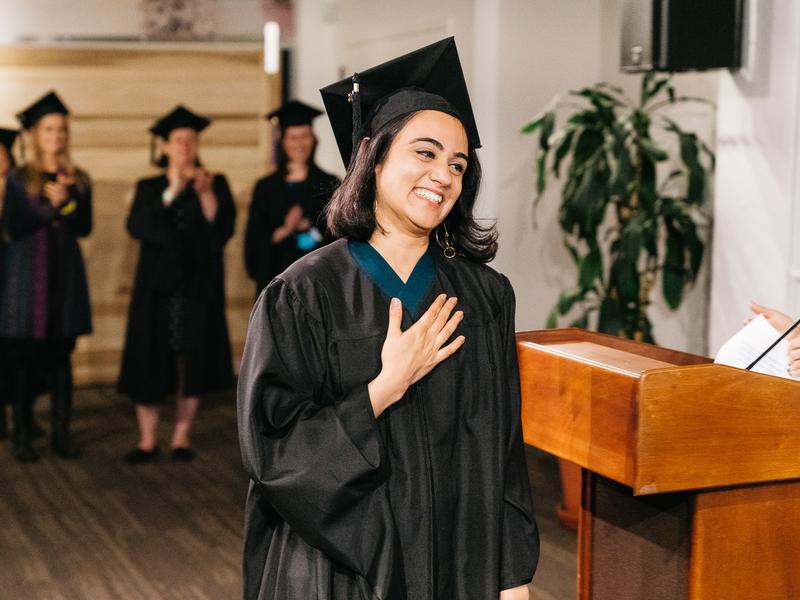
MEET PENNY, ONLINE
Ph.D. STUDENT |
| I
learned to notice my own underlying
assumptions, as well as those of others,
as an initial tool in creating change,
and how disorienting experiences can
often lead to transformative change.
Read
more »
|
|
LEARN MORE |
| |
|

The Transformative Studies doctoral program is
designed for individuals who want to engage in
innovative research, combining rigorous scholarship,
creativity, and self-inquiry. The program focuses
on the development of the following capacities:
1) Making an original transdisciplinary research
contribution in a chosen area of inquiry; 2) Engaging
in inquiry as a creative, and collaborative process
in the context of a community of learners; 3)
Engaging inquiry as an integral, spiritual, and
transformative process of personal and social
transformation; 4) Applying one’s research
to real-world problems, articulating and embodying
one’s values, and skillfully putting theory
into practice.
The course of study is transdisciplinary. It
is inquiry-driven rather than driven exclusively
by the purview of a single discipline. Students
develop a solid grounding in research on transformative
studies and integral approaches, in the complexities
of transdisciplinary research, and in the knowledge
base of their topic. Research draws on a plurality
of relevant disciplines as students select and
focus on a topic they are passionate about.
The program is also meta-paradigmatic: Students
are exposed to a plurality of perspectives and
disciplines and learn how to excavate the underlying
assumptions and paradigms informing them. Students
learn ways of inquiry that connect and contextualize
in order to integrate different, even divergent
perspectives in a coherent way.
The program stresses the role of the knower in
the process of knowing. The psychology of knowledge,
which addresses such issues perception, assumptions,
projection, creativity, habits of mind, error
and illusion, and imagination, is considered central
to the process of inquiry, as is the sociology
of knowledge, which contextualizes inquiry in
its social, cultural, and political milieu. Every
academic inquiry is viewed as an opportunity for
and exploration of the roots and matrices of knowledge
in self and society. All inquiry is viewed as
an opportunity for self-inquiry. Self-inquiry
is in turn supported by, and informs, increasing
academic depth and sophistication. Students are
encouraged to understand the biases, assumptions,
aspirations, and emotional investment that they
bring to the process of inquiry. Academic inquiry
is framed as an opportunity for personal and social
transformation, as a spiritual practice, and as
an opportunity to cultivate creativity.
The program stresses the interrelationship between
theory and practice. Thought-leaders as well as
action-leaders, students develop skills that allow
them to participate in scholarly discourse, write
for publication, and, if they choose to, conduct
action-oriented research and interventions in
applicable contexts. Graduates of the program
have the opportunity to teach in a discipline
related to their area of interest as well as to
conduct action-oriented research and interventions
in human systems at the individual, group, and
organizational levels.
As part of the course of study, advanced students
in the program will be required to take on a Learning
Assistant role in at least one course to develop
their mentoring, teaching and organizational skills.
Students will also work together in Learning Community,
a not-for-credit required course designed to provide
an opportunity for community buiding, personal
exchange, collaborative exploration, and reflection
on the learning process and the quest for personal
growth and development.
Students in the program will be able to:
Know, understand, and apply multiple theoretical
approaches to transformative studies at the individual,
group, organizational, and societal levels.
Reflect on the role of the psychology and
sociology of knowledge in their own inquiry and
in academic discourse.
Apply, evaluate, and synthesize multiple
theoretical approaches and understand the ways
in which differing approaches structure knowledge.
Make responsible transdisciplinary use
of knowledge from multiple disciplines, critically
engaging with their literatures, approaches to
knowledge, underlying assumptions, and theories.
Articulate their own approach to transformative
studies in their area of inquiry, and situate
it in appropriate discourses and fields.
Develop the ability to accept and work
with ambiguity and paradox.
Develop a topic appropriate to advanced
study and in which to make an original contribution,
and engage in inquiry as a creative and transformative
process.
Have sufficient command of methodology
to be able to apply an appropriate method to a
research question and to evaluate the appropriateness
of various methods in the exploration of different
kinds of questions.
Work in a collaborative context, creating
and evaluating groups to support learning and
change.
Demonstrate the ability to write publishable
articles and participate in the scholarly discourse
of their area of inquiry.
|